

Grab hitches a ride on the AI wave as CEO Anthony Tan steers company into next phase of growth
The South-east Asian superapp has long invested in technology, believing it to be essential for growth

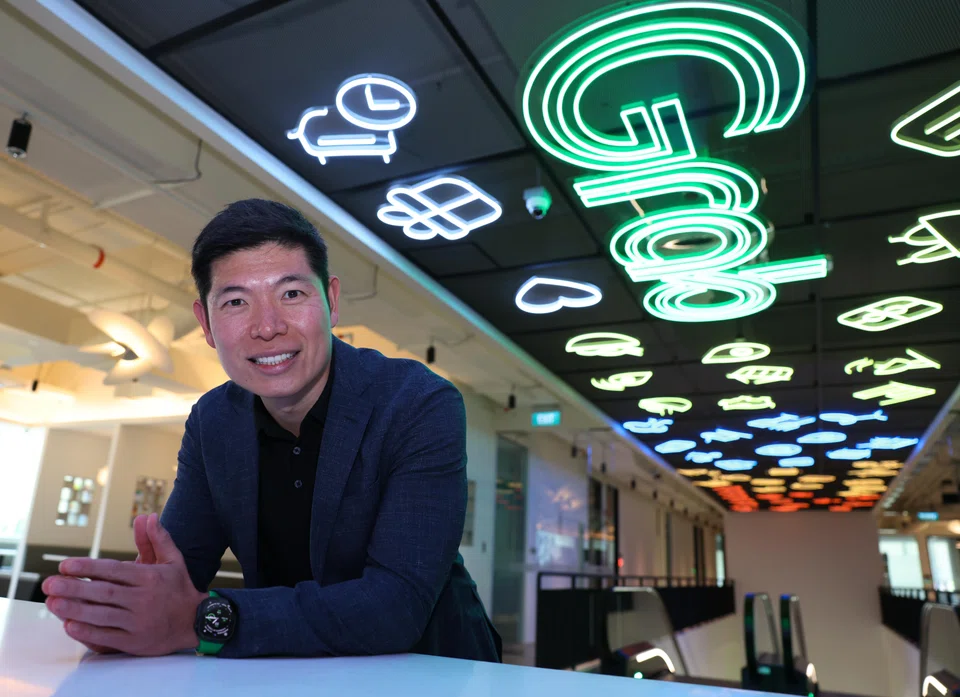
[SINGAPORE] The English word “Grab” arguably has a very different meaning in South-east Asia from the rest of the world. Because of the success of one company, the word Grab is often used when it comes to taking a cab or ordering takeout.
Singapore-headquartered Grab first built its business on mobility and then deliveries. Co-founder and CEO Anthony Tan says the embrace of technology, particularly artificial intelligence, enabled it to build its suite of offerings over the years.
“I would say I’m pretty proud of Grab’s journey as a hardcore tech company, especially now with physical AI and embodied AI,” he said of Grab’s evolution from a taxi-hailing company in Malaysia to its current form in Singapore.
Tan, who turns 45 this year, has been named Businessman of the Year for 2026 at the Singapore Business Awards.
Since beating out Uber in South-east Asia in 2018, Grab’s services has grown from transport to include food and grocery delivery, and even financial services.
The company is also investing in autonomous driving and has rolled out autonomous driving shuttle services in Singapore.
And Grab is now leaning even more into technology, particularly AI, to drive its next phase of growth.
The ‘Everyday Guide’ strategy
The company is positioning itself as an “Everyday Guide”, as it tries to increase the stickiness of its app and embed it into an even greater part of a person’s life.
Grab announced 13 new solutions in its annual GrabX event this year that target businesses, consumers and travellers. These solutions include cash loans, driver assistance and store operations monitoring.
SEE ALSO



All the solutions announced in Jakarta are powered by AI, and underscore Grab’s willingness to embrace and leverage technology in its daily operations.
Grab has long leveraged AI to batch delivery orders, build its own maps of South-east Asian cities and to predict road conditions.
These solutions are aimed at delivering better results for the company, consumer, and Grab’s merchant and driver partners.
For example, batched deliveries, in theory, mean more deliveries per trip for a Grab partner, leading to potentially higher earnings and lowered cost for a consumer who is willing to wait a little longer.
More accurate maps and road conditions can lead to more efficient travel, benefiting both driver and customer.
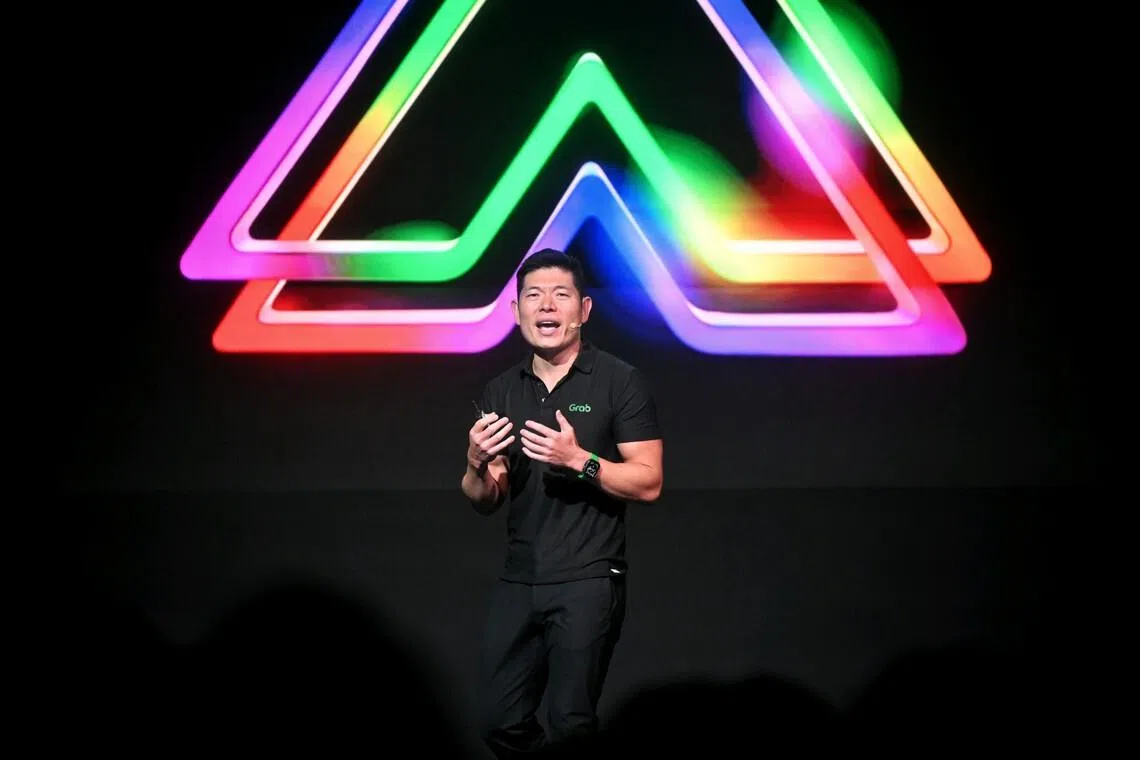
In Tan’s view, leaning so heavily on tech was born out of necessity and was the only way forward for Grab.
“Customers want the impossible from us every day,” he said.
“Grab can be cheaper, Grabfood can be cheaper, merchants want more money, drivers want more money. You’re stuck with impossible problems, so you need ways to shift the frontier. It’s not just because AI is sexy and everyone wants to talk about it, it’s need-based.”
Grab also recently launched a shopping assistant that is powered by AI. The aim was to help users streamline their grocery shopping experience on GrabMart by doing the heavy lifting.
For example, one could upload a screenshot of a recipe, and the agent would source the needed ingredients from the various merchants for the user.
Making the shopping process easier for consumers could increase interaction with the app, and plays into the “Everyday Guide” strategy. The increased interactions could then be beneficial for both merchants and Grab itself.
But, where AI could arguably result in the biggest returns for Grab is in its financial services, which is now the fastest-growing segment for Grab, and also has higher margins than deliveries and mobility.
Loans currently drive the revenue for financial services for Grab. The company uses its own algorithms to assess the creditworthiness of its driver and merchant partners for loans.
Grab announced in February that it was acquiring Stash Financial, a US digital financial services company.
It currently has more than a million paying subscribers and US$5 billion assets under management, and the deal is expected to be completed in the third quarter of this year.
While Stash will continue to operate as an independent brand in the US following the completion of the deal, the acquisition will give Grab access to recurring high margins revenue.
Importantly, it also gives Grab access to Stash’s talent and technology to accelerate Grab’s own financial services road map.
One aspect that Tan was keen to show was how Stash’s AI could simplify investing for consumers.
In our conversation, Tan prompted Stash’s AI to give advice on where he should invest if he had $100, and the app gave a diversified play covering bonds and equities in about a minute.
Grab currently has licences to operate a digital bank in Singapore and Malaysia. Its Singapore bank offers customers a chance to invest through exposure to a money market fund.
Tan said that Stash’s AI capabilities could eventually be added to Grab’s fintech ecosystem. That could potentially allow Grab to offer its millions of users to make micro-investments across equities and bonds.
He said: “The goal is basically to help the average Joe, wherever he is, to make money. It’s about helping the average Joe compound returns. How do you help people with not just micro-savings but (with) micro-investing?”
He added that this fits into Grab’s mission of empowering everyday entrepreneurs.
In its most recent quarterly earnings, revenue for Grab’s financial services for the three months ended Mar 31, 2026, rose 43 per cent year on year to reach US$107 million. Its loan book grew by 130 per cent over the same period to reach US$1.44 billion.
Overall, there was growth in all of Grab’s business segments.
Revenue for the three months ended Mar 31, 2026, reached US$955 million, up 24 per cent from the same period the year before. Profit for the period was US$120 million, a US$10 million improvement from the prior year period.
The results reported on May 5, 2026, come after a milestone 2025 for the company.
Grab, which was founded as MyTeksi in 2012, ended its financial year in the black for the first time in 2025. The company reported a profit of US$268 million last year, turning around from a US$105 million loss in 2024.
The turnaround
While Grab is in the black these days, the road to profitability was bumpy. One of those bumps was when it had to cut about 1,000 jobs or 11 per cent of its total workforce in June 2023.
At that time, Tan said the cuts were not a “shortcut to profitability” but a strategic reorganisation to adapt to the business environment. The job cuts in 2023 were even bigger than the 300 or so employees Grab cut during the pandemic.
Like in many other tech firms, Grab’s workforce ballooned over the pandemic. At the same time, investors were also valuing profitability over growth post-pandemic.
The developments of generative AI around the same period also meant that investors were directing capital into other areas.
Tan acknowledged that the period was painful, and that it was about being agile and being able to pivot quickly. He explained that Grab went hard into financial services, off-platform activities and cloud kitchens years ago, but had to pull back on some of that due to financial constraints.
“Those were painful decisions, especially when you’re telling teams who’ve given everything to a product that we’re stepping back. It’s not that we made a mistake, or that it was wrong to pursue those. The strategy was right. It was just the wrong time,” he noted.
He was also generous with his acknowledgements of the people around him that helped Grab evolve into its current form.
“It’s an award that recognises all the people who sacrificed a lot. Whether it was the many Grabbers since the earliest of days, my wife, my mum, down all the way to incredible investors and mentors.”
He spoke in particular about his wife Chloe Tong, as well as Grab’s co-founder Tan Hooi Ling, who returned to the firm in 2015 following a health scare that he, Tan, had in late-2014.
“I physically collapsed outside a Walgreens,” the CEO said, attributing it to the physical and mental toll of going on roadshows to raise funds. “At that time, I don’t think my body was used to handling three to four countries, and six to eight flights in a week.”
The incident happened in Palo Alto, California, and Tan’s wife – who was his girlfriend at that time – sent him to a medical centre.
“They brought me to the emergency room to make sure I didn’t die. I remember Ming saying, we put a lot of money in you from Softbank, don’t die on us,” said Tan, referring to Ming Maa, who was Grab’s president from 2016 to 2024, and had worked at Softbank in late-2014.
Anthony Tan suggested that his health scare was possibly a catalyst for Tan Hooi Ling’s return to Grab.
The CEO said: “I’m very grateful because I really needed help then. I was running the tech, I was running ops, I was signing up drivers myself and raising money, and dealing with governments and ministers all at the same time.”
South-east Asia, Taiwan and the future
These days, Grab operates in over 500 cities across eight countries in South-east Asia, and has established itself as a dominant player in mobility and deliveries across the region.
According to the company, at least one in 15 people in South-east Asia interact with Grab every day through payments, food or rides.
While it has constantly said that there is still opportunity for growth in South-east Asia, it has also looked outside the region in recent times.
In addition to its acquisition of Stash, Grab announced in March that it was buying Delivery Hero’s foodpanda delivery business in Taiwan for US$600 million, marking its first foray into food delivery outside its South-east Asia home market.
The deal is still subjected to regulatory approvals, but is expected to be completed in the second half of 2026. When completed, it will give Grab a presence in 21 cities in Taiwan.
“They (Taiwanese) really appreciate convenience and they can pay. Their dollar value is much higher than in Jakarta or Manila,” Tan said, and added that the deal made sense financially for Grab.
Yet, Grab may not be actively looking for opportunities outside South-east Asia as Tan said that the company is still “super focused” on the region, and just wants to do really well in Taiwan at the same time.
Referring to his remarks to investors from February, he said that the company still wants to expand its market in South-east Asia by increasing interactions with its flywheel of services.
While it has deeply penetrated the Singapore market for mobility, there is still ample room for growth in economies such as the Philippines, Thailand and Indonesia, especially outside capital cities.
The company is also investing in GrabMart to drive user spend and engagement, and wants to further embed its financial services across the platform.
Tan, when asked whether he ever thought Grab would turn out to be an “Everyday Guide” that has penetrated eight countries in South-east Asia, admitted that the initial business idea was simply to solve a safety issue.
“Once we went to Zouk (Kuala Lumpur). I was with Cheryl and a girl came up to us and said, ‘Oh my gosh, you know my boyfriend was so drunk that night and I had to use MyTeksi to go back’.”
Cheryl Goh is one of Grab’s earliest employees and is the current group head of marketing, sustainability, loyalty and support.
“I remembered I looked at Cheryl and we were like, ‘Wow, we’ve done well’. That made us happy already, so we’ve come a long way from that moment,” Tan said.
Decoding Asia newsletter: your guide to navigating Asia in a new global order. Sign up here to get Decoding Asia newsletter. Delivered to your inbox. Free.
Copyright SPH Media. All rights reserved.
TRENDING NOW

LTA proposes combining car COE categories, adding rebate-surcharge system
StarHub to acquire MyRepublic’s mobile business amid ongoing telco consolidation

DBS, OCBC, UOB rout lops billions off STI as inflation, rate concerns spook investors

Grab CEO’s wife Chloe Tong on life with Anthony Tan and finding her purpose

