

From hawker stall to Enterprise Award winner: How Han Keen Juan scaled the Old Chang Kee empire
Four decades after a risky 1986 corporate exit, the executive chairman reflects on OCK’s journey and attributes the enterprise’s success to professional branding and a “no individual heroes” philosophy.

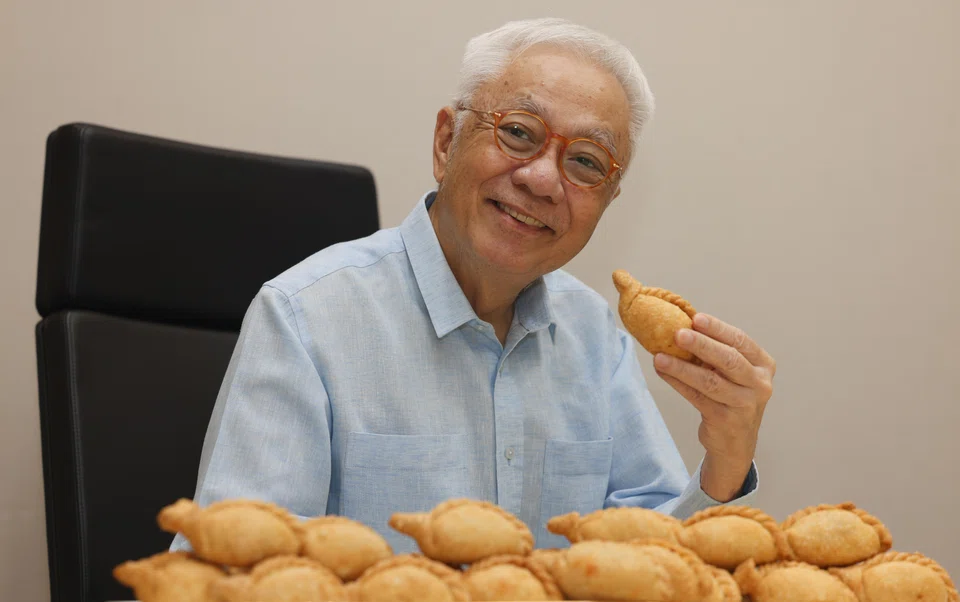
OLD Chang Kee’s executive chairman, Han Keen Juan, knew from the start that selling curry puffs was not going to be easy.
At the time, he had not one but two competitors selling the same snack just across the road from the stall he bought over for S$30,000 in 1986.
Han knew customers had options and if his curry puffs were to stand out, the business could not be run like just another hawker stall.
So he turned to what he learned from the corporate world, the one he left behind for a totally different career switch as a curry puff seller. Han brought to the stall the habits of branding, Standard Operating Procedures (SOP) and quality control – ideas that were hardly common in a small hawker operation then.
One of his earliest decisions was to spend about S$5,000 on a professionally designed logo, a large sum for the business at the time.
To Han, the logo was not cosmetic or a vanity project, but a signal that Old Chang Kee had to be remembered as a brand, not just another stall selling curry puffs. “From the start, I wanted to build a company image,” he says. “Today, people look at our logo, they recognise this is Old Chang Kee.”
From office executive to hawker
Nearly four decades later, that instinct has helped turn Old Chang Kee, which celebrates its 70th anniversary this year, into one of Singapore’s most familiar homegrown food brands.
Better known to many simply as OCK, the company is now a listed business, with its curry puffs and snacks sold through outlets in Singapore and as far away as London. This year, it received The Enterprise Award at the Singapore Business Awards.
The early days were far from glamorous. Han was in the kitchen in the morning and at the outlet in the afternoon, selling curry puffs, collecting takings and even cleaning up. “I had to make sure everything was running smoothly,” he insists.

There was even an early test. When Han took over, the lease had only six months left. After that, the landlord decided to increase the rent from S$600 to S$3,000. It was a brutal increase for a small business still finding its footing and Han says, “the jump almost killed (OCK)”.
But he was determined to bite the bullet as he had already given up the security of corporate life and knew he had to make his new venture work.
He took it as a challenge and worked harder and over time, he began to incorporate new ways of running a hawker business like he was still heading an office.
One of those things was introducing a system of SOP to maintain quality control. “Inconsistencies can be an issue, especially when you are relying on others because the way (my cooks) prepare the curry puffs can depend on their moods or methods,” Han says.
“But with a proper system and SOP, we made sure the curry puffs would taste the same the next time anyone buys it.”
Growing together with OCK
Those moves also helped OCK evolve from one stall into a chain. Its hero product, the Curry’O, remained the heart of the business, but Han knew the company could not rely on one item forever. As customers became more sophisticated, OCK had to give them more reasons to return by expanding its offerings.
One early extension was the sardine puff, with fish balls and spring rolls soon finding its way onto the menu.
Now, OCK also has festive items occasionally such as National Day specials and its current Mothers’ Day treat, Red Bean Mochi’O. Han sees this also as a way to keep the brand alive and interesting for younger customers and families: “Everyone can grow together with Old Chang Kee.”
At the same time, the company also had to adapt to a changing Singapore. Han is matter-of-fact about the Curry’O’s secret recipe.
Yes, he says, the recipe is locked in a safe, but recipes cannot be frozen forever: “The recipe is subject to changes. Why? Because raw materials change, suppliers change, and even customer expectations change.”
Even certification requirements can change when OCK made adjustments to attain its halal certification.
For Han, that was not a compromise but part of becoming a Singapore brand that more people could enjoy. “We want everybody to eat and enjoy Old Chang Kee,” he chuckles.
Prudent planning
While branding helped give OCK visibility, systems was the one that gave it scale. But Han insists neither would have mattered without his team.
He is wary of the idea that the business was built by him alone. “Team effort is very, very important in our company culture,” he shares. “We don’t believe in individual heroes.”
He talks about the company as a chain of responsibilities. Production must be reliable and logistics must deliver on time. Outlets have to be clean and staff have to be courteous. Even the look of the company’s trucks matters because they are seen on the road and reflect the brand, Han says.
That respect for the wider team also extends to older workers who have had to adapt to technology. As digital payments and IT systems became part of daily retail operations, some long-serving staff struggled but Han’s instruction to management was to be patient and train them: “We treat every member of our company as an asset.”
OCK’s challenges today might be different from those Han faced in 1986 with inflation, manpower costs, fuel prices and raw materials all weighing down food businesses but Han simply says, “We don’t cry over the challenges; we sit down and think how to overcome it.”
The answer, he shares, lies in R&D, sourcing, cost discipline and forward planning.
The company has invested in production capability in Malaysia, giving it more options as costs rise. Han also believes strongly in reserves, a lesson he says he learnt from watching how Singapore plans for the long term.
That same prudence shapes his view of overseas expansion. OCK has gone beyond Singapore, but Han is candid that not every market worked.
The company ventured as far as South Africa in earlier years, only to find that culture, buying habits and eating habits were different.
His preference now is for measured growth (“Don’t be over ambitious.”), especially in Asean markets where the company better understands consumers.
For all the scale OCK and personal success Han has achieved, his own memories of the journey remain rooted in hard work. In the early years, he was the driver, the cook, the operator and the person cleaning the floor at the end of the day.
Hobbies such as golf and photography all took a back seat. Was it worth it? Han simply answers: “If you decide to do something, always do it well. Never do things halfway.”
Decoding Asia newsletter: your guide to navigating Asia in a new global order. Sign up here to get Decoding Asia newsletter. Delivered to your inbox. Free.
Copyright SPH Media. All rights reserved.
TRENDING NOW

LTA proposes combining car COE categories, adding rebate-surcharge system

StarHub to acquire MyRepublic’s mobile business amid ongoing telco consolidation

DBS, OCBC, UOB rout lops billions off STI as inflation, rate concerns spook investors

Grab CEO’s wife Chloe Tong on life with Anthony Tan and finding her purpose

