

Asean must balance energy security with sustainability to power its future, say panellists at BT-UOB Sustainability Impact Dialogue
Greater regional cooperation through the Asean Power Grid is crucial to secure sustainable energy supplies for the region
Benicia Tan &
Meera Pathmanathan
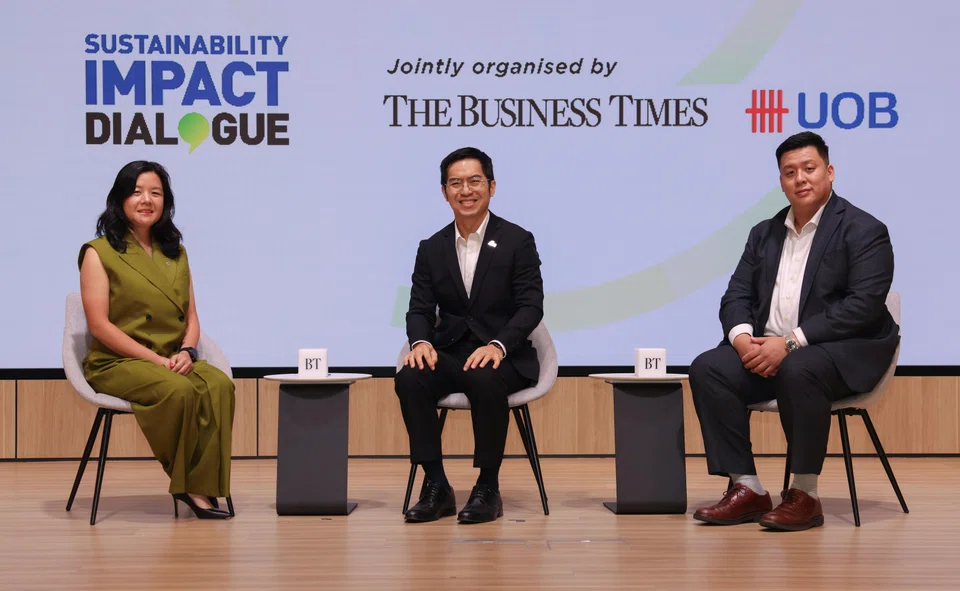
[SINGAPORE] Sustainability should remain a core business priority despite an immediate global focus on energy security, said panellists at the Sustainability Impact Dialogue on Monday (May 18).
Amid a fragmented world, greater regional integration and international cooperation remain crucial to ensure energy security, added the speakers at the event jointly organised by The Business Times and UOB.
The panellists were Energy Market Authority (EMA) chief executive Puah Kok Keong and Wood Mackenzie’s vice-chairman for Asia-Pacific, Joshua Ngu. The closed-door event was moderated by Melissa Moi, head of sustainable business at UOB.
Held at the SPH Auditorium, the dialogue was themed “Energy Security in a Fragmented World – Balancing Transition, Affordability and Independence”. The session explored how governments and businesses within Asean are navigating the competing demands of energy security, affordability and sustainability amid volatile energy markets and geopolitical uncertainty.
Balancing sustainability, security and affordability
Ngu acknowledged that amid the Middle East crisis, a greater focus has been placed on energy security, with sustainability “taking a bit of a back seat”.
“While we focus on energy security today, I think we are also at the same time thinking about how we future-proof our business, and sustainability is part of that journey,” he said.
'%3e%3cpath%20d='M12.1475%2025.5262C13.7713%2025.4295%2014.94%2023.913%2014.94%2021.8832C14.94%2019.5359%2013.474%2018.093%2011.5917%2018.093C11.3745%2018.093%2010.9582%2018.093%2010.8393%2018.1413V25.2086L11.8891%2025.5745C11.8891%2025.5745%2012.207%2025.5262%2012.1475%2025.5262ZM11.4934%2017.6281C13.2567%2017.6281%2014.3843%2016.4292%2014.3843%2014.4501C14.3843%2012.372%2013.275%2011.2973%2011.4339%2011.2973H10.8393V17.6305H11.4934V17.6281ZM6.66078%2025.6482L7.39265%2025.5492C8.02617%2025.4502%208.26403%2025.3053%208.26403%2025.1097V11.6149C8.26403%2011.4193%208.1451%2011.3709%207.23484%2011.249L6.68137%2011.173L6.6219%2010.7588H11.9508C15.7153%2010.7588%2017.0624%2012.0797%2017.0624%2014.1578C17.0624%2015.9666%2015.7748%2017.1909%2013.4969%2017.6305V17.7041C16.111%2017.948%2017.6571%2019.5382%2017.6571%2021.7636C17.6571%2024.3318%2015.8937%2026.0417%2012.1109%2026.0417H6.60132L6.66078%2025.6482Z'%20fill='%232B2B2B'/%3e%3cpath%20d='M20.6287%2025.6505L21.5596%2025.5515C22.1725%2025.4779%2022.4104%2025.3076%2022.4104%2025.112V11.249H21.9346C20.073%2011.3479%2018.982%2013.0095%2018.408%2014.6227L18.1907%2015.5018H17.6555L18.1701%2010.7588H29.3837L29.6421%2015.4787H29.1664L28.9491%2014.6227C28.3728%2012.8645%2027.3047%2011.2743%2025.5002%2011.249H24.9856V25.1856C24.9856%2025.3812%2025.1251%2025.4548%2025.9965%2025.5515L26.7695%2025.6505L26.829%2026.0417H20.5693L20.6287%2025.6505Z'%20fill='%232B2B2B'/%3e%3c/g%3e%3cdefs%3e%3cclipPath%20id='clip0_5242_21648'%3e%3crect%20width='24'%20height='16.8'%20fill='white'%20transform='translate(6%2010)'/%3e%3c/clipPath%3e%3c/defs%3e%3c/svg%3e)
“One thing for sure is that the investment in renewable or low-carbon energy is going to grow,” said Ngu. Over the next decade, the Asean region alone could require up to a trillion dollars in investment for these sectors, he added. This represents “lots of investment opportunities and business opportunities as well”.
“While we focus on energy security today, I think we are also at the same time thinking about how we future-proof our business, and sustainability is part of that journey.”
Joshua Ngu, Wood Mackenzie’s vice-chairman for Asia-Pacific
Both panellists noted that while the push for energy security beckons the exploration of alternatives, the energy transition is a long-term journey.
“I think it is not easy to completely do away with the need for fossil fuels, at least in the medium term,” said Puah. He cited Singapore’s reliance on natural gas to generate 95 per cent of its electricity.

While the city-state is exploring alternative energy solutions, time is needed for the technology to be scaled and have a significant impact on the country’s energy supplies, he noted.
In the meantime, energy conservation is a key strategy to ensure energy security, said the EMA chief. He added that Asean regions should consider how to implement “rather difficult policies” to encourage energy conservation.
When asked about practical and inclusive strategies to achieve energy security in Asean, Puah noted that the region must remain open to cross-border energy trade.
Doing so would “enable the private sector to put in the investments needed to bring more energy on stream in the medium to longer term”, he said.
Regional cooperation
The panel further discussed how greater regional cooperation through the Asean Power Grid will be important for South-east Asia to secure sustainable energy supplies amid heightened geopolitical uncertainty.
The Asean Power Grid is an initiative aimed at strengthening energy security, resilience and connectivity across the region to meet rising electricity demand, and improve access to reliable and affordable energy. The initiative seeks to integrate the power systems of member states by 2045.
“Even in these difficult times when we talk about a fragmented world, actually the response to enhance energy security is not fragmentation, but integration and more international cooperation,” said Puah.
“It is not possible for most countries to be energy-independent,” he added.
Puah noted that the grid would allow countries to harness renewable energy resources located across the region and transmit electricity to key demand centres.
“There’s clear recognition that, in this part of the world, we have abundant renewable energy resources."
“Even in these difficult times when we talk about a fragmented world, actually the response to enhance energy security is not fragmentation, but integration and more international cooperation.”
Puah Kok Keong, Energy Market Authority chief executive
However, challenges remain, given the region’s unique geography and complexity of multilateral coordination. He noted: “The archipelagic nature of South-east Asia also makes interconnections a lot more difficult.”
Ngu added that execution could prove more challenging than expected, because coordination would involve multiple countries rather than bilateral agreements alone.
“A lot of it is not necessarily just bilateral agreements, they are in part multilateral agreements as well,” he said, adding that the diversity of power markets across the region would also pose challenges to integration efforts.
Despite these challenges, both panellists said greater interconnectivity could expand energy supply and create broader economic opportunities across the region. They stressed that attracting private investment would help to accelerate the initiative.
Ngu said: “A key part to it is really making sure that we do have a liberalised market where people can participate, because that’s when private capital comes in.”
He noted that public funding alone would be insufficient to finance the scale of infrastructure needed.
“Once the infrastructure gets put in, and we put in the right incentives for people to leverage and use that system, you get a lot more investments when it comes to supply,” he said.
Puah added that countries must also balance export ambitions with domestic energy security concerns.
Greater connectivity would allow countries with surplus electricity to channel supply to markets facing shortages, easing concerns over regional supply shortfalls.
“If we can be interconnected, if we can bring in more investments, then the pie will grow,” he said.
“As the pie grows, there’ll be more energy for everybody. And for countries that are exporting, there’ll be a lot of export revenues that will help in economic development.”
On infrastructure planning, Ngu said governments across the region would need to carefully balance the approval of new data centres against the availability of energy supply. He added that planning was key to balancing demand with the pace of energy development.
Puah added that while the Asean Power Grid would help augment energy resources across South-east Asia, that was not a complete solution.
“Every country must look at their own internal energy systems, and look at where they can stimulate more investments,” he said.
About the Sustainability Impact Dialogue

The session on Monday (May 18) at the SPH Auditorium explored how governments and businesses within Asean are navigating the competing demands of energy security, affordability and sustainability amid volatile energy markets and geopolitical uncertainty.
The two speakers at the dialogue were Energy Market Authority chief executive Puah Kok Keong and Wood Mackenzie’s vice-chairman for Asia-Pacific Joshua Ngu. The moderator was Melissa Moi, the head of sustainable business in the group corporate sustainability office at UOB.
The dialogue complements the Sustainability Impact Awards, which launched in 2023 to recognise leaders and companies that serve as inspiration in sustainability development through their contributions to the environment and society. The National University of Singapore Business School’s Centre for Governance and Sustainability is the knowledge partner for the awards.
The awards will comprise an individual category and an enterprise category. The individual category is subdivided into two awards – the Impact Leader of the Year Award and the Impact Leader Excellence Award. The enterprise category is subdivided into awards for small and medium enterprises, and large enterprises.
The fourth edition of the Sustainability Impact Awards is open for nominations from now till May 29.
Applications can be submitted via the Sustainability Impact Awards website.

Decoding Asia newsletter: your guide to navigating Asia in a new global order. Sign up here to get Decoding Asia newsletter. Delivered to your inbox. Free.
Copyright SPH Media. All rights reserved.
TRENDING NOW

Once staunchly pro-China, Malaysian Chinese businesses are now distancing themselves from Beijing

Looking beyond looming CEO succession, should UOB potentially pursue a transformative merger?

Could stablecoins be the future of money?

Grab CEO’s wife Chloe Tong on life with Anthony Tan and finding her purpose

