Putting ESG at the heart of the real estate business
ESR, the largest sponsor and manager of Reits in Asia-Pacific, is aiming for a 50% increase in solar power generation and a 20% reduction in group-wide energy consumption, among other sustainability goals.



A RENEWED focus on environmental, social and governance (ESG) issues recently has seen companies globally rushing to "tick the boxes" in order to appeal to investors. But ESR Cayman chairman Jeffrey Perlman believes ESG has to be at the centre of how businesses operate if it is to be successful.
"You really have to think about ESG sitting at the heart of the business. And if you operate the business with a centralised focus on ESG, it touches on all areas - the kind of property, how we develop, and also how we finance ourselves," said Perlman, who is also managing director and head for South-east Asia and Asia-Pacific real estate at global private equity firm Warburg Pincus, which co-founded ESR in 2011.
"Today, more than ever, we all have this strong sense of purpose, of being able to deliver really good outcomes. But that outcome isn't just business performance anymore. It's contributing to the environment, it's contributing to the community, but it's also delivering sustainable growth and performance for our shareholders," he added.
ESR, a Hong Kong-listed real estate services and investment firm, on Jan 20 completed the acquisition of Ara Asset Management in a US$5.2 billion deal to transform the enlarged group into the third-largest listed real estate investment manager globally - and largest in Asia-Pacific - with gross assets under management (AUM) of US$140 billion.
It is also the largest sponsor and manager of real estate investment trusts (Reits) in Asia-Pacific, with a total AUM of US$45 billion across 14 listed Reits managed by the group and its associates.
The combined entity will cement its position as the largest "new economy" real estate platform in Asia-Pacific, with an AUM of US$59 billion in the in-demand new economy space, comprising logistics warehouses and distribution centres as well as data centres. In this segment, it has a further development work-in-progress of over US$10 billion and a development pipeline of over 9 million sq m across 10 countries.
The completion of the merger allows ESR to further strengthen its ESG leadership and offerings - joined by Ara Asset Management and its subsidiary Logos, which have been pioneers on the sustainability front.
ESR says it is committed to ensuring it continues to integrate ESG into every aspect of its business and operations.
"Both within ESR and across all of our Warburg real estate portfolio companies, we've always tried to pride ourselves on trying to be a thought leader in ESG," Perlman said.
New pocket of capital
ESR on Nov 1, 2021, announced it had secured its first sustainability-linked loan of US$700 million with an option to upsize it to US$1 billion.
The senior unsecured, committed US$700 million corporate facility consists of a 3-year tranche of US$350 million at Libor plus 2.25 per cent and a 5-year tranche of US$350 million at Libor plus 2.75 per cent.
It is designed with a tiered incentive mechanism, with ESR entitled to an interest rate reduction as sustainability targets are achieved.
The proceeds will be used to fund the group's refinancing of existing borrowings, and for working capital requirements and general corporate purposes.
The group has secured the loan from a consortium of leading international and Asian banks, with UOB acting as the sole global coordinator, mandated lead arranger and sustainability advisor.
"ESR Group has always been committed to integrating ESG considerations across all their business activities. With their responsible investment approach and strong ESG focus, ESR Group aims to enhance investor returns while making a positive impact for the society and environment," said Lim Lay Wah, head of the financial institutions group at UOB.
"Sharing the same commitment, UOB and ESR Group will work towards meeting the needs of the present while forging a sustainable future," Lim added.
On the heels of the initial announcement, the group on Nov 29 completed the incremental upsize portion of US$300 million for the sustainability-linked loan.
"From a company perspective, you always want to have diversified funding channels," Perlman said.
"It opens up a new pocket of capital - that's important. And the good thing is a lot of these sustainability-linked loans focus on longer-term financing. I think it's important from a business perspective that you try to leverage that capital.
"There is the added benefit of, if you can deliver on performance targets, bringing down the cost of borrowing as it relates to the facility.
"It's going to be a key feature of the capital structure of the company going forward, not just at the corporate level, but also trying to push that down to some of the Reits that we manage or other vehicles."
Green initiatives such as sustainability linked loans, the group says, demonstrate its ongoing commitment to ESG. This is in line with its ESG 2025 Roadmap, which was launched in November 2020.
Taking concrete steps
"Over the last few years, we've seen a pretty unprecedented degree of disruption, whether it was the pandemic, climate-related events, or social justice issues in places like the US," Perlman said. "The events around 2020 - because several of those all happened in the same year - really provided a catalyst for a much bigger focus on environmental and social change and trying to invest sustainably.
"If I look at the inflection point for ESG... I think people will look back at 2020 as a real catalyst for the ESG sector as a whole."
With the real estate industry accounting for 40 per cent of total carbon emissions worldwide, Perlman believes the sector has to take the lead on ESG to make a significant impact.
On its part, ESR has spelled out under its roadmap a clear vision and targets across the 3 key pillars of "Human Centric", "Property Portfolio" and "Corporate Performance".
The targets include improving gender ratios, achieving zero workforce fatalities, a 50 per cent increase in solar power generation, and a 20 per cent reduction in group-wide energy consumption. It also targets to invest US$15 million in local community foundations by 2030.
ESR has put in place strategies to ensure that the targets are achieved.
Firstly, ESR aims to integrate ESG considerations into all stages of the business cycle. This includes establishing data management systems, streamlining ESG data collection processes and developing policies while setting annual performance targets and reviews for a fully transparent process.
It also plans to progress further in ESG reporting each year. This will include a Global Reporting Initiative (GRI) adopted ESG report by 2022, improved GRESB scores and participation at a corporate level, as well as becoming a signatory of the Principles of Responsible Investment (PRI) by 2024.
The group sees ESG as being increasingly critical from an investor perspective. Greater transparency and accountability on environmental and social matters is a key driver of ESR's business as the company's ESG performance crystallises its approach to sustainability, it said.
"ESR has a large funds management business (and) investors are much more interested in the performance and data behind the sustainability," Perlman said. "A couple of years ago, it was a much more 'tick the box' exercise. Now, it's about real performance and the steps you are taking to meaningfully integrate sustainability issues into each of their underlying investments.
"As a manager, what are we doing to reflect that in the way we go about designing, building and managing our assets?"
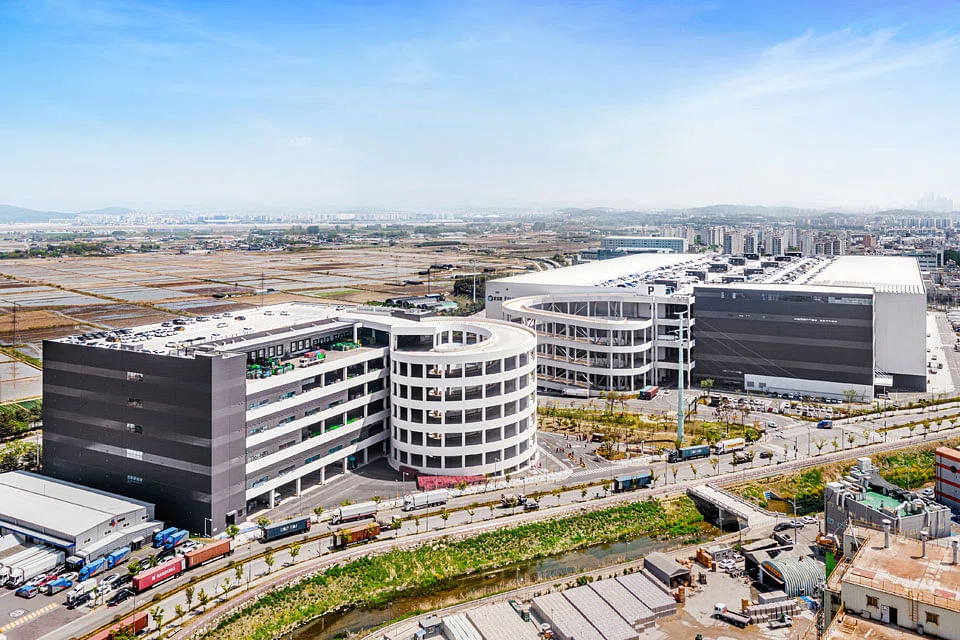
One example of ESR's ESG efforts can be found at its ESR Amagasaki Distribution Centre logistics warehousing project located in Japan's Greater Osaka Metropolitan area.
Completed in June 2020, the property, which has a gross floor area (GFA) of 388,570 sq m, comes with a wide range of amenities that are available to employees of its tenants. These include a day-care centre for children of on-site workers, and leisure facilities such as a staff lounge and a staff shop.
There is also a 1-kilometre-long sea wall at ESR Amagasaki, which provides protection from tsunamis. Employees, tenants and the local community have also contributed to decorating the wall with stunning images in bright colours in an expression of their creativity.
Meanwhile, ESR also plans to adopt new technologies and building specifications throughout its portfolio in the next few years to help improve operational efficiencies for its tenants.
This includes catering for the implementation of more robotics and automation, electric and autonomous vehicles, and big data analytics for streamlining stock management and deliveries.
Already, the group says it is testing autonomous vehicles and drones in various markets.
ESR is also collaborating with UK aircraft startup VRCO to design and demonstrate the world's first cargo drone logistics facility at ESR Higashi Ogishima Distribution Centre in the Greater Tokyo Metropolitan Area.
While Europe has been at the forefront of ESG activity, Perlman says it is heartening that the focus is starting to pick up across Asia-Pacific.
"Once you get started and get going on it, you realise you can have quite a large impact. I think it fuels you to want to do more," Perlman said. "It's our job collectively to make a bigger difference. But to do that, you've got to play your part, which starts with the man on the street as much as it does the chairman of a company. Everyone has to do their part."
This is the 18th in a 20-part Green Business series, in collaboration with UOB, exploring sustainability trends across businesses and industries.
Decoding Asia newsletter: your guide to navigating Asia in a new global order. Sign up here to get Decoding Asia newsletter. Delivered to your inbox. Free.
Copyright SPH Media. All rights reserved.