

Are money market rate spikes warning signs?
With largely positive factors in markets, there's no cause for panic at this juncture.
ONE question we often hear today is whether the recent surges in money market rates in the US and Hong Kong - that is, the US repo rate (repurchase agreement rate) and the HIBOR (Hong Kong Interbank Overnight Offered Rate) - serve as warning signs of a major market dislocation ahead.
We agree that these events need to be assessed carefully, as the end of bull markets is often accompanied by discordant warning signs.
For instance, one would recall that months before the failure of Lehman Brothers in September 2008, the Federal Reserve had to set up a term auction facility in August 2007 to supply short-term credit to banks holding sub-prime mortgages.
One difficulty in assessing these events, however, is that they often take on the appearance of prescience only with the benefit of hindsight.
In addition, many are false alarms, or some warning of potential dangers that would likely be averted once we also consider the larger picture and other forces at play.
Similar fears had also surfaced in late 1998 due to the Russian debt default and the failure of Long-Term Capital Management, a large US hedge fund which posed systemic risks to the financial system.
And yet the risk of a global recession was successfully offset by the Federal Reserve cutting rates by 75 basis points over H2 1998. From 4Q1998, global equities subsequently rose about 60 per cent over the next 18 months.
The US repo rate spike in Sept 2019
The widely reported spike in US repo rates in September 2019 was due to a confluence of factors driving demand for liquidity. During these episodes, we saw large supplies of new Treasuries issuances absorbed by the market, which coincided with seasonal demand for cash from corporate treasuries due to quarterly tax payments.
Demand was also driven by tighter financial requirements in recent years which imposed constraints on the use of liquidity at banks. For instance, coverage requirements related to resolution planning have increased the amount of liquidity that some large US banks must maintain daily.
From a broader perspective, this also suggests that the Federal Reserve's balance sheet had shrunk too much between 2018 and September 2019.
But the Federal Reserve had already attempted to address this gap in October this year by significantly increasing the size of its temporary overnight repo operations from US$75 billion to US$120 billion daily, and also committing to grow its balance sheet at least into Q2 2020 - starting at a pace of US$60 billion of purchases of Treasury bills per month.
We see the Federal Reserve's actions as supportive of overall financial conditions and would reduce the likelihood of more repo rate volatility ahead. Additionally, we see the Federal Reserve to be averse to the headlines and distractions posed by these repo spikes, and they would be prepared to decisively expand the size of its repo operations if required.
Recent surge of the HIBOR in Hong Kong
Temporary surges in the HIBOR are not uncommon, and the most recent one was driven by both temporary and structural factors.
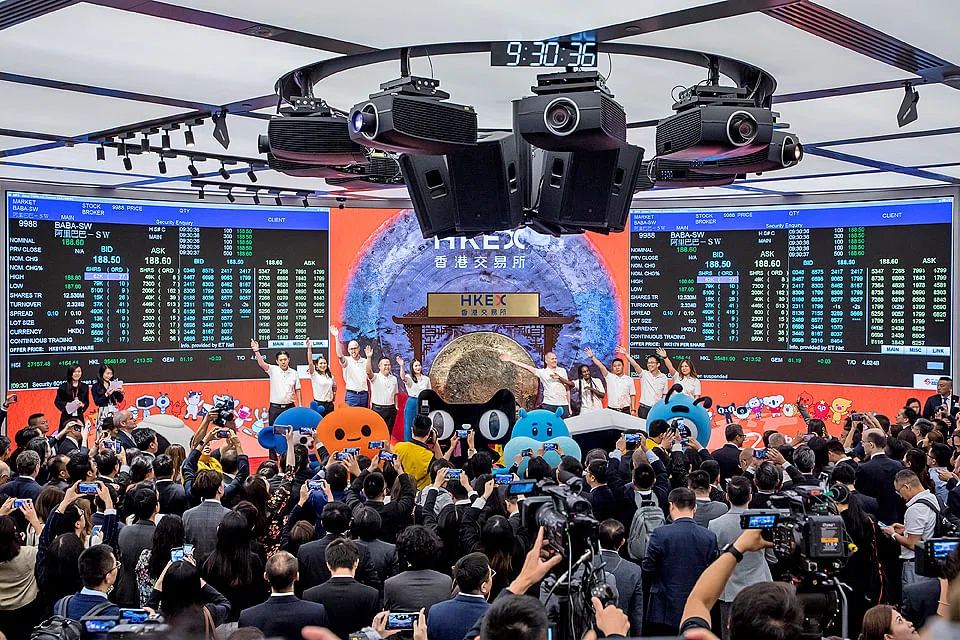
One temporary factor was the recent Alibaba Hong Kong listing, where strong margin demand led to brokerages borrowing HKD from the interbank markets. The effect of this lift on the 1-month HIBOR was evident and is now showing some signs of easing as this temporary factor unwinds.
In terms of structural factors, we see that the rate of HKD deposit growth in the Hong Kong banks has been subdued since mid-2018, which has led to increased deposit competition.
Looking ahead, the launch of virtual banks in Hong Kong would likely intensify competition for deposits. Overall, banks may need to keep rates elevated to stabilise their HKD deposit bases, and this would translate to some sustained upward pressure on the HIBOR going forward.
No cause for panic
While canaries in the coalmine should be watched carefully, we see no cause for panic at this juncture.
Over the last year, the central debate for investors has been whether the global economy would slide into a recession versus finding stabilisation.
The good news is that recent incoming data has been broadly supportive of a baseline scenario that growth would continue to slow over the next few quarters and begin to stabilise in mid to late 2020.
Of course, the uncertainty from the US-China trade war remains a wild card for the global economy, although we think it is more likely than not that a Phase 1 trade deal would eventually be ratified and that the US tariffs planned for Dec 15 could potentially be postponed or suspended.
This would aid investment and business sentiments, and bolster the positive effects of monetary policy easing from global central banks over the year to date.
These positive factors are altogether balanced against the fact that valuations of risk assets appear fairly valued at current levels, and one should be cautious that the sharp rally since October also points to the risk of some near-term volatility.
That said, if the balance of risk continues to shift towards a positive direction ahead, markets are likely to remain broadly supported.
TRENDING NOW

Motoring tycoon Peter Kwee is back in court: Here are his previous legal battles

Peter Kwee’s Ridley Park bungalow on the market with S$100 million asking price

Demand, tech capabilities position Apac and AI as Skyscanner’s next growth frontiers: CEO Bryan Batista

South-east Asia has lost Nvidia’s best salesman

