Rupiah at 1998 low defies logic, says Morgan Stanley forecaster
Kuala Lumpur
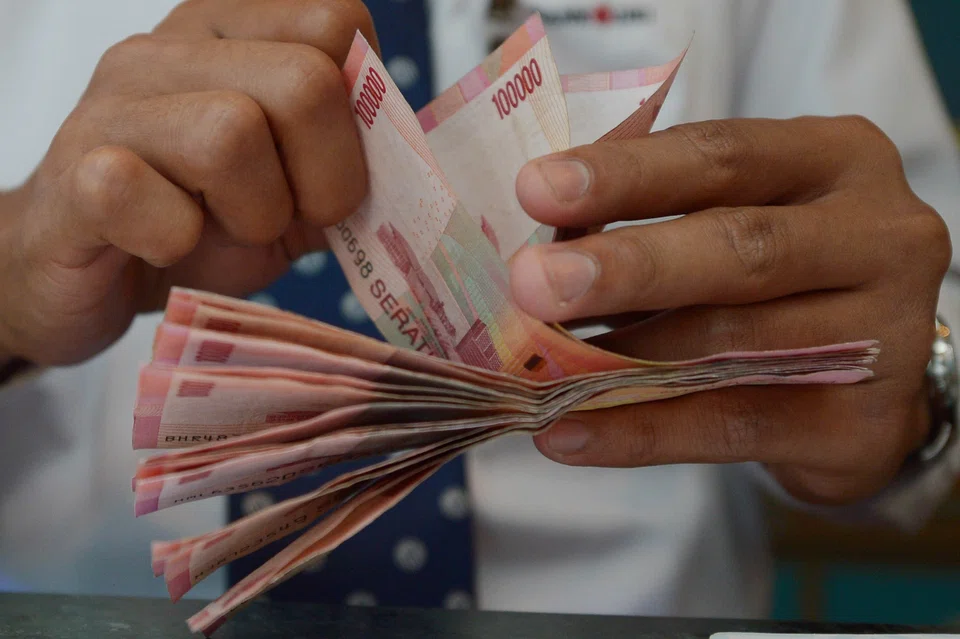
THE last time a dollar bought as many rupiah as it does now, Indonesian dictator Suharto had just been ousted and the government was paying 70 per cent to borrow money for a month after an International Monetary Fund bailout.
Sixteen years later, the country pays less than a 10th of that for three-month bills, it is rated six levels higher by Moody's Investors Service and has a new president elected on the basis of his administration of Jakarta. Geoffrey Kendrick, Morgan Stanley's Hong Kong-based head of Asian foreign exchange and interest rate strategy and the most accurate rupiah forecaster, said that he didn't "have any logic to apply" to the sudden drop and is sticking for now to his end-March estimate of 12,400 rupiah per dollar, stronger than Monday's close of 12,698 rupiah.
The rupiah has fallen 5.6 per cent this month, the most in Asia, and is now at a weaker level than all of 30 analyst forecasts for the end of the first quarter of 2015. It was down 1.8 per cent to 12,933 rupiah per dollar as at 9.43am in Jakarta, according to prices from local banks. That came after a 1.9 per cent slump on Monday to the lowest close since the 1998 Asian financial crisis.
"There was no specific domestic news that caused the currency move, just a combination of very thin liquidity and general negative sentiment towards emerging-market currencies," Khoon Goh, a Singapore-based senior foreign exchange strategist at Australia & New Zealand Banking Group Ltd, the third-most accurate forecaster, said on Monday. "Given that the rupiah has held up reasonably well compared with other Asian currencies in recent weeks, it appears to be trying to play catch up."
Before it dropped 4.7 per cent in the three days through Tuesday, the rupiah had weakened 1.2 per cent in the month through Dec 11, compared with declines of 4.1 per cent in Malaysia's ringgit and 1.7 per cent for Taiwan's dollar.
Overseas investors have pulled 10.2 trillion rupiah (S$1.03 billion) from local sovereign bonds this month through Dec 12 as the prospect of US interest rate increases damped demand for emerging-market assets. They have sold a net US$243 million of local shares in December through Monday.
While Mr Goh said that ANZ's end-March prediction of 12,250 rupiah per dollar is under review, he said Monday's move was orderly and was probably just "market positioning". The rouble's 9.3 per cent plunge on Monday has "spilled over into Asian currencies", Mr Goh said in a separate interview on Tuesday.
Bank Indonesia attributed Monday's move to "panic buying" of dollars by local companies before the Federal Open Market Committee starts a two-day meeting on Tuesday at which US interest rate increases will be discussed. Investors are worried about the country being "strong enough" if the current-account deficit remains high, Peter Jacobs, a central bank director in Jakarta, said on Monday.
Indonesia recorded a shortfall of US$6.8 billion in the broadest measure of trade in the third quarter, and the monetary authority expects a US$24 billion deficit for the full year. South-east Asia's largest economy will expand 5.1 per cent in 2014, the slowest pace since 2009, going by the median estimate of analysts in a Bloomberg survey.
Slowing growth
Inflation accelerated to 6.23 per cent in November as President Joko Widodo raised the price of subsidised fuel less than a month after taking office, and the central bank sees it reaching 7.7 per cent to 8.1 per cent by year end.
As Indonesia is a net oil importer, Brent crude's 36 per cent drop this quarter should be positive for the rupiah. However, the prices of some of the country's key commodity exports have also fallen, with palm oil down 4.6 per cent over the period and coal retreating 5.8 per cent.
"Growth is clearly on a path of slowdown and there is inflation concern," Masashi Murata, a Tokyo-based currency strategist at Brown Brothers Harriman & Co, said on Monday. "There's also some speculation Bank Indonesia is shifting its focus to keep the rupiah's volatility stable rather than defending a certain level."
The central bank was "present" in the sovereign bond market on Monday, senior deputy governor Mirza Adityaswara said.
The yield on Indonesia's 10-year government notes rose four basis points to 8.49 per cent on Tuesday after surging 43 basis points in the previous two sessions, according to the Inter Dealer Market Association. That took the advance this month to 79 basis points, compared with increases of 37 basis points for similar maturity Malaysian debt and 25 basis points, or 0.25 percentage point, for Philippine securities.
PT Mandiri Sekuritas, a unit of Indonesia's biggest lender by assets, will probably revise its year-end forecast for the 10-year sovereign bond yield upwards, Handy Yunianto, head of fixed income and research in Jakarta, said on Monday.
"I don't see any significant news coming in the near term," he said. "But probably inflation will be slightly higher than market consensus expectations."
The rupiah is weakening on a "combination of a stronger dollar globally and higher demand for dollars in the domestic market for imports and interest-debt payments," Finance Minister Bambang Brodjonegoro said on Monday. Local companies typically need to buy more US currency before the end of the year.
"People who haven't got their dollars need to square up their books," Jonathan Cavenagh, a currency strategist at Westpac Banking Corp in Singapore, said on Monday. And "the general tone in markets is more risk averse", he said.
Investors withdrew more than US$2.5 billion from US exchange-traded funds that buy emerging-market stocks and bonds last week, the biggest outflow since January. While the rupiah has fallen the most in Asia this month, Turkey's lira, the Colombian peso and Russia's rouble have all weakened more.
The monetary authority is guarding the rupiah and volatility should return to normal in January, Bank Indonesia's Mr Jacobs said.
Outside of the current period of illiquidity, the fuel-price increase should mean imports will slow down a bit, Morgan Stanley's Mr Kendrick said. "Which should at least in theory be currency positive because the current account will probably improve slightly," he said.
"That assumes everything else equal. Clearly at the moment everything else is not equal and hence the reason we're getting illogical moves like these." BLOOMBERG