Clear targets a must for climate-change action
A common reporting framework for climate-change disclosures will enable comparability of data

Singapore
AS discussions around climate change grow in urgency in Singapore and across the globe, the need for a common set of standards and definitions of key terms is increasing. Yet, governments and companies around the world are still at odds over the actions and targets they need to aim for.
In Singapore, a panel discussion on sustainability reporting, hosted by the Singapore Exchange (SGX) on Wednesday, called for a common reporting framework for climate-change disclosures to bring about greater consistency and comparability of such information.
"It's a perennial problem globally - people have difficulty integrating the information because there are so many frameworks out there ... it is like an alphabet soup of standards," said panellist Abigail Ng, executive director for the Corporate Finance and Consumer Department in the Monetary Authority of Singapore (MAS).
It is an issue that goes beyond corporate reporting standards; disclosures at the governmental levels are also inconsistent and incomparable across jurisdictions, creating serious ramifications beyond just a difference of opinion. Arguably, one needs to be dealt with before the other can be fine-tuned.
To begin with, defining what constitutes climate change, in terms of achieving the oft-cited "net zero", lacks agreement.
The term "net zero" has its roots in the 2015 Paris agreement on climate change, a legally binding international treaty adopted by 196 parties that year, which aims to limit global warming to around 1.5 deg C, compared to pre-industrial levels.
Countries party to the agreement have pledged to reduce their greenhouse gas emissions as soon as possible with the aim of achieving a "climate neutral" world by 2050.
In 2018, the Intergovernmental Panel on Climate Change (IPCC), the United Nations (UN) body for assessing the science related to climate change, said in a special report that limiting warming to 1.5 deg C implies the globe reaching net zero carbon-dioxide (CO2) emissions by around 2050 (and concurrent deep reductions in emissions of non-CO2 forcers, particularly methane).
But, in spite of the pledges, the targets differ: Some (such as China) take the net-zero target to apply just to carbon-dioxide emissions, others (such as the European Union) have applied it to all greenhouse gases. And then there are those who have not defined the types of gases at all, such as the United States.
Tackling different gases leads to different climate outcomes.
Discrepancies also exist between corporations that have made climate-change pledges.
Oliver Miltenberger, a PhD candidate in environmental economics at the University of Melbourne, and Professor Matthew D Potts, SJ Hall Chair in forest economics at the University of California, Berkeley, said in a recent report in The Business Times: "The process is complex and still largely unregulated and ill-defined.
"As a result, companies have a lot of discretion over how they report their emissions."
For example, they said, a multinational mining company might count emissions from extracting and processing ore, but not the emissions produced by transporting it.
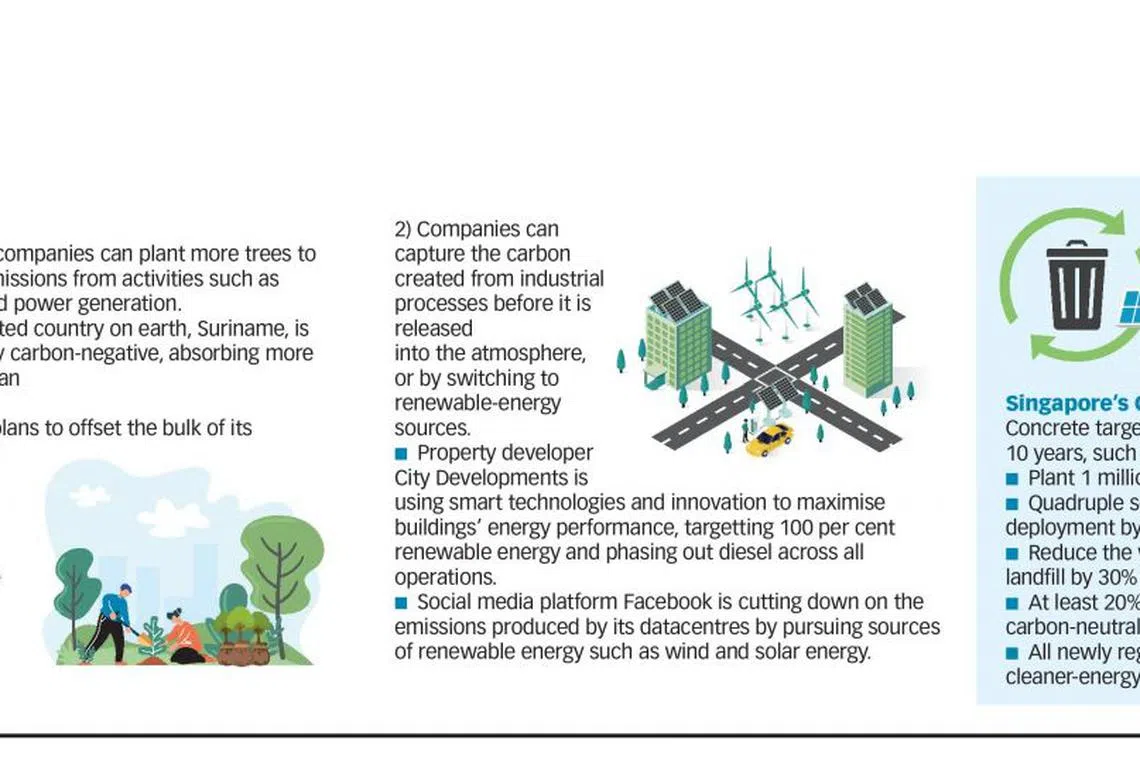
Companies also have discretion over how much they rely on "offsets" - the projects they can fund to reduce emissions, such as re-forestation.
This has given rise to concerns about potential manipulation, greenwashing and the unintended consequences of such projects. There are those who argue that a global push towards lower emissions, however poorly defined or thought out, is better than no push at all.
This is perhaps true - to an extent.
A study published by Joeri Rogelj and his colleagues at Imperial College London showed that differing definitions and pathways to net-zero can have drastically differing outcomes - and why it will not do to be content with vague disclosures.
"The stakes are too high to take comfort in mere announcements. Everyone need not make the same choices," they said. "Without more clarity, strategies behind net-zero targets cannot be understood; nor can their impact be evaluated."
Another recent study, titled "Recalculate the social cost of carbon", by Giacomo Grassi, a scientific officer with the Joint Research Centre directorate of the European Commission (EC), found a yawning gap between the amount of emissions reported by countries and the amount measured by independent models because different methods were used.
The difference amounts to 5.5 billion tonnes of carbon dioxide per year - equal to about what the United States emits annually.
So, what is to be done?
Mr Rogelj's suggestion is that nations, companies and the researchers advising them have to clarify three aspects of their targets:
- Scope: Targets must specify the emission sources and the gases covered, when net zero will be reached, and whether the intent is to reduce, remove or offset the emissions;
- Adequacy and fairness: What is considered "fair" differs across countries and communities, so parties to the Paris agreement should proactively disclose why they consider their net-zero targets to be fair and adequate, with consideration given to whether emissions will be limited or offset;
- Road map: Targets are more credible if they include milestones, an implementation plan, and a statement about longer-term intent for either maintaining net-zero or going net-negative. Leaving these out risks inaction, diversions and failure.
Let us use Singapore as an example to illustrate the application of these suggestions.
At the SGX event on Wednesday, Minister for Sustainability and the Environment Grace Fu reiterated Singapore's climate-change efforts as detailed in The Green Plan 2030. The nation-wide endeavour has a clearly-defined scope that seeks not just to limit carbon emissions through more eco-friendly modes of transportation, greener buildings and lower energy consumption, but also to promote a more sustainable way of living through education in schools, financial incentives and government investments.
In terms of what would be a fair contribution for Singapore to make in the global push towards climate change, Mr Rogelj's report pointed out that, while Singapore is a small, densely populated country with limited potential to deploy renewables, it is rich and has high capacity to finance action - indicating where it can best make a difference.
As for its road map, The Green Plan 2030 has clear targets. Among them are the developing of more than 130 hectares of new parks by end-2026, making 80 per cent of buildings (by gross floor area) green by 2030, ensuring that all new car and taxi registrations are of cleaner-energy models from 2030, and, as announced by Ms Fu on Wednesday, the public service setting a carbon emissions target of peaking around 2025.
It is an excellent start to what is surely going to be a complicated journey. Countries and companies will have to embrace the conviction that, while complexities and difficulties abound, defining clear targets and making them measurable and assessable are going to go far in achieving the climate change they claim to seek.
READ MORE: