As unicorns emerge, angels gather for the hunt
Investing clubs have sprung up for deep-pocketed but time-starved investors looking to gather some fairy dust from South-east Asian unicorns

Singapore
THE emergence of South-east Asian "unicorns" has fuelled a wave of angel investing clubs in Singapore that cater to wealthy individuals hoping to capture their own magical startup.
Among the newly-incepted organisations are AngelCentral, female-focused angel investment network she1K, Investible from Australia and NEXT50 Angel Network by venture capital firm Trive.
Older organisations such as the Business Angel Network of South-east Asia (BANSEA), which has enjoyed significant traction, has grown its membership list from 60 members in 2016 to 180 members as at this month.
These angel networks or clubs source for potential startups to invest in, conduct due diligence and provide their members with opportunities to tap each other's expertise; some also run training workshops or co-invest with members.
Angel investors are typically affluent individuals who put their own money into startups in exchange for equity or convertible debt. Because the investments are highly illiquid and happen at an early stage, when the startup is just getting off the ground, the risk involved tends to be higher than with other asset classes.
Angel network executives that The Business Times spoke agreed that the growth of privately-held startups with a valuation of US$1 billion or more - the so-called "unicorn companies" - is causing the sprouting of these investing clubs.
Christina Teo, founder and executive director of she1K, said: "There's growing interest. That means more people know what it means and more people are curious about what it means. It still takes quite a way for them to get started. And if they do, maybe it's still pretty casual."
Organisations such as BANSEA, she1K and Investible recruit members on an invitation-only basis to discern between casual and serious investors. Potential members are required to fulfill certain criteria, such as a minimum number of years of corporate experience to be eligible to join.
BANSEA looks to recruit high-net-worth individuals who are well-linked business leaders able to support startups with their capital, knowledge and networks, said Michelle Kung, executive director of the network.
These angel clubs have executive boards that curate startups even before the startups make their pitch to members. Companies that have raised money through angel investment networks include property portal 99.co, e-scooter-sharing startup Neuron Mobility and online classifieds platform Carousell.
To be part of these investing clubs, members are required to pay a joining fee, which varies by type and length of membership. In return, they gain access to a curated deal flow, share the cost of investment with other members and are invited to club events.
One perk of membership is that the network undertakes the due diligence on the startups - sparing its members this tedious and lengthy process.
Annie Luu, general manager of Investible, an Australian angel investment club that expanded to Singapore last September, said: "The truth is, a lot of these investors are time-poor. They don't have the time to go around the world to find these deals and to meet these founders to negotiate terms.
"But when a great deal comes along which they really want to back, they use (angel investment networks) for that outsourcing, sourcing and screening process. So they know that when they come to our quarterly presentations, we've already done the due diligence; they only need to decide how much (to invest)."
Angel networks use a number of investment structures to facilitate investment for their members.
One is investment via a special-purpose vehicle; members contribute to a pool of funds used to invest as a single entity. This diversifies the risk, with investors putting in a set sum of funds, which then go into investing in a wider portfolio of startups, said Shoko Suzuki, member of the board at BANSEA and fund lead of the BANSEA TWO Fund.
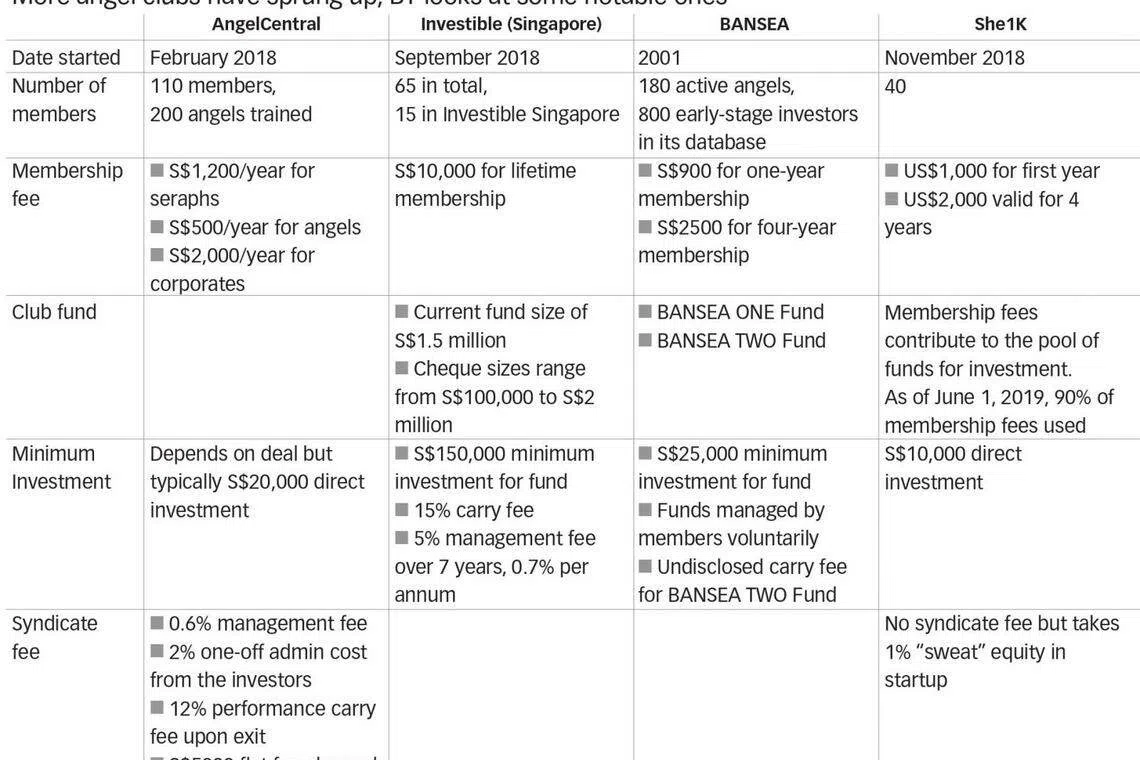
Another investment structure is the syndicate, which is a business entity rather than a fund. Several angels pool their money and invest as a single entity, allowing them to put in smaller cheque sizes. This route also gives startups better control over the number of investors on their capitalisation table.
Depending on the organisation, a carry fee or management fee may be charged by the network for syndicate investment. This means a certain percentage of the returns from the syndicate investment will be paid to the angel network as compensation.
Co-investment with venture capital firms is a third common route angel investment networks take to get to the size of the funding round startups hope to raise.
Some angel networks share the mandate of educating rookie business angels about startups by organising workshops and learning events.
AngelCentral, founded in February 2018, ran a series of workshops called Angel 101 in response to demand from friends for information on angel investing.
Clubs place an emphasis on their members adding value to the startups by sharing their corporate experience and networks. Investible, for example, offers its members up to 3 per cent of the club's 15 per cent carry if the member introduces a startup in which the club eventually invests, and if the member becomes an advisory board member of that startup.
Another trend beginning to surface in the angel investment scene is that of the growth of female angel investment.
she1K was founded in late 2018 to educate and encourage corporate women to get involved in the angel investment scene. It now has about 40 members. Another network, the Ladies Investment Club, was started in late 2017 to support female entrepreneurs.
Although the resources are becoming more accessible for those interested in building a portfolio in angel investing, the general consensus is that this asset class is not for everyone.
Huang Shao Ning, partner and chief angel of AngelCentral, said angel investing is different from buying a publicly traded stock or bond. Stocks and bonds can be traded, or the investor could set a cut-loss price or a price target to trigger profit taking.
Angel investing, on the other hand, is binary: If the business takes off, one can have potential returns in terms of multiples; the flip side is that one can also be "wiped out" if the business doesn't pan out.
Ms Huang said: "It's important to see it as an asset class, not a gambling tool. One should have both financial resources and non-financial resources to do well in angel investing.
"In addition to one's overall financial portfolio strategy, one should realise the importance of angel portfolio diversification too. Bite-size management over a period of four to six years, across different verticals, and ideally, a portfolio of 15 to 25 companies."