Chinese VCs sanguine on Asean despite Covid-19 and geopolitical headwinds
Long-term interest still robust despite 2019 dive in such VC deals


Singapore
THE inflow of venture capital (VC) from China into South-east Asia may slow down this year, but interest is likely to remain robust into the longterm, given the region's accelerated digital adoption amid the Covid-19 pandemic, industry players have told The Business Times.
This trend comes as Chinese tech companies are expected to further deepen ties with South-east Asia while trade tensions escalate with the US and India. India banned 59 Chinese apps in late June, including the popular TikTok and WeChat, following border skirmishes.
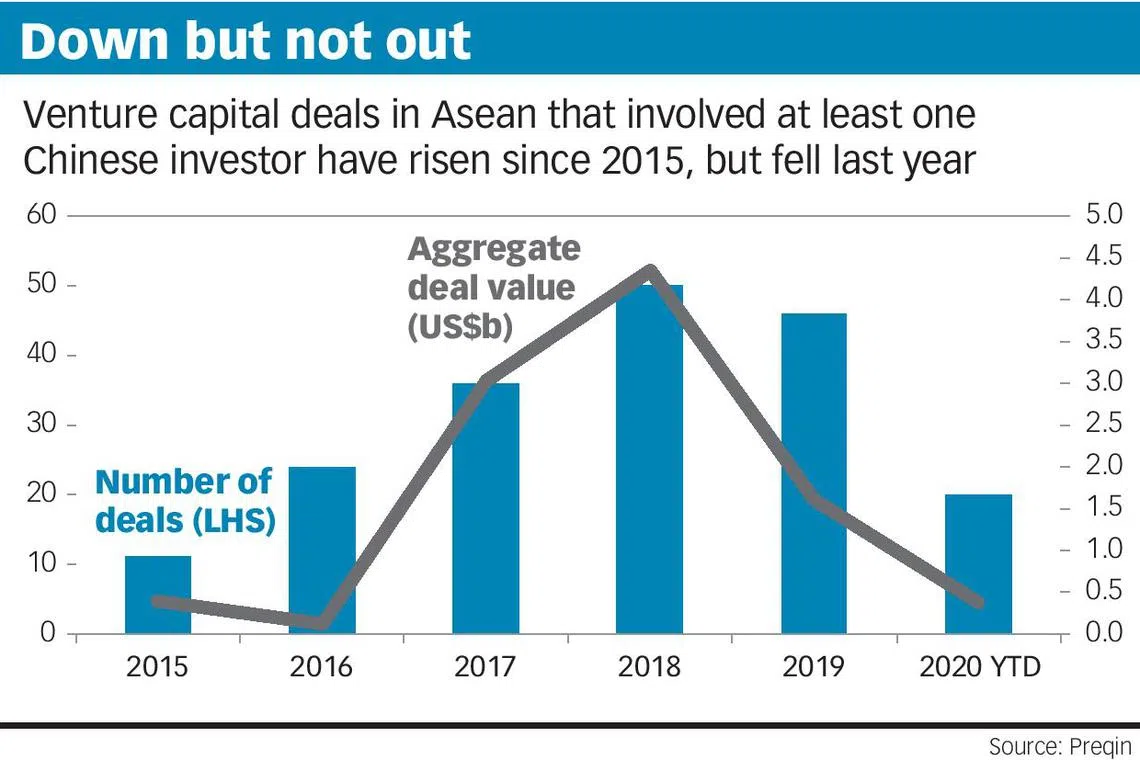
Data on VC inflows from China into South-east Asia is limited, but according to private market data provider Preqin, the number of VC deals in Asean involving at least one Chinese firm has trended upwards since 2015, with deal value peaking in 2018 at US$4.3 billion.
Deal value has since cooled, with it coming in at US$1.6 billion last year (see chart). The sum could fall further this year, given the broad-based global slowdown in venture deal flows.
Even so, Qiming Venture Partners and 01vc, both Shanghai-headquartered VCs, told BT that they continue to hunt for deals in Southeast Asia amid the Covid-19 headwinds.
Both firms have been actively looking at South-east Asia's venture scene since around 2016.
Helen Wong, a partner at Qiming, acknowledged that deal-making in South-east Asia has become more challenging for Chinese venture firms due to travel restrictions, as this hinders due diligence.
But she added: "At the same time, I think that Covid-19 will accelerate adoption of the Internet in many areas in South-east Asia. For example, in China, we've seen a lot of acceleration with the adoption of online groceries, with education and online entertainment. This is likely a positive for the ecosystem in South-east Asia as well."
Qiming, which has backed Chinese tech giants Meituan Dianping and Xiaomi, was drawn to invest in South-east Asia due to the burgeoning consumer Internet market, said Ms Wong, a Singaporean and a veteran of China's VC scene.
The firm's South-east Asian bets include Indonesian pay-later service Akulaku, Singapore-based budget hotel startup Reddoorz and Malaysian social e-commerce platform Fingo.
Similarly, 01vc's managing partner Ian Goh, who is also Singaporean, is looking at sectors where there could be synergies between Chinese and South-east Asian businesses, namely in cross-border e-commerce, payments and logistics. 01vc is a backer of Hong Kong logistics unicorn Lalamove.
Mr Goh cites the friction that small businesses face in remitting money between China and South-east Asia as one key problem startups could solve. 01vc's regional bets include comic app MangaToon and Vietnamese news app VN Ngay Nay.
"Everyone is fascinated with South-east Asia because it's the next boom in population growth and Internet adoption in the next 20 to 30 years ...Valuations in South-east Asia are not cheap, but the opportunity that Chinese VCs also see here is that there is an overseas Chinese diaspora here," Mr Goh said.
Interestingly, South-east Asia's growth story has even compelled some veterans of the Chinese tech world to set up their own South-east Asia-focused venture funds.
One such firm is ATM Capital, which was started by Tony Qu, a former director at Alibaba's Ali Capital, Jeeves Jiang, the former head of the overseas marketing department at Oppo and Jonathan Zhong, a co-founder of live-streaming startup Nonolive, which was acquired by China's Douyu.
ATM's fund is backed by Alibaba's e-WTP (World Trade Platform) tech innovation fund - which the tech giant set up to promote digitalisation among small and medium-sized enterprises - as well as prominent Chinese tech entrepreneurs like Sogou's chief executive Wang Xiaochuan.
Mr Zhong said: "We are very bullish on the e-commerce ecosystem, and also on logistics, as well as everything associated with population growth, such as mother-and-baby and consumer-product domains. With per capital income rising (in South-east Asia), people are going to buy better-quality products."
Times are tough now, said Mr Zhong, but he emphasises that ATM hopes to take a "patient" approach to its investments in South-east Asia.
This sentiment is echoed by ZWC Partners, another Chinese VC on the lookout for deals in South-east Asia. ZWC is famously known for backing Chinese social app Tantan and Tesla challenger Xpeng. In South-east Asia, it recently invested in GoPlay, the digital streaming service by Indonesia's Gojek.
ZWC is undeterred by current Covid-19 headwinds, as it is a long-term investor and has a "China plus" investment thesis for South-east Asia, said Sky Tsoi, an associate at the firm.
"If you compare the stage of the Internet economy between China and South-east Asia, we generally see a gap of 10 to 15 years. We believe we can bridge that gap by sharing knowledge and business model know-how, matching tech talents with experienced entrepreneurs, and helping established Chinese tech companies explore local opportunities in South-east Asia," he said.
Garage is BT's startup vertical. Read more news, analysis and opinions at bt.sg/garage