

Grab and foodpanda go physical in race to win q-commerce grocery wars

Singapore
THE pasta sauce has been cooked to perfection, but as you open the cupboard for the spaghetti, disaster strikes, there's none at home. No fear, quick commerce (q-commerce) will have pasta at your door within 15 minutes, all without you stepping out of your home.
The keen competition in this space is seeing food delivery players Grab and foodpanda race neck and neck in their attempts to win mindshare and develop habits in users.
The nascent stage of this grocery game means any leader now might not continue to be the leader in the future. Rather, it's about figuring out the most efficient model that fully utilises both the drivers, merchant partners and dark stores.
The move into delivering groceries by food-delivery platforms can be seen as an adjacent business rather than a pivot, that gained momentum during the lockdown periods of the past 2 years.
"The services we offer are complementary rather than contradictory - for example, when hosting, customers find it particularly useful to purchase food from our restaurant delivery feature, and have their other party essentials such as disposable cutleries, alcohol, additional snacks or even ice delivered from pandamart," Diego Pinto, retail director of foodpanda Singapore told The Business Times.
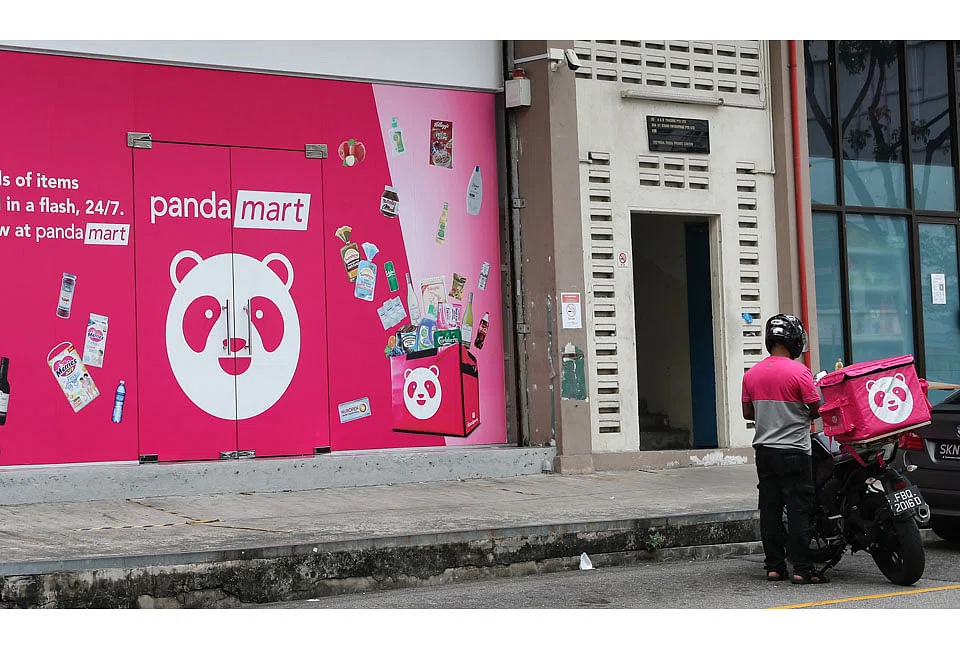
The first off the block was foodpanda when it started its pandamart warehouse in Singapore in October 2019.
With groceries and now electronics available - Xiaomi's tie-up with foodpanda means you can get a wireless mouse within the hour - this new business segment has food delivery players moving to acquire physical assets, a move that seems contrary to the platform mantra of being asset-light.
Grab recently acquired a supermarket chain, Jaya Grocer in Malaysia in December 2021, and claims over 2 million registered merchant-partners across the region. At present, foodpanda has 15 pandamart stores along with their own inventory, as well as 4,000 merchants on its pandashop platform in Singapore. It also runs 300 pandamarts across 11 other markets: Malaysia, Thailand, Taiwan, Hong Kong, Bangladesh, Pakistan, Myanmar, Laos and the Philippines.
The foray into physical assets doesn't seem to be slowing down, with foodpanda looking to add 9 more stores in Singapore in its second phase of pandamart expansion. Some existing stores will also be refurbished to include cold chain facilities to keep fresh produce and meat for sale.
Going physical seems like a natural evolution for these players to shorten delivery times. But dark stores are just part of exploring how to optimise and figuring out the best way forward for q-commerce, said Crystal Yu, analyst at venture builder Momentum Works.
Having already taken on leases and outfitted cloud kitchens for their food delivery business, Grab and foodpanda are perhaps less reluctant to turn physical.
The physical model isn't inevitable. Players like Deliveroo also have a grocery segment but rely on partner grocery stores rather than having their own dark stores.
Still, there are advantages to heading down the online-to-offline route, giving players more chances to slice the pie for revenue. With food delivery, Grab and foodpanda are taking commissions from restaurants and delivery fees from customers. With the dark store model, purchasing inventory means potential volume discounts.
"With you purchasing inventory from brand principals, it just makes sense that the higher the volume the better the margins," said Kristine Lau, analyst at research house Third Bridge.
According to foodpanda, there are advantages to operating its own stores and managing its own inventory. In short, the food delivery platform can control more variables in the delivery process.
"Managing our own inventory also enables us to be nimble to the specific demands in a particular locale and adjust the stock of items accordingly so that we can minimise wastage and ensure availability," said foodpanda's Pinto. "We are also able to import exclusive products that are not readily available at other grocers."
Aggressive discounting and subsidies is often the name of the customer acquisition game. To make a dent with quick commerce groceries, price points have to be at par or slightly cheaper than what customers can get from incumbent supermarkets. These platforms might also be competing with their grocery merchant-partners as well with their dark stores.
"In the beginning stages, before you can get enough scale to bargain with brand principals, you have to subsidise out of your own pocket just to match these incumbent players' pricing strategy," said Third Bridges Lau.
"Whoever's able to scale that model and operate it efficiently will probably be the eventual winner," said Jianggan Li, founder, Momentum Works.
Grab has been experimenting with different models across the markets where it operates, in Singapore, Malaysia, the Philippines, Thailand, Myanmar, Cambodia and Indonesia. "We want to build a hyperlocal service for our users in each city and country," said a Grab spokesperson.
Such a service does make sense in a mass affluent market like Singapore, where basket sizes and prices are high. But in emerging markets like Indonesia where average basket size is smaller, models have to be fine-tuned to make economic sense.
The future could see private labels emerge on Grab and foodpanda's grocery services.
"I think Meituan is probably a model a lot of players in South-east Asia will look at, I wouldn't say it's very mature but it's definitely a successful model here in China," said Momentum Works' Yu. Chinese delivery player Meituan partners grocery stores to fulfil customers' grocery orders.
But a key sticking point could be keeping to the promise of delivering within a set time, rather than just reducing delivery times.
Reliability and credibility will be key to sealing brand image in consumers' minds.
"When everyone has typically the same lead time, it's more sticking to what you promise that will give you a better impression from the consumer side," said Third Bridge's Lau.
With the foot firmly on the throttle, foodpanda is not letting up. "We are looking to expand our offerings even more this year, and to liken the availability of products available on pandamart to that of a large-sized grocery store, except everything is done online, and delivered on-demand in 30 minutes and under," noted foodpanda's Pinto.
Garage is BT's startup vertical. Read more news, analyses and opinions at bt.sg/garage
TRENDING NOW
Malaysian king buys stake in Singapore-listed mining firm expanding into rare earths

Family offices ‘kept captive’ by relationship managers turn to independent advisers, direct deals

Once staunchly pro-China, Malaysian Chinese businesses are now distancing themselves from Beijing

Could stablecoins be the future of money?

