Impress.ai uses artificial intelligence to automate recruitment process
Singapore
HIRING the right person for the job is no easy task. Recruiters often have to plough through stacks of CVs and sit through numerous interviews to identify suitable candidates. To make this process faster and fairer, a local start-up, impress.ai, uses artificial intelligence (AI) to automate recruitment.
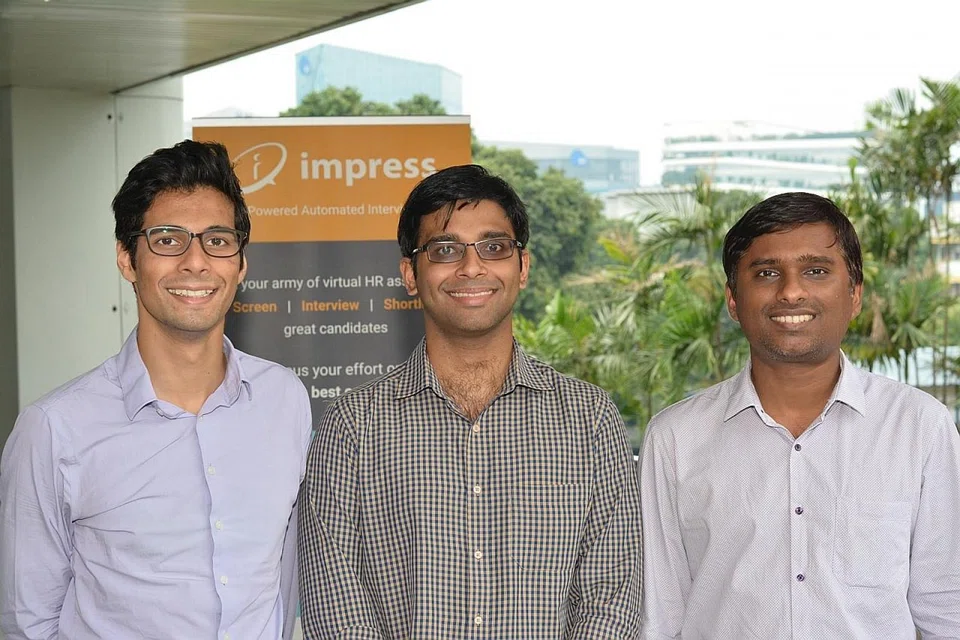
Founded in 2017 by Sudhanshu Ahuja, Vaisagh Viswanathan and Amrith Dhanajayan, who met as engineering and computer science students at Nanyang Technological University, impress.ai is now poised to expand into regional markets.
Currently, about 30 per cent of the company's revenue is generated abroad. The next country that the company is planning to target its services at is Australia. Many businesses in Australia are familiar with using software and automation, hence there is likely to be a higher demand for enterprise software like impress.ai, said Mr Ahuja, co-founder and CEO of impress.ai.
The company is also eyeing markets in Greater China and Japan. It plans to do so through direct hiring and partnerships. These plans are likely to kickstart as soon as January 2021.
"The problem solved by impress.ai is universal," said Eric Tachibana, an investor in the company since its early days. "They have found a real solution that solves a huge pain for many giant enterprises," added Mr Tachibana, who also holds active investments in local technology start-ups Savant Degrees, Vibease and Cialfo.
Simon Piff, an analyst at the International Data Corporation (IDC), said that using AI to provide advice to recruiters is a great opportunity and invaluable in large markets. "Where there are hundreds and thousands of people applying for a job, that is where this technology can really deliver," he added.
Impress.ai's technology includes a chatbot used to conduct interviews and assessment platforms for easier evaluation of candidates. Its chatbot, which took two years to develop, was built using about S$30,000 of the three co-founders' personal savings.
Today, impress.ai has a team of 42 employees, and plans to increase the number to 50 by the end of the year. The company serves clients from a range of industries including banking and finance, insurance, education, government services and healthcare. Some of its clients are DBS, Singtel, Accenture and Ngee Ann Polytechnic.
Having a portfolio of about 50 clients from different industries helped to cushion the impact of Covid-19 on the company. While some industries have taken a hard hit, others, such as those from the government and education sectors, have performed well, said Mr Ahuja.
The company is growing faster than expected despite sluggish economic activity globally, he said. He declined to provide financial specifics as the company is in the midst of a pre-Series A funding round expected to close in the first quarter of 2021. However, he added, impress.ai has been consistently posting a 21 per cent quarter-on-quarter increase in revenue last year.
Although the demand for impress.ai services has increased, the road towards expansion is not without its set of challenges. For instance, companies that are hard-hit by the Covid-19 pandemic may find it difficult to pay for impress.ai's services, said Mr Ahuja.
In terms of global expansion, the company is building brand recognition overseas, a process that will take a while. Navigating foreign manpower regulations and data protection laws can also be tricky, he added.
Another challenge for an AI company such as impress.ai is the danger of bias in using AI in recruitment, according to IDC's Mr Piff. "If the people writing the algorithms are not aware of their unconscious bias, it can be embedded into the AI," he said. He noted that the risks of this are much higher in recruitment as it affects livelihoods. "Until we can guarantee that the AI can do what is expected, all forms of AI require human oversight," he added.
To prevent biases, impress.ai uses a white-box model of AI that offers transparency and is auditable - with it, recruiters can set clear metrics and see why certain scores are given to candidates, said Mr Ahuja.
Candidates are automatically scored by the AI based on customisable criteria set by recruiters, who cannot view candidates' details such as their names and experience when they review responses.
This story is part of a tie-up between BT's Garage and Nanyang Technological University's Wee Kim Wee School of Communication and Information, featuring startup profiles produced by business journalism students.
- Garage is BT's startup vertical. Read more news, analyses and opinions at bt.sg/garage
Decoding Asia newsletter: your guide to navigating Asia in a new global order. Sign up here to get Decoding Asia newsletter. Delivered to your inbox. Free.
Share with us your feedback on BT's products and services