

Insectta sees a big future from small insects
The urban insect farm rears black soldier fly to turn its larvae into biomaterials, including chitosan used by research labs and renowned local cosmetic companies
Singapore
IN THE years to come, semiconductors used in devices such as phones and computers, and protein and probiotics used in animal feed additives, could be made from the larvae of black soldier flies.
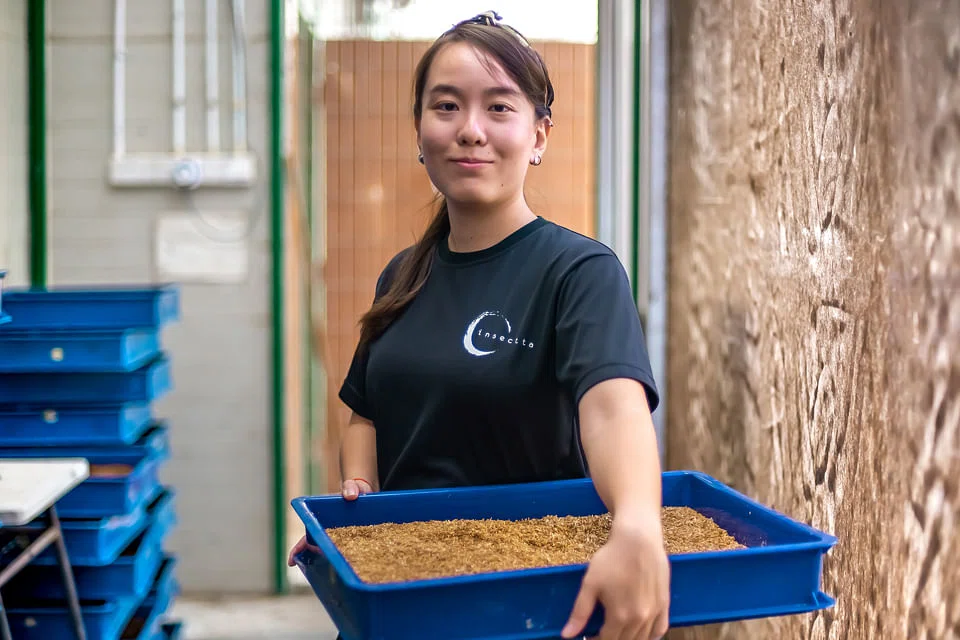
At least, that is what the team at Singapore-based Insectta is gunning for. Insectta is an urban insect farm here that rears the black soldier fly and turns its larvae into biomaterials, including one known as chitosan - a biodegradable polymer typically derived from crustacean shells. Its black soldier fly chitosan is already being used by research labs and renowned local cosmetic companies.
"We've already got all the products in the lab . . . now it's about furthering the R&D (research and development) and scaling up, to start producing it on a factory level rather than (at) a lab level," said co-founder and chief marketing officer Chua Kai-Ning, 24.
The urban insect farm aims to close its seed funding round by the first quarter of this year, to test the application of its organic semiconductors and protein and probiotics. Ms Chua declined to reveal the amount that the startup is raising.
The seed funding will mainly be used to bring the biomaterials - of which they own the intellectual property rights - from "lab to market", through the expansion of their R&D, commercial and logistic processes, said Ms Chua.
With this, her team is eyeing a slice of the global insect protein market, which - based on a report published by market research firm MarketsandMarkets - is expected to reach US$1.34 billion by 2025, supported by an annual growth rate of 45 per cent from 2019 to 2025.
Founded by Ms Chua and Phua Jun Wei, 29, in March 2018, Insectta breeds black soldier fly larvae - which feed on discarded food waste from breweries and soya bean manufacturers - to create its biomaterial products.
"It's the idea of a circular economy . . . the production system we are targeting is the food supply chain, and this means taking food waste out of the food supply chain and converting it into valuable products," Ms Chua said.
Located at Margaret Drive, the 200 sq m farm, enclosed in a small container store, houses trays of black soldier fly larvae. The adult flies are kept in a small chamber with protective netting.
Having taken a keen interest in farming at a young age, Ms Chua had always wanted to be a farmer. In university, she did an internship with an urban farm that opened her eyes to the industry.
"It's nothing like what we read in story books. It's now all very technology and innovation-driven," she said.
After her internship at the farm, Ms Chua began working on Insectta at the start of 2017. By mid-year, she had Mr Phua on board, after he expressed interest to join her team.
Mr Phua, Insectta's chief scientific officer, studied entomology (the scientific study of insects) in his final year of undergraduate studies at the National University of Singapore. He graduated with a bachelor's degree with honours in life sciences.
Less than a year later, the company was incepted.
With the likes of Dutch company Protix and British company AgriProtein being big names in the black soldier fly farming industry, Insectta also hopes to make its mark on the world someday.
While most insect farming companies harvest their insects whole and sell them to customers, the company has discovered a way to separate the black soldier fly larvae into different parts through biorefinery processes to produce its chitosan, organic semiconductors, and protein and probiotic products - an industry model which is estimated to triple the larvae's final product value, said Ms Chua.
Most of the firm's funds, which came mainly from the co-founders and a grant from Enterprise Singapore, went into building the farm, developing machinery and hiring manpower.
The team is now joined by two full-timers, and has partnerships with A*Star's Institute of Chemical and Engineering Sciences and other tertiary institutions.
Its R&D projects are conducted at research labs in Jurong Island under A*Star, and are helmed by a lead scientist along with a team of other scientists from the organisation.
However, finding angel investors for the next round of funding has been a challenge, despite the team's "better than average performance" in terms of R&D and revenue, said Ms Chua.
Insectta started earning revenue in October 2018 when it obtained its licence to sell its revenue-generating products - live larvae, dried larvae and fertiliser made from black soldier flies - and has just begun to break even.
The bulk of its customers include nurseries and landscapers, as well as individuals who purchase the products from online shopping platforms such as Shopee and Lazada.
"We're dealing with a technology that is new to the world. Instead of trying to improve a model or innovate on one, here we are trying to create the model for insect farming. Trying to get investors to see that our model works is really hard," said Ms Chua.
But she revealed that negotiations are ongoing with investors interested in the agritech sector.
A common concern that the investors have raised, said Ms Chua, is the edge that Insectta has to offer over other farms in countries capable of larger scale production and manpower.
"But we are not a big farm - we are a smart farm. Our focus is very much on creating high-value materials, not on banging out volume and banging out tons of stuff," she said.
TRENDING NOW
32 companies, 6 individuals bag accolades at Singapore Corporate Awards 2026

He built the Vingroup empire. Now South-east Asia’s richest man is handing some key roles to his sons
URA to review guidelines on floor space to give developers more design flexibility: Chee Hong Tat

Chagee, Mixue and Luckin won the market. Sustaining their edge is the harder part

