Knives are out with more cooks now in virtual kitchens
Food delivery operators were the early birds, but good demand and attractive margins have drawn new rivals

Singapore
A FIERCE battle is brewing in the world of cloud kitchens as new and old players rush to capture the margins and network-building opportunities created by the rising popularity of food delivery services.
In that fast-changing market, a growing number of rivals are jostling amid complaints of anti-competitive behaviour, experimentation with business models and concerns about over-stretching.
The original drivers of the current trend were food delivery operators, who have helped to reduce food merchants' reliance on foot traffic.
If enough customers want food delivered, restaurant owners need only a kitchen to prepare the food and can ditch the cost of providing dining-in space.
Cloud kitchens, which are also referred to as dark kitchens, ghost kitchens or virtual kitchens, are popping up all over the world.
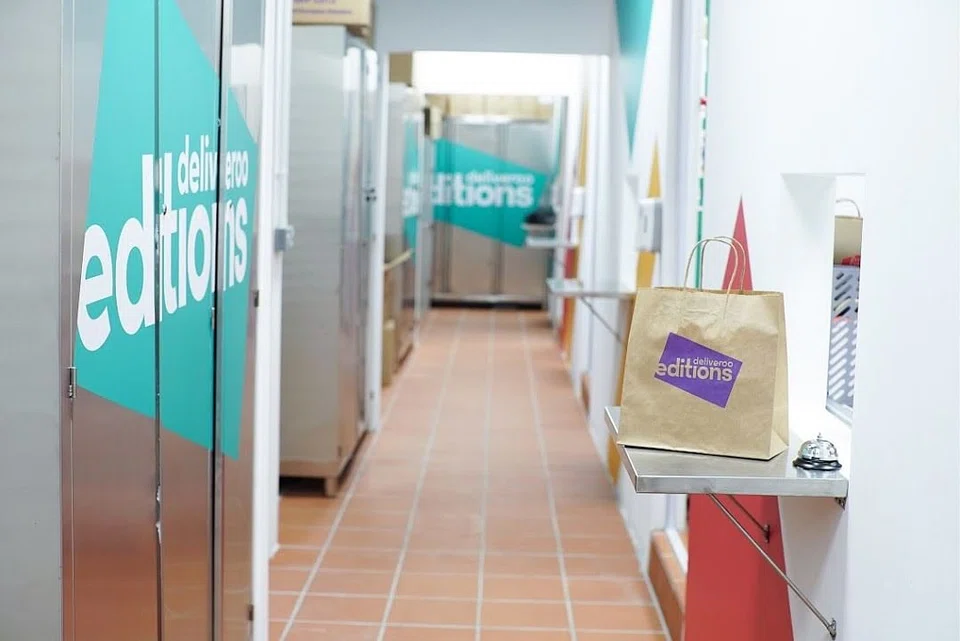
In Singapore, food delivery operators such as Deliveroo and foodpanda have built a total of five cloud kitchens around the island to capture demand in underserved areas. foodpanda also has a kitchen in Bangkok.
Last week, GrabFood expanded its cloud kitchen network outside of Indonesia with launches in Thailand and Vietnam, bringing the number of kitchens it operates to 20. It plans to launch more than 50 GrabKitchens in five markets, including the Philippines and Singapore, by year-end.
In Mumbai, Rebel Foods boasts more than 200 cloud kitchens across 18 cities in India. Rebel Foods is joining forces with its investor, Gojek, to build a hundred cloud kitchens in Indonesia by the end of 2020.
For consumers, the shared kitchens can mean a wider range of food options as several merchants operate under one roof. For the merchants, the cloud kitchens represent a low-cost way to launch a food and beverage (F&B) business where customers are mostly served by delivery.
Bringing more food choices to consumers increases user satisfaction and stickiness, which generates more delivery orders that result in higher revenue, foodpanda Singapore's managing director Luc Andreani told The Business Times.
For the kitchen operators, there are other potential rewards such as healthier margins and ability to better capture merchants' total spending.
Operators typically charge a monthly rental to merchants and take a cut of their revenue. For instance, Singapore-based shared kitchen operator Smart City Kitchens (SCK) offers pricing options tailored to the type of F&B business, including combinations of monthly fixed licence fees and revenue sharing. Fixed licence fees start from S$3,000 per month.
Professor Lawrence Loh of the National University of Singapore (NUS) Business School said: "Food production, which commands better margins, is the next frontier of profits for delivery providers. The end-to-end concept of pot to plate is an attractive business value proposition and it's obvious every player wants to capture the whole pie."
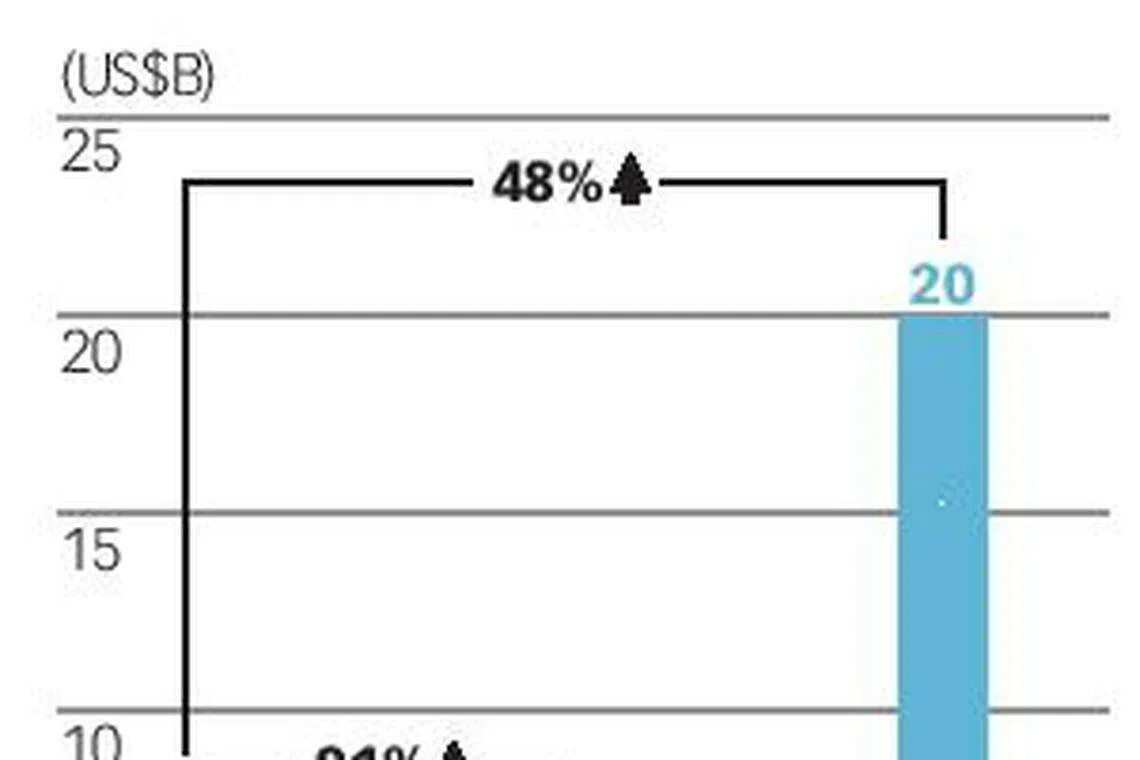
The scrumptious pie is growing at a brisk pace. The gross merchandise value of food delivery in South-east Asia is expected to cross US$20 billion by 2025, representing a growth of about 50 times over a decade, according to a recent report by Temasek, Google and Bain.
The bright prospects indicate that food delivery companies are no longer simply fighting among themselves, but also with a host of newcomers.
SCK - linked to ousted Uber chief executive Travis Kalanick - opened its first independent 10,000 square feet kitchen in Tampines in June. Three more are set to launch by the end of this year, and regional expansion plans are in the making.
Some of the new players on the block are coming up with their own versions of the business model. Local firm Incubaker, which caters to F&B startups, uses a co-working concept instead of allocating kitchen space; it also shares its licence with its merchants and connects them with mentors and investors.
Hong Kong-based Spoonful Meals, which set foot in Singapore this month, houses its own food brands and has its own online platform where users can place orders for delivery.
In the cut-throat environment, players will have to rely on whatever edge they can find, observers said.
Operators that have experience running a chain of cloud kitchens in other markets "will have an understanding of how to source restaurants, coordinate logistics, and negotiate commercial terms with restaurants and delivery companies", said Reshmi Khurana, the managing director and head of South-east Asia at risk consultancy Kroll.
She added that on the other hand, food delivery operators such as foodpanda and GrabFood are able to understand the nuances of the local market and have established relationships with merchants. These can help them in navigating the cloud kitchen space in the region.
Not surprisingly, there have been allegations of some unfair elbowing.
In Singapore, the Competition and Consumer Commission of Singapore (CCCS) has launched an investigation into anti-competitive behaviour in the food delivery and cloud kitchens space, the watchdog told BT last Friday.
This comes after SCK filed a formal complaint with the competition watchdog in July against Deliveroo and GrabFood for allegedly shutting out restaurants under SCK.
In response, Deliveroo said it has not informed any restaurant partner that they cannot work with SCK as the firm is still in discussions with SCK, while GrabFood said SCK's kitchen location was not optimal, hence the vendors were rejected.
Some SCK customers told BT that they are considering terminating their contracts with SCK as they were banking on a delivery-only model to grow their brand.
With two out of three major food delivery platforms in Singapore not servicing the kitchen, they worry that their businesses will miss out on significant customer volume.
To be sure, over 30 restaurants are still due to go live in SCK's facilities in the coming weeks, according to an SCK spokesperson.
For all the buzz about cloud kitchens, prospects of sustainable profitability are still fuzzy.
Valmiki Nair, a partner at law firm Dentons Rodyk, said that the current shared kitchen model might not be "completely workable" if it only binds merchants through short-term contracts.
For cloud kitchen operators which enter into a long-term lease for properties and sublet the space to restaurant business owners for their operations, they run the risk of being liable for the lease without having secured tenants for the entire duration.
Another risk that operators face is the over-reliance on delivery operators to dispatch food.
"The question becomes whether the shared kitchen business is a market that, for economic reasons, is dependent on delivery services," said Walter Theseira, an economist at the Singapore University of Social Sciences.
He pointed out that the concept of shared kitchens does not depend on delivery services.
The kitchens could, in principle, be used by any type of retail food establishment, including caterers and restaurants, with the business not directly depending on food delivery, he said.
"However, food delivery services have certainly increased the value of shared kitchens, which solve some logistics problems for food delivery services and also help delivery-oriented restaurants expand geographically. So, I think the question really turns on the degree of interdependence."
If shared kitchens are integral to the evolution of the food delivery model, then the large delivery players will not let the market go without a fight, he reasoned.