

Low uptake of old IP scheme spells valuable lessons for Singapore

Singapore
BACK in 2014, Singapore made an impressive S$100 million available for the ground-breaking Intellectual Property Financing Scheme (IPFS).
But the IPFS was likely ahead of its time: only S$12 million was disbursed to three companies, the Intellectual Property Office of Singapore (IPOS) said in response to queries from The Business Times (BT). The scheme ceased in 2018.
The IPFS was a novel move. Companies could collateralise their IP to obtain loans for growth and the Singapore government would share the risk of the loan with the financial institution. This could have been a boon to asset-light tech startups.
But the only beneficiaries were shoemaker Masai Group International, manufacturer NSP Tech and infocomm firm Globalroam Group.
Why look back at this old scheme now? It highlights just how important it is for Singapore to first build up an ecosystem that knows how to accurately value intangible assets (IA) - right from SME towkays all the way to banking bigwigs.
Or, as TSMP Law Corp partner Ong Pei Ching puts it: "We would need valuers of IA to become as common a sight in banks as valuers of real property."
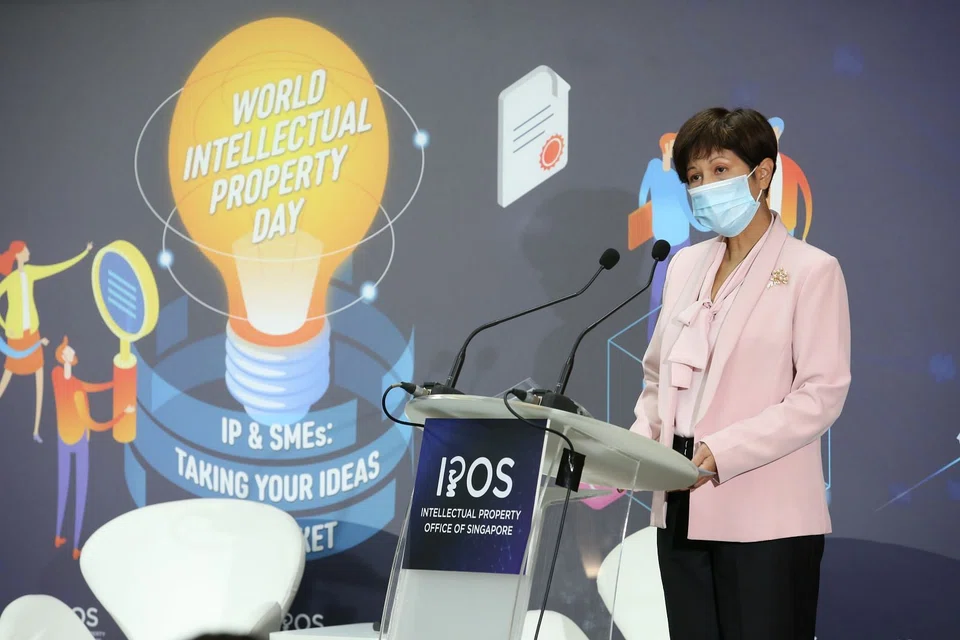
And that seems to be exactly the approach that Singapore is taking with its new IP blueprint launched on Monday. Called the Singapore IP Strategy (SIPS) 2030, it aims to build up the existing ecosystem for IP and IA services, Indranee Rajah, Minister in the Prime Minister's Office, announced at a press conference.
Looking back on the IPFS, there were three key reasons the scheme ceased in 2018, an IPOS spokesperson told BT.
One, high upfront valuation costs were required for participating financial institutions (PFIs) to assess IA. This deterred applications.
Second, PFIs themselves lacked familiarity with the use of IA as collateral, and how such loans can be structured.
And finally, perhaps most crucially, the absence of secondary markets for IA in Singapore meant that the PFIs faced difficulties accepting collateral lacking "clear avenues for disposal and recovery of value", the spokesperson said.
Beyond these, many prospective applicants simply did not meet the risk profiles required by the PFIs.
Since then, the government has looked at the outcomes of the IPFS "to develop better, more effective financing options for enterprises, so as to identify key enablers of IA and IP financing", said the spokesperson.
These learnings are valuable in shaping Singapore's IP strategy.
Compared to the IPFS, the initiatives under SIPS 2030 are not exactly headline grabbers. But they seem to focus more on laying the groundwork for building IP talent and industry standardisation.
For instance, Singapore will set up an international IA and IP valuation panel to establish guidelines, focusing on key asset classes, as well as grow a pool of valuation professionals here.
The blueprint will also introduce "complementary initiatives specific to IP, such as growing the IP dispute resolution expertise", said Edwin Tong, Minister for Culture, Community and Youth and deputy chair of the SIPS 2030 implementation committee, at Monday's press event.
There are infrastructural improvements. For instance, IPOS is building a new IP filing system with predictive assistance and analytical insights, to be launched by mid-2022. Another initiative is the roll-out of IP Grow, an online marketplace for enterprises to access IA and IP services.
In addition, Singapore will develop a set of nationally recognised IP standards and certification programmes that the industry can adopt, to be able to hire workers and engage professionals with the right skills.
The IPFS was "an innovative start, but more can be done to broaden the appeal of this financing avenue", said TSMP's Ms Ong, who specialises in litigation and dispute resolution.
"There should be a fluid market for IP rights, such that in the event of insolvency, lenders have the option to recover their investments easily, instead of stepping in to run the borrower's business," Ms Ong said.
She also suggested that more data on successfully obtained loans be made public, "so as to motivate more business owners to consider this route".
"Banks and other financiers will also be able to better assess the risks if they have more data on reliability of IP valuations, rate of recovery in events of defaults and rate of successful challenges to patents," Ms Ong said.
Beyond hard data, education will be key. Commenting on SIPS 2030 broadly, Lam Yi Young, chief executive of the Singapore Business Federation, said: "In addition to the ecosystem of IP service providers, SMEs are frequently faced with the challenge of discerning where to begin and what schemes best fit their needs...
"Education and outreach, as well as IP capacity building are also important in supporting our companies."
The pandemic adds urgency to this, as Covid-19 "has accentuated the importance of IA and IP as a competitive advantage and in enabling the recovery and growth of businesses", said Mr Lam.
There is hope yet that once a stronger ecosystem is in place, IP financing can take off in Singapore.






