MyTeksi to US$40b: How Grab evolved over the years


GRAB has announced a merger that will result in a US public listing, in a major milestone for the company and the region's startup landscape.
Here's a look back at how the group edged out rivals, diversified its business and stole the hearts of investors to become South-east Asia's most exciting tech story.
2012: It all started in a tiny rented storage space in Kuala Lumpur. Back then, Anthony Tan and his Harvard MBA classmate Tan Hooi Ling knew exactly what problem they wanted to solve in their hometown Malaysia: taxi safety.
Their solution: MyTeksi, the earliest iteration of Grab.
But it was not built in a day. "When Ling and I first started, she wouldn't even leave her McKinsey job. We never thought Grab could pay our bills," Mr Tan recounted to The Business Times.
FULL STORY: Ultra driven
2013: Grab expands from Malaysia to three markets: Singapore, Thailand and the Philippines.
2014: Grab enters Indonesia and Vietnam, and also launches ride hailing for private-hire cars and motorcycles.
It raises an eight-figure Series A sum from Temasek's Vertex, and then another US$15 million in a round led by Silicon Valley-based GGV Capital. Other investors included Chinese online travel platform Qunar and Vertex. Grab later moves its headquarters from Malaysia to Singapore.
In September, US ride-hailing app Uber enters the Singapore market, heralding intense competition for Grab. Meanwhile, players such as EasyTaxi and Ryde crowd the market.
2015: Grab launches its parcel delivery service, GrabExpress. It also invests heavily in building up its Singapore base, investing US$100 million into its Singapore R&D centre.
2016: Speculation over whether Grab and Uber would merge surfaces as early as 2016, after Uber struck a deal with Didi Chuxing. As BT then noted, an Uber-Grab deal would leave consumers on the losing end.
Grab also expanded its ride-hailing offerings with the launch of its carpooling service.
2017: Grab enters fintech after launching its GrabPay e-wallet. It also expands into two frontier markets, Cambodia and Myanmar, marking its full expansion into South-east Asia.
The company hits US$1 billion in gross merchandise value (GMV).
2018: Grab's price war with Uber culminates in its merger with Uber's South-east Asian business in March 2018. Uber took a 27.5 per cent stake in Grab. The agreement came with the condition that Grab would have to go public by 2023, or potentially face a US$2 billion payout to Uber.
The deal was a stark reminder for ride-hailing players: the cash burn can't go on forever. The competition watchdog also stepped in to investigate a potential breach of the rules.
Grab hits US$5 billion in GMV and breaks into the food delivery vertical with GrabFood. It also launches GrabAds, an advertising arm. In July, it announces a major shift in its strategy - to pursue a "super app" goal.
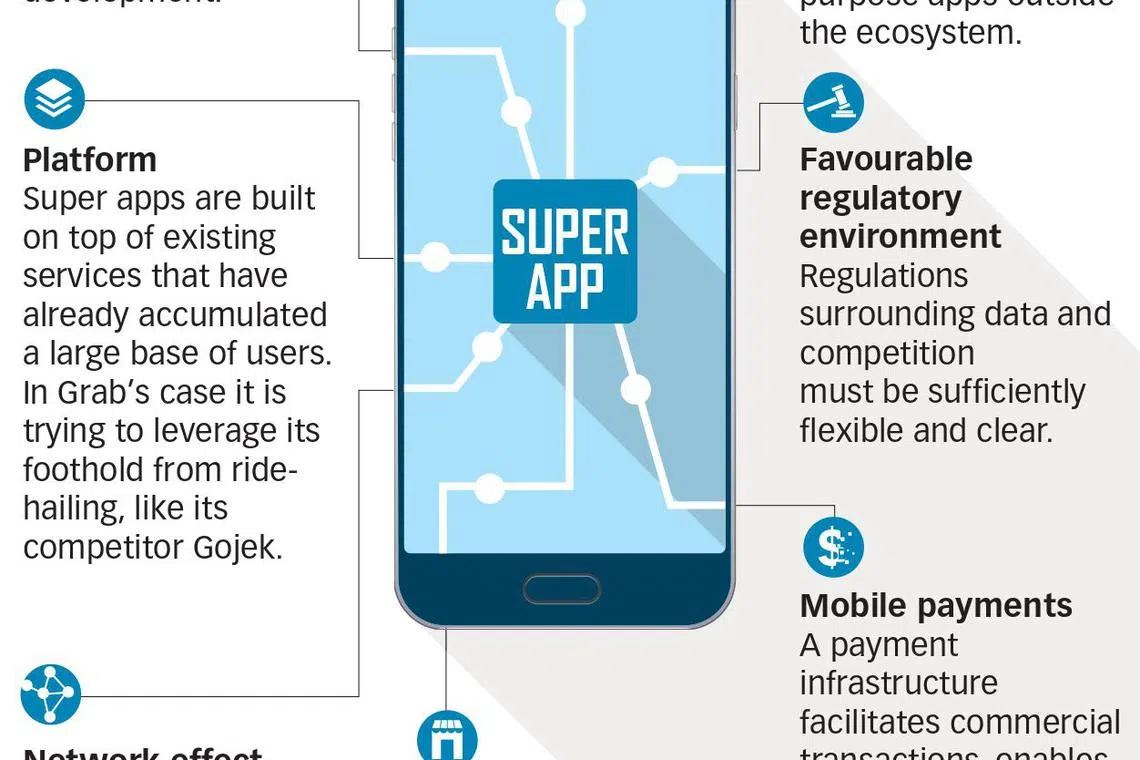
FULL STORY: Grab's super app goal calls for good grasp of users
2019: Grab expands further on its food delivery vertical with the launch of physical cloud kitchens, known as the GrabKitchen business. It also enters on-demand grocery delivery with the introduction of GrabMart.
The company also ventures further into fintech through lending and insurance. It focuses on wooing SMEs with a suite of financial services.
Grab hits US$10 billion in GMV and claims to have US$1 billion in "adjusted net revenue". It launches its GrabForGood programme that focuses on social impact.
2020: Reports of merger talks with arch-foe Gojek surface. The potential union has the market abuzz with talk of shareholder pressure, final deal terms, anti-competitive concerns and public backlash.
The pandemic throttles the ride-hailing sector. Grab in June cuts about 360 staff - or just under 5 per cent - of its workforce amid the economic downturn. It axes non-core projects and consolidates certain functions.
Grab launches an investment platform, GrabInvest, following the acquisition of robo-advisor Bento. It also makes a quieter entry into anti-fraud technology, launching a suite of solutions called GrabDefence.
After an intense battle with several contenders, Grab's consortium with Singtel receives the digital full bank licence in Singapore. It says it will hire around 200 staff in Singapore by the end of 2021, with banking veteran Charles Wong leading the charge.
FULL STORY: Grab-Singtel group puts cybersecurity at top of digital bank agenda
2021: Grab's fintech arm raises US$300 million in Series A funds, valuing the unit at US$3 billion. But despite the fresh firepower, observers reckon it still faces a tough fight as tech rivals in the region scoop up stakes in Indonesian banks.
Merger talks between Grab and Gojek fail despite much back and forth. In January, BT reported that the proposed merger was called off.
FULL STORY: Why the Grab-Gojek ride was not meant to be
On Jan 25, it surfaced that Grab has picked banks Morgan Stanley and JPMorgan Chase & Co for the potential US IPO. Reports said that the listing could happen as soon as the second half of 2021.
It joined a handful of other regional startups aiming for the public markets.
Grab on Tuesday said it will list in the US via a merger with Altimeter Growth, a special purpose acquisition company (SPAC), that is expected to value the group at about US$39.6 billion.
The spotlight is now on Grab's financials. Industry observers wait with bated breath for information on the unit economics of Grab's core ride-hailing and food-delivery businesses.
They expect that Grab will tap the funds raised to continue to compete aggressively, although it may need to streamline its multiple verticals to better appeal to retail investors.
FULL STORY: All eyes on Grab's financials ahead of mega SPAC deal