

Consolidation in Indonesia's e-wallet war could reshape Grab-Gojek dynamics
Reported merger discussions between Ovo and Dana could have implications on fintech battle between Grab, Gojek

Singapore
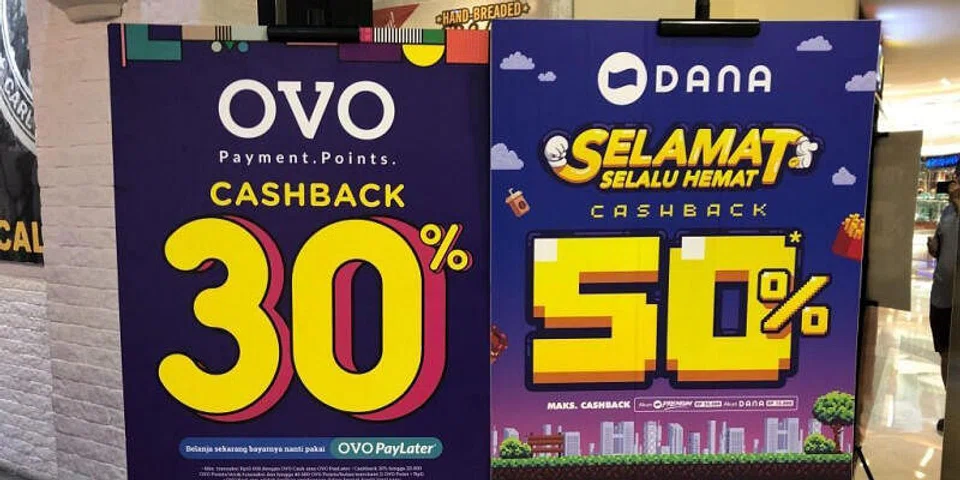
IN RECENT years, Indonesian consumers have been greeted by storefronts adorned with a colourful array of posters screaming about steep e-wallet cashback offers. Unlike Singapore, where such offers are usually in the low single digits, cashback rates there can run as high as 60 per cent.
"Some people say that in Indonesia, you can have your meals subsidised by whoever's money is being burned (to fund e-wallet cashback)," mused Joel Shen, a special counsel at Withers KhattarWong experienced in Indonesian tech. Many consumers download multiple e-wallets on their mobiles to maximise such offers, he noted.
But as with any market flush with venture capital, the prospect of consolidation is in the air. Media reports over the past year indicate that a merger is in the works between two major e-wallets: Ovo and Dana.
What is significant is that Ovo counts Singapore's Grab as a key shareholder, alongside Indonesian e-commerce giant Tokopedia. Grab does not operate an e-wallet directly in Indonesia and instead has integrated Ovo for payments on its Indonesian app.
Dana, meanwhile, is a joint venture between Chinese fintech juggernaut Ant Group and Indonesian media giant Emtek.
Ovo's reported merger attempt with Dana is largely seen as a move to one-up Gojek's e-wallet, GoPay. What may seem like a simple turf war also spells broader implications in the fight for fintech dominance between Grab and Gojek.
Ovo declined to comment on the reported merger effort, while Dana did not respond by press time.
E-wallets have exploded in Indonesia, with 51 licensed e-money platforms, according to Bank Indonesia data. There are a handful of big players (see table), but the battle for the top spot is primarily between GoPay and Ovo, said Zhi-Ying Barry, a senior analyst at Forrester.
It is hard to tell who has the lead, as market research is hazy. According to Forrester, 60 per cent of Indonesian adults with an online presence have used Ovo in the past three months to make purchases; GoPay's figure stands at 54 per cent.
But a study by iPrice and App Annie in September said that GoPay beat other e-wallets in terms of monthly active users from Q2 2019 to Q2 2020, although the data lumps all Gojek users together.
In any case, owning the preferred e-wallet of the 270-million strong Indonesian market is a key step to dominating South-east Asia's fintech space, noted Willson Cuaca, managing partner of East Ventures.
"Payments (infrastructure) is like glue, it brings everything together. Ride-hailing has small-ticket transactions but high frequency. With food, the ticket size is slightly bigger than ride-hailing. Then with e-commerce, there's bigger ticket items but not that frequent," he said.
Any player with access to all three pools of rich data will then be best positioned to build value-added fintech services, such as loans or buy-now-pay-later services, he noted.
An Ovo-Dana merger would bring together heavyweights like Grab, Tokopedia and Ant, as well as Dana's e-commerce partner Bukalapak. This "pooling of strategic interests" would be beneficial to Ovo, noted Li Jianggan, chief executive of venture builder Momentum Works. But "it remains to be seen how the different parties can work effectively together", he said.
If the Ovo-Dana merger crosses the finish line in the near future, and Grab has a significant say in the merged entity, it could be a plus for Grab in negotiating its own merger with Gojek.
Media reports since February indicate that both ride-hailing unicorns are in merger talks, spurred on by investors, but are having trouble agreeing on specifics.
"If Ovo and Dana merge, then Grab may have one more negotiating line that it can use in its back pocket; that (it) has effectively divided the payments market in Indonesia into two, rather than having three or four big operators," said Mr Shen of Withers.
But of course, there are still many moving parts. "A merger between Dana and Ovo will add another complication to what could already be a very complex deal (between Grab and Gojek)," Mr Shen noted.
What does seem certain is that Indonesia's e-wallet war will be raging on, and that as long as they remain competitors, both Grab and Gojek will continue to battle on new fronts.
This could already be happening with LinkAja, an e-wallet linked to several state enterprises. In July, news outlet KrAsia reported, citing sources, that Grab and Gojek are both bidding to invest in the Series B round of LinkAja. Both Grab and Gojek declined to comment on the report.
The emergence of other strong competitors will also keep Grab and Gojek on their toes. For instance, according to a survey by MarkPlus, ShopeePay, the e-wallet of Sea Group's e-commerce arm, outperformed both GoPay and Ovo during the months of the Covid-19 pandemic.
Broader geopolitical factors are another wild card in the e-wallet war, said Varun Mittal, global emerging markets fintech leader at EY.
Ultimately, while e-wallets may seem like the simplest infrastructure of the digital economy, they hold the key to Grab and Gojek's "super app" ambitions.
As Alan Hellawell, a venture partner at Indonesian investor Alpha JWC, sees it: "The pot at the end of the rainbow is really about who can enable the most frictionless transactions."
TRENDING NOW

Indonesia begins cutting natural gas exports to Singapore from Oct 24: reports

Singapore’s central gas buyer affirms Indonesia’s role as ‘important partner’ amid export review warning

KKR founders among investors buying 42% of Peter Lim’s Valencia; club valued at US$1.4 billion

NEA issues notices to 10 Singapore-based companies, including Wilmar and APP, over haze

