Liquidity drying up for VC firms as investments age

Singapore
THE pressure is mounting on venture capital (VC) funds to show real cash returns to investors, but as exits are delayed and market conditions remain rocky, some early VC funds might be burdened with a backlog of ageing investments.
As they look to divest their shares in portfolio companies to realise returns, fund managers will have to decide between offloading shares at a discount in the secondary market, or asking investors for more time - and they are treading a thin line because this might in turn affect their ability to fund future bets, observers said.
Funds need to show their investors that they can exit their positions over time, said Chua Kee Lock, chief executive of Vertex Holdings.
"Although they might have on paper a good net multiple or internal rate of return (IRR), what investors are really looking for are real cash-on-cash returns," said Mr Chua, who is also managing partner for Vertex Ventures South-east Asia and India.
IRR reflects the performance of a fund by taking into account the size and timing of its cash flows and its net asset value over time; net multiple, or total value to paid-in ratio (TVPI), measures the fund's total value - realised and unrealised - as a multiple of its cost basis.
A more accurate benchmark of a mature fund's performance is measured by the distributions to paid-in (DPI), which measures how much of a fund's returns have actually been paid out to investors.
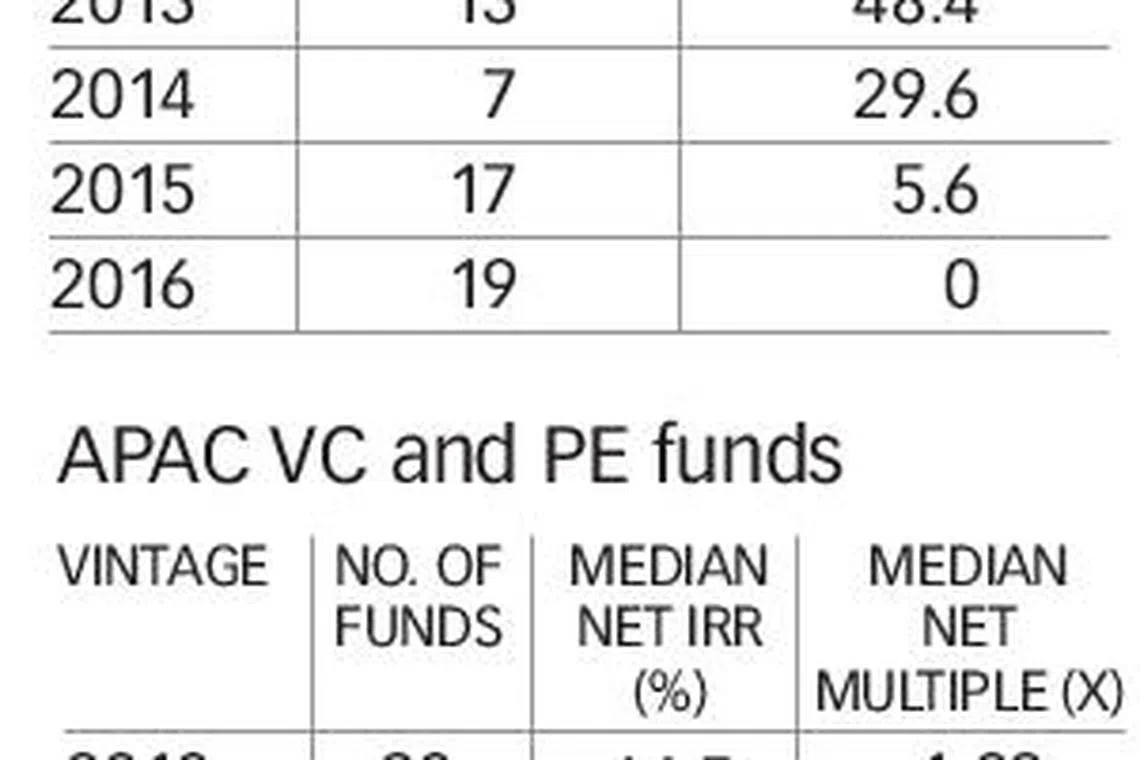
Venture firms rely mainly on these key metrics, among other things, as a track record to help them raise a new fund. (See table)
However, the flow of capital back to investors varies greatly across funds, with top-quartile funds performing significantly better than their peers, observers told The Business Times.
For example, while the median DPI for 2010 vintage funds in the Asia-Pacific stood at 162.5 per cent according to Preqin, outliers such as East Ventures' (EV) Fund 1 outperformed its peers in that vintage with a DPI of 700 per cent. This meant that EV had returned up to seven times what investors had put in.
Good performance can give managers some holding power, since investors already have some sizable realised returns on hand, said EV's co-founder and managing partner Willson Cuaca.
EV still holds stakes in Indonesian unicorns such as Tokopedia and Traveloka from its 2010 vintage fund.
Consistent performance across EV's other funds has also helped in fund-raising efforts, said Mr Cuaca. Its 2013 vintage fund too, has a 650 per cent DPI, following "home runs" such as Grab's acquisition of portfolio company Kudo for around US$100 million, and a US$130 million acquisition of Moka by Gojek.
But not all fund managers have that luxury.
Startups have a long gestation period, said Joel Shen, a tech lawyer at global law firm Withers. Not all startups are able to find acquirers or go public in eight to 10 years, the typical fund life of a VC fund.
A startup's early-stage investors might thus be unable to realise a full exit during their fund term. Another way fund managers can seek liquidity is through a partial or full exit in the secondary market, but this would mean contending with a discount for their shares.
The pressure for liquidity on early-stage investors rises each year as funds mature, said Harold Ong, managing director of Indies Capital Partners, a Singapore-based alternative asset manager which also purchases secondaries in high-growth, pre-IPO tech firms in South-east Asia.
Discounts can range from 15 to 50 per cent, depending on the startup, but typically average around 20 to 30 per cent to the latest valuation, said Mr Ong.
Current market conditions might not favour startups in the travel or hospitality sector, so discounts for these startups could thus be very steep. Fund managers that hold positions in these startups are thus more likely to wait out the storm than to unload their stakes, for fear of negatively impacting fund returns.
Funds nearing the end of their fund term, however, might have to convince their investors for more time.
Sophisticated investors who understand this asset class typically do not mind the extension, as long as managers have shown some promise of return, said Vishal Harnal, general partner at early-stage VC firm 500 Startups.
While this is a request that could help fund managers capture more upside in the next couple of years and optimise returns, it may not sit well with investors if fund returns thus far have been sub-par.
Some funds give investors a "no fault" right to remove the general partner, even if they have not done anything wrong, said Jason Nelms, a partner specialising in fund formation at law firm Morrison & Foerster. "While it is not common for investors to use this right, it can provide leverage for investors to push the general partner to find exits more quickly or reduce the fees charged during a fund extension."
Despite the slowdown in exits in South-east Asia now, there is still a realistic prospect of liquidity in the next 24 months that may pave the way for exits when the market conditions are ripe, said VC firms.
"There is still a lot of interest in South-east Asia that has yet to be unlocked because there have not been many IPOs, but once we start, more money might flow in," said Withers' Mr Shen.