In pursuit of success and meaning: Sea founder shares his journey
Having gone through the pains of entrepreneurship, Forrest Li gives some advice to those eyeing the same route.

THE founder of one of South-east Asia's most well-known tech companies had an unconventional way of pumping up his confidence level.
Back before he became the CEO and chairman of consumer internet firm Sea, Forrest Li was yet another graduate student at Stanford's business school. As fate would have it, he was also among the audience when Steve Jobs gave his now-famous 2005 commencement speech and told graduates: "Stay hungry. Stay foolish."
For months afterwards, Mr Li replayed the speech on YouTube two to three times a day to gather the courage to turn his back on the corporate world and become an entrepreneur.
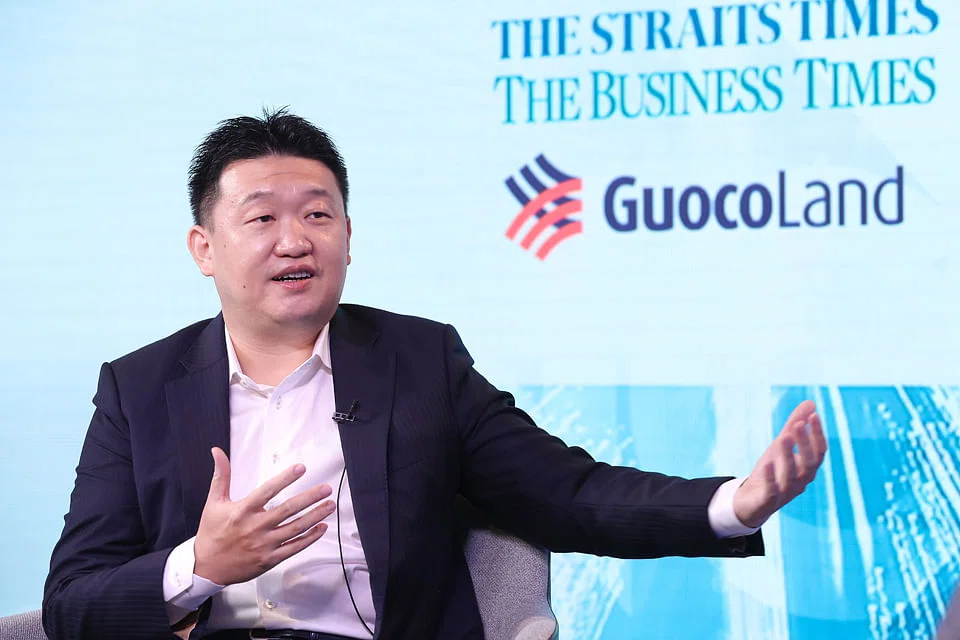
"The spirit of that speech was that you should do what you're really passionate about ... and eventually when you look back, you will see that all your experiences can be connected to your success today," Mr Li shared during a virtual forum session organised by The Straits Times and The Business Times. The Cutting Edge forum, which is sponsored by property group GuocoLand, spotlights renowned global experts at the forefront of their field of interest and features audience participation.
While at Stanford, Mr Li had many chances to meet or listen to talks by successful people. It was always the entrepreneurs that he resonated with, he recalled.
This group of people had very personal stories and shared about their failures as much as their successes. It was then that Mr Li decided that he wanted to be like one of them.
"If you can succeed, it's very exciting and it will be a very meaningful life for you. But even if you didn't, the lessons and experiences you've gone through make for a very rich life experience," he said.
Leap of faith
His leap of faith paid off. His company Sea, which began in 2009 as a scrappy startup in a Maxwell Road shophouse office, is now listed on the New York Stock Exchange and recently became Singapore's most valuable homegrown public company.
Sea has a gaming arm called Garena, an e-commerce arm Shopee ,and a digital financial services business called SeaMoney. The group's market capitalisation was US$57.8 billion as at Aug 3. While the company has yet to turn a profit, it managed to narrow its net loss to US$280.8 million for the first quarter ended March, from US$689.6 million a year ago, after its revenue more than doubled.
Having built a company from scratch and gone through the pains of entrepreneurship, Mr Li, 42, now has some advice of his own for founders. "It's very important for entrepreneurs to really try to think through who they are, what they're like, what they're really passionate about, and what kind of risk appetite they can take before they jump into becoming an entrepreneur," he said. The key is to "have a very solid understanding" of oneself.
The good news is that the startup ecosystem is much more developed today than it was a decade ago. "Back in my day, nobody wanted to be an entrepreneur," he said with a laugh.
Venture capital investments in South-east Asia have been booming. The number of deals closed rose from 230 in 2014 to 517 in 2019, according to data provider Preqin. Deal value increased almost seven times in that period.
This is a good thing, but some entrepreneurs have started to become obsessed with their company's valuation and see it as a success factor, Mr Li pointed out. "Capital plays a very important role in the growth of a company, but I always think that it's probably not the most important thing. (At any stage), the most important things are your customers and your employees, and your teams and your partners."
As fresh graduates become more willing to take on the risk of working in startups, or building their own companies, society needs to be more forgiving of failure, he emphasised.
If he could redo his entrepreneurship journey, what would he do differently?
"I would have liked to be more aggressive in hiring people, (especially) young, ambitious and very driven fresh graduates from universities," Mr Li said.
In 2012 and 2013, the company hired five to six of such people and trained them hard. These employees went on to play critical roles in Sea's growth. "Maybe our business size could have been double (what it is now) if I had hired 10 or 12!" he quipped.
In fact, Mr Li considers the supply of talent as one of the key risks for his business. As a part of the first generation of internet companies in South-east Asia, Sea does not have the luxury of tapping a large existing talent pool as its business grows rapidly. To add complexity to the challenge, Sea also needs to hire from each of the markets it is present in because of its intensely localised strategy.
Talent bottleneck
It's the reason why the group doubled down on campus recruiting, management associate programmes and on-the-job training. Many opportunities to expand the business are out there, but talent can be a bottleneck, explained Mr Li.
Sea, which was then called Garena, started out as a distributor of digital games for developers such as Riot Games, the name behind the hugely popular League of Legends. Although most in the gaming industry have dreams of creating their own game, distribution was the prudent choice to make for a startup with few resources.
But even though the company was a PC game distributor, it always knew mobile gaming would rise, said Mr Li. Indonesia, for instance, was never a huge market for the group despite efforts to introduce exciting games there. This was because most households did not have a computer, or faced challenges with internet access. "But that completely changed when mobile gaming became very popular, and Indonesia is probably the largest game market in terms of revenue for us today in South-east Asia," said Mr Li.
The group tapped on its years of experience and industry knowledge as a distributor to create mobile game Free Fire in 2017. Last year, Free Fire became the most downloaded mobile game globally, according to data analytics firm App Annie.
This eye for spotting long-term trends was also what led to Sea venturing into e-commerce in seven markets in 2015. The industry was booming in China and the US then, but not in South-east Asia.
Mr Li recalled that while on a family trip in his native China five to six years ago, his five-year-old daughter saw e-commerce platform Taobao as a "magic box" - all she had to do was tell her mother what she wanted, and with a few clicks, a package would arrive at their doorstep the next day.
Mr Li said: "I asked my daughter what she missed most about the days when we were travelling in China, and she said it was Taobao. So I joked with her: Okay, Daddy will make one for you here!"
Jokes aside, Sea's e-commerce arm Shopee has grown rapidly in that short span of time to become one of the most popular platforms in the region. One of the biggest barriers for merchants to go online is that they simply do not know how to do so. So Shopee invested time and resources into programmes for sellers, said Mr Li.
Now, the company is expanding in digital financial services, which Mr Li sees as a natural extension to its existing business. Sea has even applied for a highly-coveted digital banking licence in Singapore.
While SeaMoney is a fledgling initiative in a highly competitive segment, Mr Li believes that the company's network of merchants and users is a powerful arsenal to tap. For one, it provides valuable credit data on which the company can offer financial products, he said.
New opportunities
Gaming, e-commerce and digital finance. So what will Sea's next act be?
"For each of the businesses we're in today, we still see a very long runway and a lot of growth opportunities. At this moment, we really want to focus on these three things," said Mr Li.
Ultimately, the company wants to stick to the areas where it sees that technology can play a big role. This will hold true if it decides to expand to another business segment, Mr Li said. "Although I'm not an expert, I do feel that there's a lot of digital opportunity in healthcare and in education ... all those opportunities could be very interesting down the road."
For now, Sea needs to be cautious with every dollar it spends. "We always need to feel 'poor' and humble and trade every dollar seriously," Mr Li emphasised.
As it is, one of the group's core values - Mr Li even calls it the "core of the core values" - is "Stay Humble". It relates to the company's early days, when Mr Li and his team faced and overcame all sorts of struggles.
Perhaps the easiest glimpse of the entrepreneur behind the multi-billion-dollar company is in his name. It was in college that Mr Li, whose Chinese name is Xiaodong, named himself after the main character from the hit 1994 film Forrest Gump.
"If you think about his childhood and his experiences, he's not always the smartest person or the physically strongest among his peers, but he has a very good heart. And because of that good heart and his persistence and courage, he lived a very successful and meaningful life," said Mr Li.
"I hope I can live a similar life."