Oyika raising US$100m to roll out greener rides in Asean
Singapore startup to offer leases on battery packs, bundling these with e-bike subscriptions. It also aims to bring power to those off the grid with those same battery packs

Angela Tan
Singapore
OYIKA wants to pull off the electrification of mobility in South-east Asia, specifically by bundling subscriptions to electric motorbikes with fully-charged battery packs that power these bikes.
The Singapore venture-funded company is raising US$100 million in its drive to persuade cities with teeming numbers of petrol-guzzling, carbon dioxide-spewing motorbikes to make the switch to a greener ride.
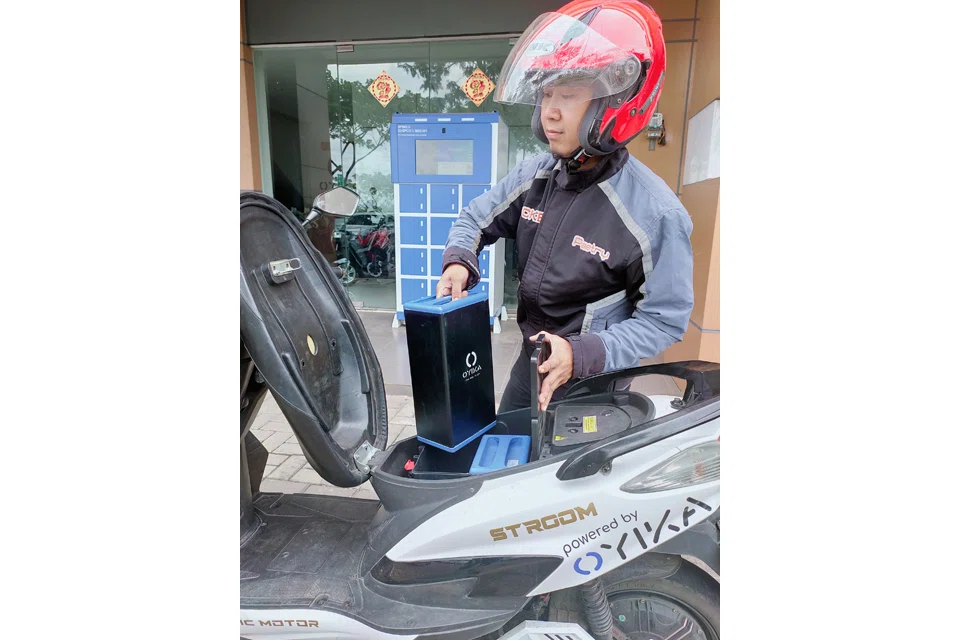
The company offers a subscription-based battery-sharing concept that allows e-motorbike riders to swap their depleted leased battery for a fully charged one. All they need to do is stop at an Oyika "swap station", which looks like a parcel locker terminal.
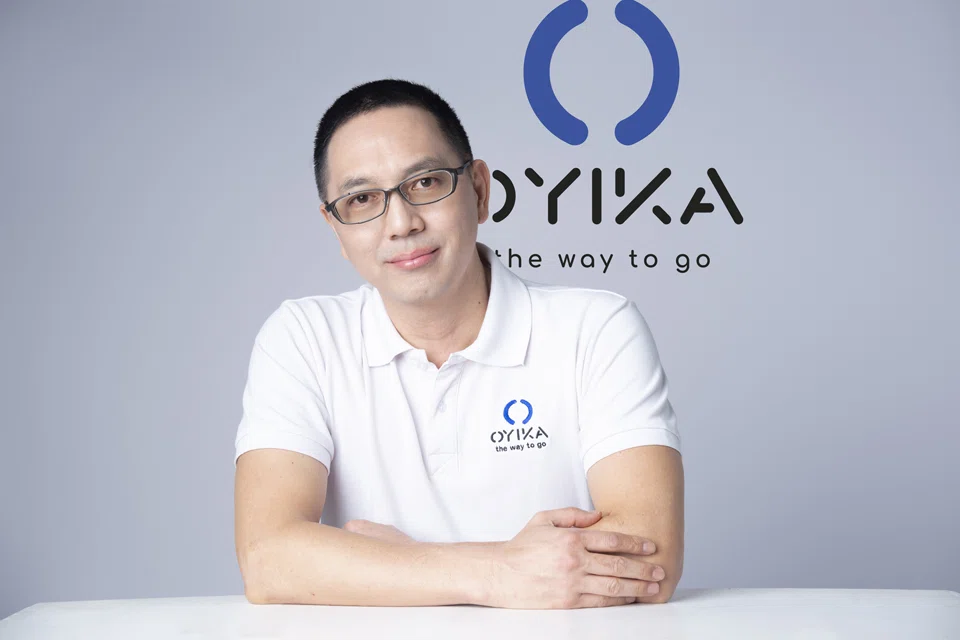
In an interview with The Business Times, Oyika's chief executive officer and founding member, Jinsi Lee, said South-east Asia is home to an estimated 250 million motorbikes - half of them in Indonesia, and a quarter in Vietnam; these two markets are respectively the third and the fourth largest motorcycle markets in the world.
However, while motorbikes make up 85 per cent of the vehicle populations, less than 0.1 per cent are electric.
In a Zoom call from China, Mr Lee said: "The electrification of mobility will happen. South-east Asia has the highest density of motorbikes globally."
Having introduced the concept in Cambodia, Oyika is now expanding to Indonesia. Vietnam, followed by Thailand, will be next. He is betting that these countries, where motorbikes are key to the economy and culture, will embrace his green electric revolution.
Each internal-combustion engine motorbike on the road replaced by an e-motorbike saves about a tonne of carbon dioxide a year - equivalent to planting 16.5 trees over 10 years, says the US Environmental Protection Agency.
Oyika - its name inspired by the expression "Oh, e-car!" - has an order book of 30,000 power subscriptions in Indonesia, including for union members from the Indonesian cooperative, Friends of the Indonesian Police.
By 2025, this is expected to grow to more than one million, he said.
The company, which has raised a total of US$4.4 million to roll out in Cambodia and Indonesia, is planning to raise an additional US$100 million in the private market for the execution of its expansion plans. Half the funds will go into rolling out its battery-swap service for e-motorbikes in Indonesia; US$20 million to US$30 million for Vietnam, and the rest for research and development and software upgrading.
Unlike most rivals in the e-motorbike space, Oyika requires no contract, no down payment and no deposit. Its power subscription plan bundling a swappable battery with an e-motorbike is not unlike a telco's business model of bundling data and calls with a mobile phone.
It offers battery swaps bundled with its partners' e-motorbikes on a pay-as-you-go basis at US$0.05 per minute for short trips, and by the week at US$18 to delivery riders. It also offers a monthly subscription plan at US$72 to individuals and corporations. Under its pay-as-you-go offering, customers can pick up a motorbike wherever it is available and drop it off anywhere at the end of their trip.
Mr Lee said: "We work with the local e-motorbike brands and transform their two wheelers into smart bikes by integrating them with our batteries and network of swap stations." He added that many e-motorbike players are keen to get on board because they can sell more motorbikes.
As the batteries are IoT (Internet of Things)-enabled, they can be monitored remotely for optimal performance and safety. A stolen e-motorbike can be tracked and remotely switched off, effectively making it theft proof.
The system is runs on Oyika's mobile application, which enables riders to locate a nearby swap station to exchange their flat battery for a juiced-up one.
By providing a portable smart battery that is leased, the cost of e-motorbike ownership is sharply reduced, given that batteries account for half or more of the total cost of an e-motorbike. This makes it a viable alternative to subsidised fuel - even without government subsidies.
In Indonesia, for example, a motorbike travelling for 50 km would typically need two litres of petrol costing US$1. The cost of Oyika's battery-swap option: US$0.70.
Oyika's chief financial officer (CFO) Tay Chin Kwang estimates that the breakeven period of its plan that bundles its power subscription with an e-motorbike would be around 20 months.
Unlike traditional batteries, which can be recharged up to 300 times for lead-acid ones and 800 times for lithium-ion versions, Oyika's smart batteries, with cells from Murata in Japan, last 5,000 cycles.
And precisely because of their longer life spans, Oyika's batteries enjoy a second lease of life - when used to bring off-grid electrification to Asia's remote villages, where some 30 million have no access to the grid. (This excludes the 600 million who are off-grid in Africa.)
Mr Lee said: "The same batteries that power the motorbikes can power up homes too. It's all about energy share. Even for the villages, we do it on a power subscription plan."
Oyika is conducting trials in Indonesia, where the same portable batteries used in e-motorbikes provide electricity to households in remote parts of the country.
Under its plan, getting electricity at home will simply entail placing the battery into an Oyika home-docking system and connecting electrical appliances to it. As with e-motorbike users, customers can exchange their flat battery for a fully-charged one at a nearby swap station when its power levels are low.
Beyond powering e-motorbikes and energy storage, metals are also recovered from the old batteries.
Oyika started working on its battery-share concept for e-motorbikes in 2018. In 2019, it arrived in Cambodia and launched a service in the capital of Phnom Penh, where it now has 300 riders and 11 swap stations.
The company was awarded a grant from the UN Development Programme (UNDP) to expand its rideshare trial in the capital, with a view to extending the service to rural Cambodia.
It is also taking part in Singapore's pilot tender for EV charging points in public car parks. The tender, which closed on March 12, covers the installation and operation of more than 600 EV charging points at over 200 public car parks across the country. Successful tenderers will have to install charging stations in their allotted car parks by the third quarter of 2022.
Oyika's team comprises Singaporeans. Most of them started out in the 1990s at Postkid, an online education platform for children. Oyika's CFO Mr Tay was formerly the CFO of Horizon Education & Technologies Group, which acquired Postkid.
Just as Germany's Volkswagen is "the people's car", Oyika wants to promote the idea of "the people's e-motorbike"; beyond this, it wants to bring power to off-grid households in rural communities as well.
"It's an exciting proposition to have the same battery lighting up homes as well as powering transportation. It has taken many years for battery prices to fall to a point where they can electrify rural communities and improve millions of people's lives - and this is just the beginning," said Mr Lee, who worked for the Sunseap Group and pushed for a 10-megawatt solar farm - Cambodia's first - and a 140-megawatt solar farm in India, the largest by a Singapore consortium at the time.
- Garage is BT's startup vertical. Read more news, analyses and opinions at bt.sg/garage