

PEs target Asean startups as they join VCs in funding landscape
Startups' stepped-up fundraising draws PEs with war chests amid low-rate environment

Singapore
A BURGEONING startup scene coupled with record levels of dry powder are nudging some private equity (PE) firms in South-east Asia into the territory of cash-burning, rapid-growth companies.
As these PE firms go deeper into startup land, investors are rethinking the way business models are being evaluated in order to capture the opportunities in the space, even as they eye it with much caution.
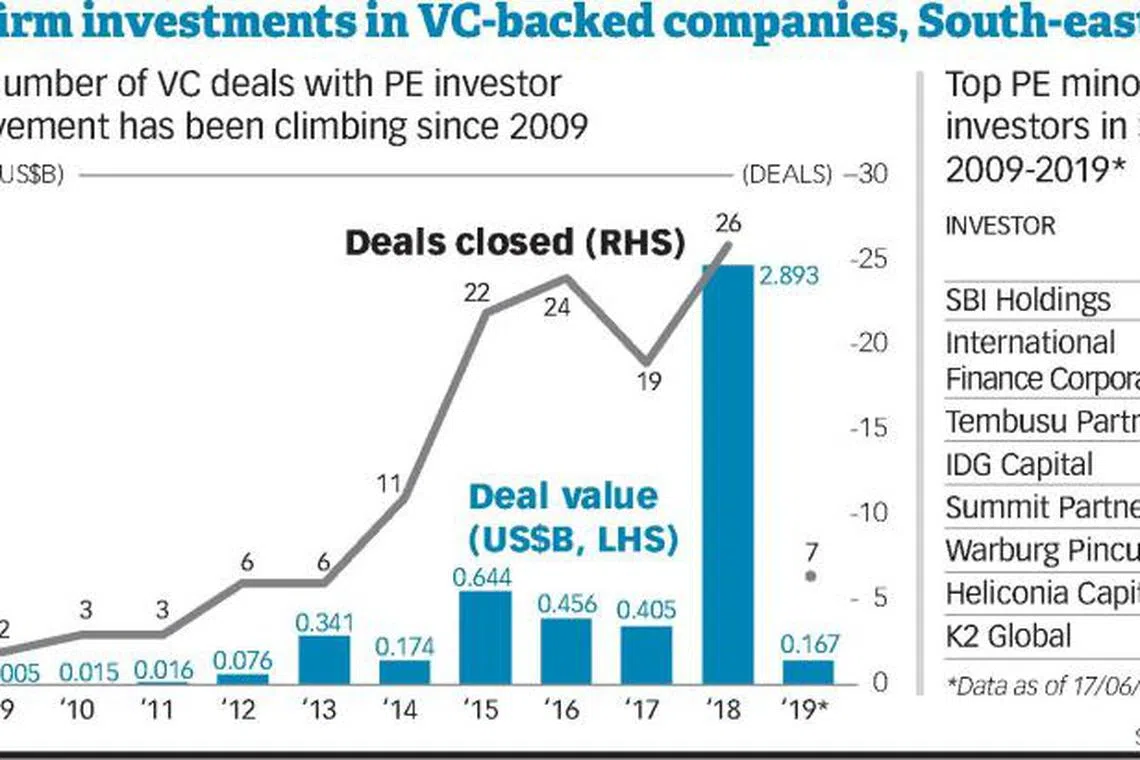
According to fresh data from PitchBook, a Seattle-based research outfit, deal value and volume for PE firm investments into venture capital (VC)-backed companies in South-east Asia have been climbing over the last decade.
From 2009 to 2018, deal value increased to US$2.9 billion from US$4.9 million, while deal count grew to 26 from just two. To be sure, 2018 was marked by a few blockbuster funding rounds. Grab bagged US$2.5 billion from investors including SoftBank Capital and Goldman Sachs Investment Partners, while PropertyGuru raised S$200 million from KKR.
Even then, deal value and count saw a marked increase from 2015 onwards, with double-digit deal volume consistently being recorded and deal value always punching above US$400 million.
The data captured completed VC deals with participation from one or more PE investors, and included buyouts of VC-backed companies by PE firms.
Venture capital was defined as capital given to startups and early-stage companies with long-term, high-growth potential, and are not listed on a public stock exchange. A PE investor was defined as an entity involved in buyouts, provision of growth capital, and private investment in public equity.
While the presence of PE investors is a function of the region's startup scene maturing, bigger funding rounds - even at stages as early as Series B and C - have made cheque sizes large enough for startups to open the door to PE firms.
"It's starting to make economic sense for them to look at it," said Chris Tran, head of Asia at North Ridge Partners, which advises tech firms on capital raising, mergers and acquisitions, and strategy.
With PE funds holding on to large amounts of dry powder, the race is on to park those funds someplace with the potential for high returns, he said.
Last year, dry powder in buyout and growth funds in the Asia-Pacific hit a record of over US$200 billion, according to alternative assets data provider Preqin.
For growth capital, the compound annual growth rate from 2008 to 2018 was 21 per cent, while buyout capital grew at 10 per cent per year.
"Many of us have gotten used to this benign environment since 2009 because of low interest rates and quantitative easing. Capital was easy to raise," said Chris Loh, managing partner at Axiom Asia, a PE fund of funds.
While PE investors tend to be more risk-averse than venture capitalists, it is possible that the favourable fundraising environment helps mitigate the downside risks of investing in startups, since these cash-burning companies are able to continue financing their operations without great difficulty.
That said, Mr Loh also cautioned that this phenomenon can easily change if an economic downturn hits. But until then, PE firms are unlikely to take money off the table.
North Ridge's Mr Tran pointed out that PE firms have seen technology disrupt the traditional businesses they've typically operated around, giving rise to a greater urgency in wanting to understand tech.
Mr Tran is making introductions between startups and PE firms earlier than before, and currently advising on two buyout deals.
Going by Pitchbook's South-east Asia data as of June 2019, the top PE minority investors in venture-backed firms, by deals closed, include SBI Holdings and the International Finance Corporation, with eight deals each since 2009; Tembusu Partners, with seven deals; and IDG Capital, with six deals.
Other notable PE investors that have dipped their toes into the space include Temasek unit Heliconia Capital, which funded autonomous tech startup Sesto Robotics and biopharma firm Tessa Therapeutics.
Gojek-backer KKR has also said it plans to invest more in early-stage tech.
"In the future, we are planning to expand our strategy from focusing just on the large tech plays to investing in companies at an earlier growth stage, when we can play a greater role in shaping businesses' direction and opening doors for them to expand by leveraging our global portfolio," said Ashish Shastry, KKR member and head of South-east Asia, in an interview with the Singapore Venture Capital and Private Equity Association (SVCA).
Although there are opportunities in the startup space, venture investing is not for everybody.
Management consulting firm Bain's 2019 survey of 144 general partners (GPs) in the Asia-Pacific showed that 96 per cent of GPs focused on South-east Asia find it challenging to invest in the new economy.
The top reasons include difficulty in justifying an investment in a loss-making business, and how traditional PE valuation techniques do not work.
PE investments have tended to work well in companies that have predictable cash flows, established business models and proven management teams, said Tan Choon Hong, managing director of Northstar Group, which manages more than US$2 billion in committed capital.
"However, the common factors in evaluating potential investments in both traditional private equity-style businesses and early-stage tech companies are assessing the management team, business model and focusing on the unit economics of the business," said Mr Tan.
"If it makes sense at the unit level, you can then think forward and say, 'Look, if this model is scaled up, then at some point you can underwrite a case where it is a viable, profitable and growing business'."
Following Northstar's early investment in Gojek, the firm has funded Vietnamese e-commerce player Tiki and injected US$50 million into Vietnam-based education startup Topica Edtech.
As the region's startup landscape develops, the secondary market is expected to heat up as well, with more venture capital firms getting their exits through sales to PE players.
Chua Kee Lock, chief executive of Temasek-owned Vertex Holdings, described a phenomenon in more mature ecosystems where public market investors noticed tech firms staying private much longer. As a result, most of the value was being captured before the initial public offering (IPO).
So these fund managers, such as Fidelity Investments, began dabbling more in the pre-IPO phase. This pushed PE firms to invest further upstream, said Mr Chua.
But the challenge with earlier-stage investing is the higher risks involved, so PE firms that find it tricky to assess value would prefer to get in at a lower price. This is done through buying some shares from early-stage investors, negotiated at a discount.
The lower price is possible because of liquidation preference; in the case of a liquidation event such as a trade sale, liquidation preference - expressed as a multiple - dictates the amount of money that must be returned to an investor before other shareholders can receive returns. This shaves off some of the money that venture capital firms get.
"I may have a 20 per cent discount from the real value, for example. So as a result of this, a lot of the PE funds coming in to buy at the later stage will always want to take out the earlier guys to lower their price," said Mr Chua.
TRENDING NOW

Knight Frank’s Tan Tee Khoon leaves firm, Nicholas Keong takes over auction business

Keppel Energy, Sembcorp Utilities and Tuas Power to supply biomethane in pilot project

GovTech retrenches another 38 staff in second round of layoffs

Take-up of new private homes dives 45% in Q3 as prices accelerate with 1.4% rise

