Prestige Biopharma eyes at least 1.8t won valuation in Korean IPO
Biotech firm also plans to expand its headcount to about 300 in next five years

Singapore
SINGAPORE-BASED Prestige Biopharma expects an implied market capitalisation of between 1.8 trillion won and 1.93 trillion won (S$2.2 billion to S$2.3 billion) in its upcoming initial public offering (IPO) on the Korea Exchange (KRX), the company told The Business Times.
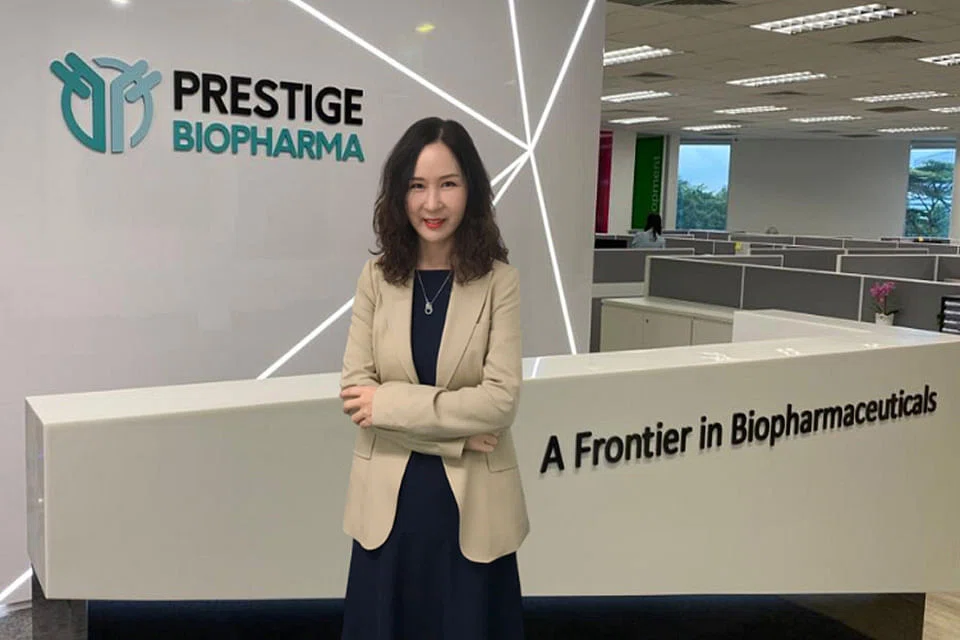
As it looks to list early this year, the biotech firm also plans to expand its headcount from the current 70 to about 300 staff, possibly in the next five years, its chief executive Lisa Park told BT.
Founded in 2015 by Ms Park and co-founder Michael Kim, Prestige Biopharma specialises in the development of new antibody therapeutics and biosimilars, which are copies of biologic drugs - or drugs derived from living organisms - with expired or expiring patents.
Ms Park reckons that the timing is now optimal to pursue an IPO. Investor appetite for a biotech play on the KRX appears buoyant, she said. And after five years of building up a pipeline of drug development projects, Prestige itself is ready to accelerate its growth.
"Biosimilar and antibody drug development programmes require a lot of funding to carry out efficiently... I think we're ready to have a more scaled approach in developing a lot of programmes in a systematic manner. For this, we need sizable funding and also need to grow our operations. We need to invite a lot more talent," Ms Park said. She is eyeing more hires in research and clinical development.
"So I think that it's the right time that we IPO and execute all our grand plans to become a top global player in biopharmaceuticals."
Prestige's current lead pipeline projects are biosimilars for two cancer drugs, Herceptin and Avastin. The Herceptin biosimilar is for the treatment of breast and gastric cancer, while the Avastin biosimilar is for treating cancers with solid tumours, such as lung and colorectal cancer.
The Herceptin biosimilar has completed its Phase I trial, as well as a global Phase III trial in Europe and Asia. Prestige filed for approval from the European Medicines Agency (EMA) in April 2019, and anticipates approval in mid-2021. It also has plans to file for approval in the US and South Korea thereafter.
Meanwhile, the Avastin biosimilar is currently undergoing a Phase III global clinical trial in 21 European and Asian countries. This is expected to be completed in mid-2021.
Other projects that Prestige is working on include a biosimilar for the arthritis drug Humira, as well as an innovative antibody drug to treat pancreatic cancer.
According to data platform VentureCap Insights, Prestige's Singapore-registered entity had raised US$71.5 million in Series B funding in October 2019, valuing the firm at US$826.9 million.
The investors were Singapore family office Octava, Korea's KB Financial Group, and the entities Vulcan Venture Investment and CQ Capital. Octava had also invested US$48.3 million in the firm's earlier rounds, VentureCap data shows.
Pang Sze Khai, Octava's chairman, told BT in a statement that as one of the early investors, "we have engaged closely with the leadership team and witnessed their grit and dedication in growing the company".
"In Lisa and her team, we believe Prestige possesses a strong leadership team that will stand the company in good stead," he added.
With her previous experience as a biotech researcher, Ms Park said that drug development has always been her "dream and goal". While putting out new drugs is part of this vision, she reckons that focusing on biosimilars can help build a solid foundation for Prestige. Unlike new drugs, developing biosimilars generally does not require Phase II trials, she noted.
"It has comparatively lower risk than new antibody drug development. When I was thinking of starting my business, I felt that biosimilars could have more stability in terms of business growth potential than doing innovative drugs alone," said Ms Park.
Beyond the stability factor, there is also a pressing market gap for biosimilars. "A lot more patients can benefit from (biologic) drugs but are not able to, because (they) are very expensive. So as a drug developer, it's very meaningful that we provide a lot of alternative options; the same quality but a lot more affordable," she said.
To be sure, the biosimilar market is still tough. Biosimilars are more complex and expensive to develop than generic drugs, which are copies of synthetic drugs. According to a
Pfizer article, the process of developing a biosimilar may take five to nine years and cost more than US$100 million, excluding regulatory fees.
But Ms Park is up for the challenge. As she puts it: "Drug discovery is always a battle with time. I think I am obligated to work very hard and efficiently to provide drugs to the patients in need."