Private markets data providers tap rising demand in S-E Asia
More funding going to such firms providing insights to traditionally opaque space as demand for data grows in the region


Singapore
THE business of providing data on privately held companies and their capital raising activities is looking more promising than ever as investors continue flocking to South-east Asia in search of the next tech unicorn.
As a common standard, these data providers track startup funding and venture capital (VC) fund-raising. As the region's ecosystem matured, the incumbents also turned to creating benchmarks and deep analyses of sectors. New players also entered the fray, touting more accurate data and new ways of mapping information.
Unlike the public markets, companies and investors operating in the private space are rarely required to disclose their dealings. Information on private companies is kept close to the chest and often seen as a competitive advantage.
Even if disclosures are made, the lag between the event and the disclosure can stretch to months. This makes the data less useful as a tool for decision making.
Unlike Silicon Valley, where legal documentation for startups is dominated by a handful of specialised law firms, there is no single repository of information that is truly representative in this region, said Doris Yee, director of the Singapore Private Equity and Venture Capital Association.
"Private equity (PE) and VC deals may also be invested through complex legal structures, which makes validation difficult," she said. "VC deals are often syndicated and co-investments are common with other VCs, PEs, corporates or sovereign wealth funds. So it is a challenge to attribute investments on a more granular level."
Such challenges present an opportunity for data providers, who tap sources such as company announcements, documents, the internet and direct outreach to aggregate information on both PE and VC.
Their services don't come cheap. Incumbents Preqin and PitchBook keep prices off their websites, but sources said the former charges US$7,000 to US$9,000 annually, while the latter can charge well over US$15,000 per year. Competitor CB Insights' subscription starts at US$59,690 per year and includes tools for team collaboration.
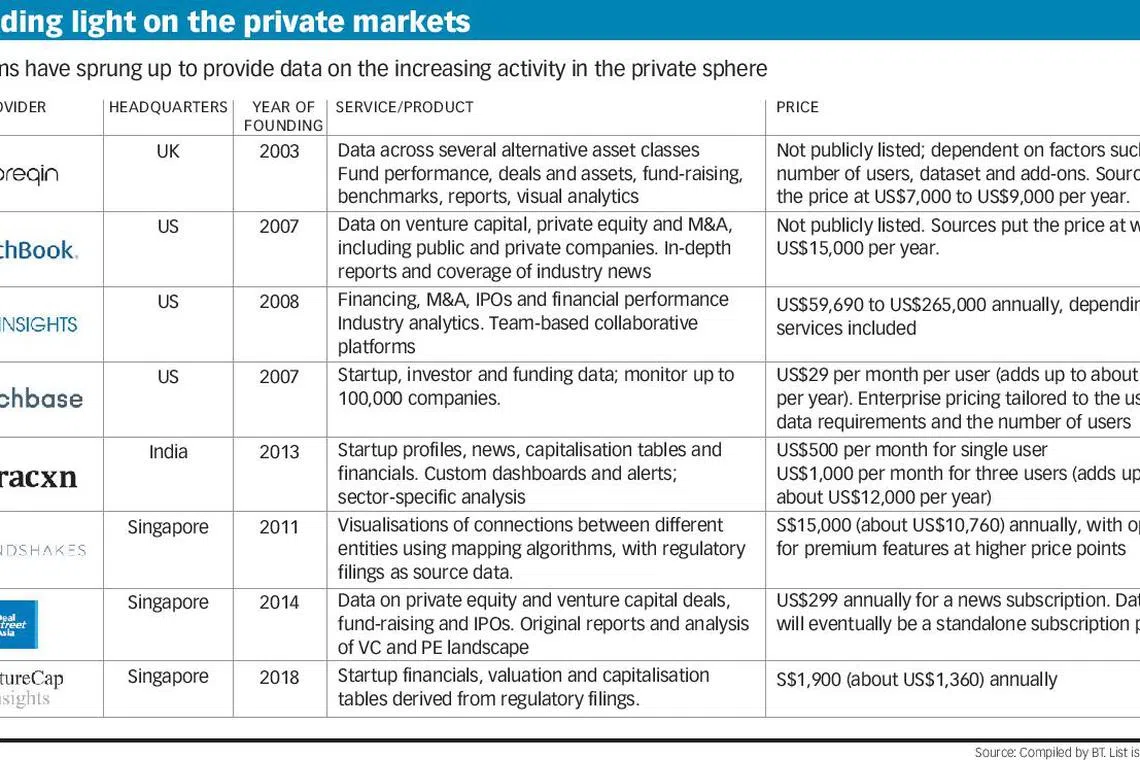
While much progress has been made on information transparency, finding reliable and complete data is often an uphill and tedious task.
London-headquartered Preqin, for instance, has performance data for only 13 per cent of VC funds in South-east Asia despite extensive outreach. "I have seen improvements in my decade covering the space, but there's more work to be done in terms of encouraging greater transparency and openness to data disclosure in Asia," said Kam Ee Fai, head of research and data operations, based in Singapore.
Preqin launched an Asean benchmark in 2019, which Mr Kam said helped convince fund managers that contributing performance data is beneficial to themselves and would-be investors in the long term. And as more foreign limited partners such as pension funds eye the region, there is the heightened sense that transparency by VC firms is the way to go.
More than five years ago, the main demand was for data on venture markets in the US and Europe, said Adley Bowden, vice-president of market analysis at US-based PitchBook.
"But over the last five years as the venture ecosystems grew in China and South-east Asia, we have seen significant demand arise for data on these regions - not just from within the region, but globally as well," said Mr Bowden.
As the demand for structured data grew, so did the investments into companies seeking to bridge the information gap. New York-based CB Insights raised US$10 million in Series A funding in 2015. Its goal, according to its website, is to "use machine learning, algorithms and data visualisation to help corporations replace the three Gs (Google searches, gut instinct and guys with MBAs)".
Crunchbase, a database that was spun out from US-based tech publication TechCrunch in 2015, raised US$30 million last year to bring its total funding to US$56.5 million.
Each player has tried to differentiate itself in various ways. India-based Tracxn, started in 2015 by ex-investors from Sequoia and Accel, believed that in-depth understanding of a company's competitive landscape is an invaluable asset to VC firms.
"So, we built sector specialist teams that organise millions of companies under detailed taxonomy trees having more than 50,000 unique nodes. This allows us to accurately map exact competitors for more than a million companies," said co-founder Abhishek Goyal.
Others, such as healthtech intelligence and innovation platform Galen Growth, have chosen to focus on specific industries.
Still, the gap remains wide for clean, up-to-date data on the South-east Asian startups space. It was frustration with existing platforms that led Singapore-based venture capitalist Jason Edwards to build his own database by pulling filings straight from company registries.
His platform, VentureCap Insights, aggregates startup valuation, revenue and funding (broken down by investor and funding stage) derived from documents such as annual returns and changes in shareholding.
Since its launch in January, the service has clinched users such as Sequoia Capital, KKR, GIC and EY. Maintaining such a platform can be very costly, though - one corporate filing in Singapore typically costs S$26, and data is pushed to the platform every day. Mr Edwards said he eventually wants VentureCap Insights to facilitate dealmaking by connecting investors and startups.
Trade news publication DealStreetAsia also plans to tap corporate filings and analysis on a larger scale as it ramps up its research and database product. The group's edge as an intelligence platform comes from its deep industry relationships forged over the past five years, said founder and editor-in-chief Joji Thomas Philip.
As information about capitalisation tables and company performance becomes more transparent, they could eventually form the basis of a platform to trade private company shares. With private market funding surpassing funding from initial public offerings, it's easy to see the appeal of a private stock exchange.
Silicon Valley startup Carta, for instance, started off eight years ago by helping venture-backed companies to manage their capitalisation tables and digitise paper stock certificates. After developing more services around data and analytics, it now plans to launch a private share trading platform in the US.
"I think people who understand how to unlock the liquidity part of the puzzle are the people who are going to win in the longer run," said Vishal Harnal, general partner at VC firm 500 Startups.
Other companies have seen how the uses of private market data can extend beyond investments. Singapore-based Handshakes is a licensed reseller of data from the Accounting and Corporate Regulatory Authority, positioning the company as an upstream provider for VC databases.
But its main offering comes from its mapping algorithms, which churn out visualisations of how multiple entities are directly and indirectly connected - a powerful tool for regulators, auditors and financial institutions.
Some banks have also recently approached Handshakes to identify the more vulnerable business sectors affected by Covid-19. Using criteria such as cash position and liquidity ratios, they can then decide where best to allocate their help, said Handshakes co-founder Daryl Neo.
Meanwhile, young startup Darwiin is on a mission to help companies and vendors find each other more efficiently. The company's platform, The Grid, provides data on business track record, financials and shareholders, and assigns scores for corporate spending and market presence.
"Services are found either through word of mouth or Google," said founder Ng Guan Jia, the former head of South-east Asia at Japan-based data service provider Uzabase.
"That's a gap, and a lot of private company data can be used to shed light on all these vendors and get the companies more informed."