R&D in nutrition, sustainability to drive disruption in food industry
More global brands in food, nutrition and consumer care are setting up shop in Singapore, and this could translate to more jobs in the future

Annabeth Leow
Singapore
BETTER food and beverage (F&B) could soon be served up, as companies here pick up on calls for healthier grub - and invest in innovation.
While it's still early days, research and development (R&D) is catching on with both multinational consumer groups and small and medium-sized enterprises (SMEs), observers said.
Matthew Kovac, executive director of industry body Food Industry Asia, told The Business Times: "You have the majority of the big food companies with their R&D centres, and even others within the supply chain. You've got that big ecosystem and, of course, you've got an army of SMEs."
Now, the government is "trying to help and facilitate those more disruptive startups that can come up with new food products for the future".
Food has been disrupted by issues such as food scarcity, climate change and sustainability, and by new business and delivery models, said consultant Valerio Nannini, former managing director of Nestle Singapore.
He said consumers now want "to be fed with authentic stuff - you know where it's coming from, it's sustainable, it's natural, it's nutritious".
Anand Sundaresan, regional vice-president of Dutch multinational DSM's human nutrition and health division here, added that various specific trends are driving demand for the company's products, which include vitamins, lipids and enzymes.
Lower sugar, "enhanced taste experience" and generally improved health and wellness were among the five key market trends that he named.
Danone's Nutricia Research arm - which develops products for pregnant and breastfeeding people, young children and patients - set up a research hub here in 2011, and followed up with a Precision Nutrition D-Lab in Biopolis last year, to glean data for better product formulas.
The Paris-based F&B giant, which has worked with Singaporean stakeholders such as hospitals on experimental and clinical studies, opened the new lab with digital tools for projects such as measuring baby faeces with an app to find out more about their nutritional needs.
Lab director Reshmi Rajendran said that the Singapore facility "is empowered to be creative and agile in developing tailored nutrition solutions".
Meanwhile, DSM opened its Asia-Pacific Innovation Application Centre here in 2015, which supports the development of F&B and supplement products that are tailored to regional needs, according to Mr Sundaresan.
Some of the consumer products that the Singapore facility has helped to make are natural "modulators" fixing how low-fat or low-sugar food tastes and next-generation lactase enzymes to make dairy easier to digest, as well as snacks and other products with extra oat fibre for heart health.
"With an increasing elderly demographic in Singapore, DSM works on solutions around dietary supplementation and easy-to-use personalised nutrition," Mr Sundaresan added.
Mr Nannini, who wants to bring his Bologna-based incubator Future Food Institute to Singapore, told BT: "The element related to personalisation is also something that's increasing. We are moving from a mass-market approach to a more phenotype-based approach, which means that not everything is okay for everybody."
But it's not just multinationals that are ploughing funds into improving how Singaporeans eat and drink.
Mr Kovac suggested giving SMEs "more support in showing where the trends are going" in markets worldwide. Indeed, some SMEs are jumping at the chance to move with the times.
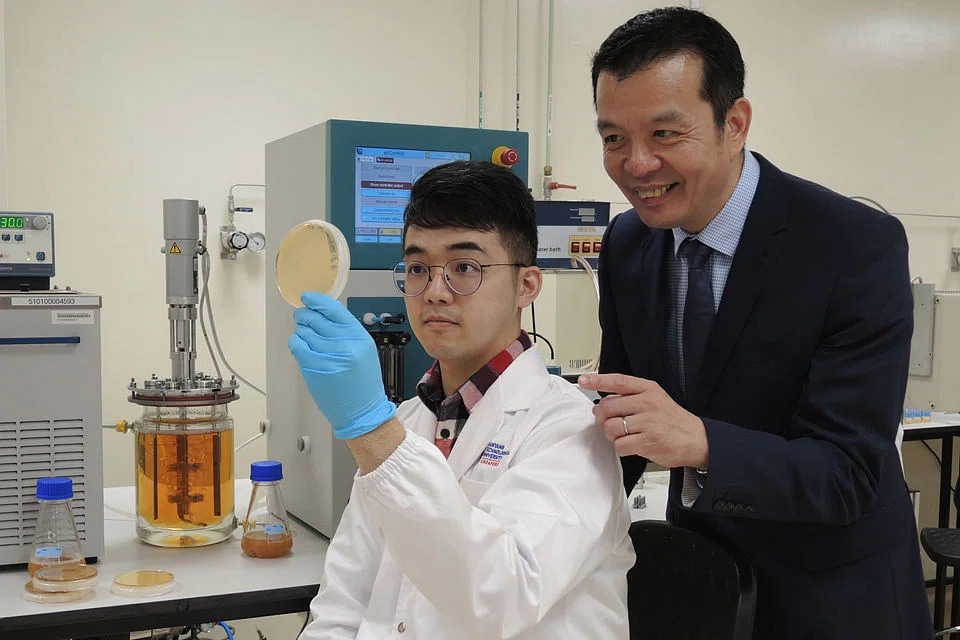
The Nanyang Technological University (NTU) food science and technology programme may have snagged a lab partnership from drinks maker Fraser and Neave (F&N) in January to develop new ingredients and greener packaging, but programme director William Chen told BT that he has had more R&D project tie-ups than the "five to 10" with F&N.
The projects under way are geared towards business-to-business outcomes, such as developing natural food preservatives, durian seed gum as a food stabiliser, and fermentation for micro-nutrients, Prof Chen added.
He noted that SMEs have also sought R&D partnerships from his research team - for instance, homegrown ice vendor Uni-Tat Ice and Marketing wants to put probiotic microbes into the cold stuff so any chilled drink can be good for the guts.
Uni-Tat general manager Andy Goh told BT that the family business has invested about S$100,000 into probiotic ice development since 2017 "and we are seeing good progress in our research collaboration".
The probiotic ice is expected to be launched by end-2020, he added.
Previous innovations had focused on ice cubes of different shapes, sizes and quality, but Mr Goh noted that "most of our customers are F&B outlets, supermarkets and convenience stores", so the probiotic product would open up a new business-to-consumer frontier, especially with the ice market "pretty competitive, especially for traditional products like block ice and food-grade tube ice".
Meanwhile, commercial spin-offs from the food science and technology programme at the National University of Singapore include startup Probicient, which has been trying to brew up probiotic beer for several years.
The team is now refining the taste of its two wheat beers, and aims to explore variants such as dark beers, said Lum Yi Chyi, who is overseeing Probicient's commercialisation.
"We are collaborating with an international brewery to commercialise the version targeted at the mass bottled beer market," she added. "At the same time, we are also working closely with a local micro-brewery to commercialise another version targeted for the craft beer market."
All this is on top of newfangled creations like the plant-based "seafood" out of US startup Sophie's Kitchen, which plans to open a lab here to develop novel algae-based proteins.
"Our strategic priority in Singapore, for now, is R&D," Sophie's Kitchen founder Eugene Wang told BT, noting that he is chasing research tie-ups with both the private sector and academia. He believes that focusing on algae "will help us gain a different edge in the global market".
"We can not compete head to head with large multinationals on the conventional plant-based proteins like soy or pea," Mr Wang added.
Singapore launched an industry transformation plan for food manufacturing in 2016, with the goal of making the Republic "the leading food and nutrition hub in Asia".
More recently, the National Research Foundation rolled out in March a fresh budget of up to S$144 million for agri-food, including fields such as "future foods" and food safety.
Mr Nannini, calling the budget allocation "a big injection of money", said that "this is a call to action to get more people thinking about the sector".
Still, he acknowledged: "The margins are not high either, and that's an issue sometimes, because in IT... if you make it, you can make a lot of money. In food, not necessarily."
Beh Kian Teik, assistant managing director at the Economic Development Board, noted that global brands in food, nutrition and consumer care have been setting up shop in Singapore.
"We are also seeing strong momentum in the food ingredients and flavours and fragrances space," he added, citing ADM, Roquette, Tate & Lyle and Tereos as examples.
Mr Beh added that, with a range of innovation activity "from in-house research and innovation teams to collaborations with local partners and public research organisations", his agency expected jobs, training and capabilities to spill over into the local industry.