Singapore unicorn helps clients access IP data with snap of finger
Jeffrey Tiong's PatSnap draws global giants like NASA, Disney, Tesla with intellectual property platform
Singapore
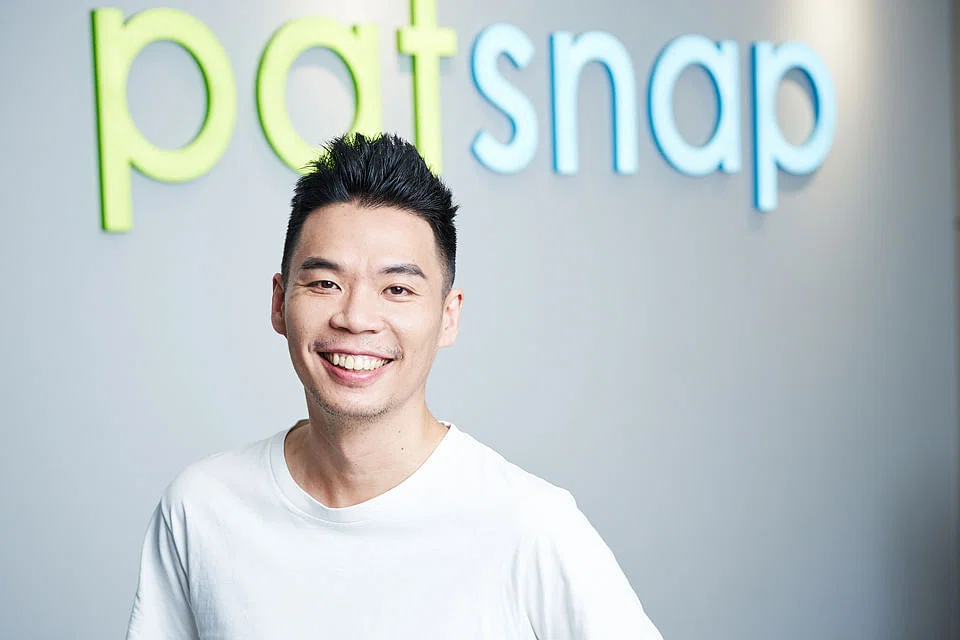
AS A child, Jeffrey Tiong used to tinker with things around the house. Once, much to the chagrin of his parents, he took apart his newly gifted desktop PC, the IBM 486 - only to build it up again.
This sense of curiosity led him to want to be an astronaut, or a scientist. So Mr Tiong never thought about becoming an entrepreneur then, much less the chief executive of one of Singapore's rising tech companies.
But watch his space. For NASA (US National Aeronautics and Space Administration) and a dozen other research institutions now come to him for help.
It could be the spirit of building things that spurred him to start his own company straight out of university. In 2007, he founded PatSnap, a data analytics company for intellectual property (IP) that aims to be the "Google Map of patents".
Mr Tiong had the idea for PatSnap while he was on a year-long NUS Overseas Colleges internship in the US. He told The Business Times in a video interview that he found IP could be commoditised, just like "buying or selling a car or a house".
Companies can buy patents to build on existing inventions, or file patents so that competitors have to pay if they use the same technology. A smartphone alone might be open to a quarter of a million patent claims.
But patent filings, wrought with technical jargon and legalese, are difficult to understand. There also wasn't immediate visibility on all the different patents filed across the world. "I thought, this data - if collated and simplified - could help people innovate better."
After returning home and completing his bachelors in bioengineering at the National University of Singapore, he founded PatSnap with incubation support from NUS Enterprise and a S$55,000 government grant.
Back then, it was difficult to find investors that believed in PatSnap. He often recounts how he had to make a decision to relocate the company to China to save costs and touch base with potential clients. Once, the team resorted to switching the heater off to cut their electricity bills.
PatSnap went on to buy patent information from governments across the globe. It then built artificial intelligence and machine learning systems to analyse the hard-to-understand text. The last step: make it searchable and digestible.
Fourteen years on, the startup has joined the unicorn club, after raising a US$300 million Series E funding round led by big-name investors such as Softbank Vision Fund 2 and Tencent Investment. Several SPACs (special purpose acquisition companies) have approached the startup, wanting to take it public.
While an initial public offering is a key milestone that Mr Tiong hopes will materialise in a few years, he said that PatSnap still has "a long way to go".
"If we are honest with ourselves, we'll admit to never quite reaching a peak. It is constantly an uphill battle, he told BT. "No choice lah. There are fires to put out daily. Just have to find a way."
This last sentiment propelled Mr Tiong to shake off every setback in the course of PatSnap's journey.
"There are many things I wish I could have done differently or that I didn't make a mistake that made me feel like I had to bang my head on the wall."
Mr Tiong admitted that the majority of his mistakes stem from not finding the right fit.
Two years ago, he went on a global hiring spree, convincing senior executives from large organisations and multinational corporations to join the company.
But 90 per cent of these hires didn't fit in, he said. "When the senior leadership team didn't work out, it really impacted the whole organisation's morale and culture.
"In a startup like ours, everyone will need to roll up their sleeves, jump in, and solve problems daily. I learnt that I needed to hire leaders not just with experience in a big organisation, but also with some entrepreneurship experience as well."
He took these missteps in his stride: "If you want to do something new, you will be bound to make some mistakes. Hopefully these will not be too big or irreversible, so you can learn from it and press on. It helped immensely that I could turn to some of my investors or seniors for advice too."
PatSnap currently has close to 900 employees across offices in the US, Singapore, Germany and China. Half of them are research engineers and data scientists, while the other half are spread across functions such as sales and marketing.
Staff costs make up the bulk of the company's operating expense, its filings show. For the financial year ended Dec 31, 2019, the company made a loss of US$24.2 million, on the back of US$64.2 million in revenue. Employee benefit expenses added up to US$67.8 million.
While the startup has over 10,000 clients in more than 40 countries, the most heavy users on its platform are large global organisations conducting research and development, institutes of higher learning and research institutes, said Mr Tiong. PatSnap earns by charging a subscription fee that is typically US$20,000 to US$30,000 a year. This varies based on the number of modules users subscribe to, and could go up to US$1 million. Disney, Hershey's, Dyson, NASA, Heineken and Tesla are among its clients.
With PatSnap, they can potentially have some sort of insider insight to whatever a company (or competitor) is doing, its product roadmap or even its strategy forward. Apple, for instance, has been filing patents for its electrical vehicles systems, software operations and vehicle structures since 2017.
Innovators want to know if something similar has already been done, added Mr Tiong. "They need to understand the landscape so they can focus their efforts and finetune their strategy."
While the company is focused on markets that have billion-dollar R&D industries - such as the US, China, UK and Singapore - it is looking at new verticals and geographies to grow its topline by 50 to 60 per cent year on year.
Mr Tiong said PatSnap will zoom in on specific verticals such as pharmaceuticals, life sciences and the automotive industry, and expand in markets such as Germany and Japan. The startup is also rolling out a new feature focused on the financial community.
Banks and financial institutes can use this new feature to identify and assess a tech company's credit risk, he said.
PatSnap's algorithms will score each startup (out of 100), based on technology indicators such as the number of patents filed, and the strength of its patents - which translates into how good it is in protecting their tech, among others. Potential users also include hedge funds, quant funds and government agencies.
In a startup economy of so-called "tech geniuses", Mr Tiong wants to be known in simpler terms. "I hope I can inspire more to take up entrepreneurship," he said. "If someone like me, who came from a local university and is just a normal dude can do it, maybe the younger generation will know they can too."
- Garage is BT's startup vertical. Read more news, analyses and opinions at bt.sg/garage
PatSnap at a glance
- Founding team: CEO Jeffrey Tiong, senior vice-president of Asia-Pacific Guan Dian, chief technology officer Markus Haense, and vice-president of new ventures Ray Chohan
- Business: Patent analytics
- HQ: Singapore
- Backers: NUS Enterprise, Accel-X, Vertex Ventures, SoftBank Vision Fund 2, Tencent Investments, CPE Industrial Fund, Sequoia Capital China, Shun Wei Capital and others