

Spacetech firm Aliena secures S$1.5m, inks partnership with Northern Territory government

Claudia Chong
Singapore
WHEN a small satellite is launched into space, its journey does not end there. Air resistance in the Earth's atmosphere can cause it to go off course, and the satellite has to be constantly steered back into its intended orbit. And if the satellite looks like it might collide with another spacecraft, it has to be manoeuvred to safety.
Singapore-based startup Aliena builds propulsion systems that allow satellites to perform those advanced manoeuvres. The company has received a vote of confidence from Cap Vista, the strategic investment arm of Singapore's Defence Science and Technology Agency, which led Aliena's S$1.5 million pre-seed funding round. (see amendment note)
Other investors include American venture capital firm 500 Startups and Paspalis Innovation Investment Fund (PIIF), the venture fund of Australian family office Paspalis Group. PIIF pumped in S$500,000.
Cap Vista invests in early-stage deeptech startups to nurture talent and grow the companies to meet potential defence and security needs. Its portfolio companies include Atomionics, which develops sensing systems for navigation and positioning, and cybersecurity firm Insider Security.
Cap Vista chief executive Chng Zhen Hao told The Business Times (BT): "Aliena's electric propulsion technology is novel and the talented team possesses the requisite expertise to propel the company to the next frontier of space."
The investment comes as more countries around the world, such as the US and France, incorporate elements of space into their defence strategies.
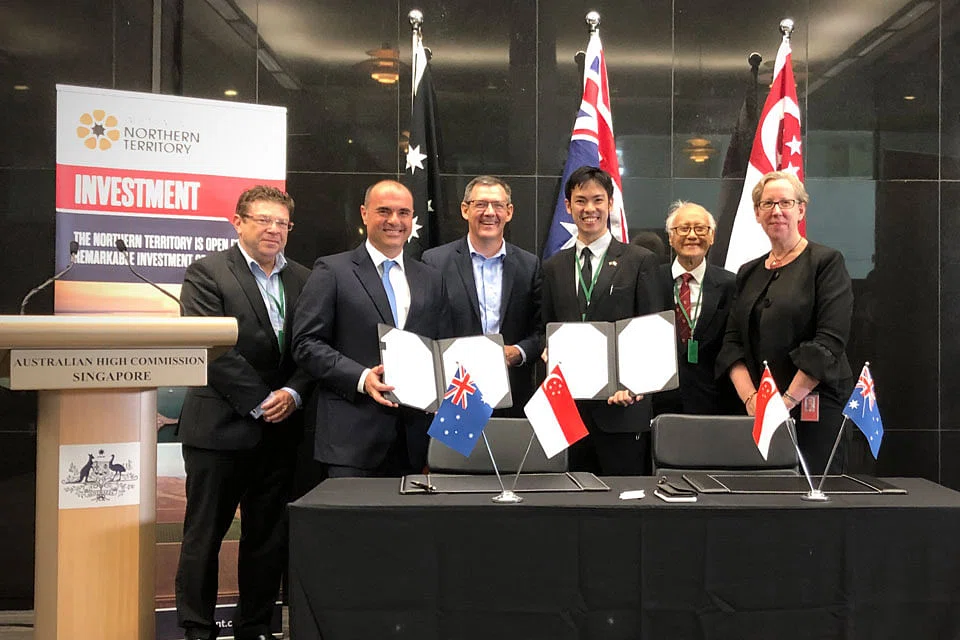
Last week, Aliena inked a memorandum of understanding with the Darwin Innovation Hub in an event attended by Australia's Northern Territory chief minister Michael Gunner. The agreement paves the way for the parties to build a collaborative platform for firms in the region to access turnkey solutions for space projects, such as satellite engineering services and launch operations. The Darwin Innovation Hub, a regional incubator, is a partnership between Paspalis, Charles Darwin University and the Northern Territory government.
Aliena's chief executive Mark Lim told BT that by helping to build the spacetech ecosystem, the startup can ensure that there is a stable pipeline of customers for their technology.
More companies and public institutions have been sending satellites into space for a multitude of use cases, including research, telecommunications and satellite imaging. More than 8,500 small satellites are projected to be launched globally between 2019 and 2028, for a total market value of US$42 billion, according to French space consultancy Euroconsult.
Aliena, a spin-off from Nanyang Technological University, is gearing up for its first tech demonstration in space next year with partners from local satellite firm NuSpace. "A successful tech demo will allow for a serious fundraise that will immediately enable an opportunity to rapidly deploy the full constellation (of 35 satellites for NuSpace)," said Mr Lim.
Aliena will also be providing five units of its propulsion system to a foreign customer for a tech demonstration in space. If successful, it will fulfil an order of 400 units for a satellite constellation.
Unlike conventional chemical-based propulsion systems that are fuel-inefficient, Aliena's system is able to continuously fire its thrusters for four months - five times longer - just on 100g of fuel. This means more manoeuvres can be performed before fuel runs out.
The company develops Hall-effect thrusters, based on electric propulsion that uses highly-charged particles. Current Hall thrusters in the market require more than 100 watts of energy, but Aliena's are able to function at just five watts, said Mr Lim. Futhermore, its propulsion system can be fired on demand, unlike conventional Hall thrusters that take seconds to minutes to warm up.
The huge cherry on top is the price. "Commercial thrusters from the top five companies cost anywhere from US$1.5 million to US$2.2 million. And this is because of space legacy - their systems have been qualified in space for a couple of years. Our systems are intended to be marketed at around US$125,000 to US$150,000," said Mr Lim.
The fresh capital from Aliena's investors will be used in part to commission an integrated space simulation environment and electric jet propulsion test facility, based in the firm's upcoming test centre at an aerospace park in Changi.
With extensive lab testing racking up costs, Mr Lim believes that developing core intellectual property will help ease the strain on the firm's bottom line. For instance, a key component is a propellant management system, which costs tens of thousands of dollars per unit. If Aliena can make it in-house, the product will cost an estimated four times less, excluding research and development expenses.
While Aliena's technology enables fanciful manoeuvres for new operations, Mr Lim's personal goal is to see operators use the propulsion system to de-orbit their satellites and reduce the accumulation of space debris. This is done by allowing satellites to burn up in the atmosphere after their operational life-cycle.
Space junk is a threat to active satellites and spacecraft. About 22,300 debris objects have been catalogued by space surveillance networks as at January 2019, according to the European Space Agency.
"We want to ensure that space remains accessible and available for our generation, the next generation, and the generations to follow," Mr Lim said.
Amendment note: A previous version of this article stated the amount raised in US dollars. It is in fact S$1.5 million. The article has been amended to reflect this.
TRENDING NOW

Britain’s mansion tax shows the difficulty of targeting wealth

Once staunchly pro-China, Malaysian Chinese businesses are now distancing themselves from Beijing

The only common thing in S-E Asia is that we all eat rice: Cisco’s Asean president
Singapore data centre operator DayOne opts for US IPO at likely US$20 billion valuation

