

Startup IPO jitters spill over into South-east Asia
With large venture-backed US IPOs struggling, region could see delay in such listings


Singapore
A REALITY check on mega flotations in the world's biggest stock market is sending ripples through the region's initial public offering (IPO) market for venture-backed startups.
Following the recent flops of startup IPOs in the US, market sentiment in South-east Asia has also turned more cautious, say analysts.
PropertyGuru appears to be a victim of the weakened sentiment in the region. On Wednesday, the property portal axed its bid to list on the Australian Securities Exchange, citing "uncertainty in the current IPO market". The KKR-backed firm was to have raised some A$362.6 million (S$338.1 million) had it achieved the mid-point of its pricing range.
Jake Robson, a partner at law firm Morrison and Foerster, said: "If you're looking at a five-year horizon, are most of the South-east Asian unicorns going to be listed by then? I imagine so. But the next six months? No, I don't think so, because the market conditions just aren't right."
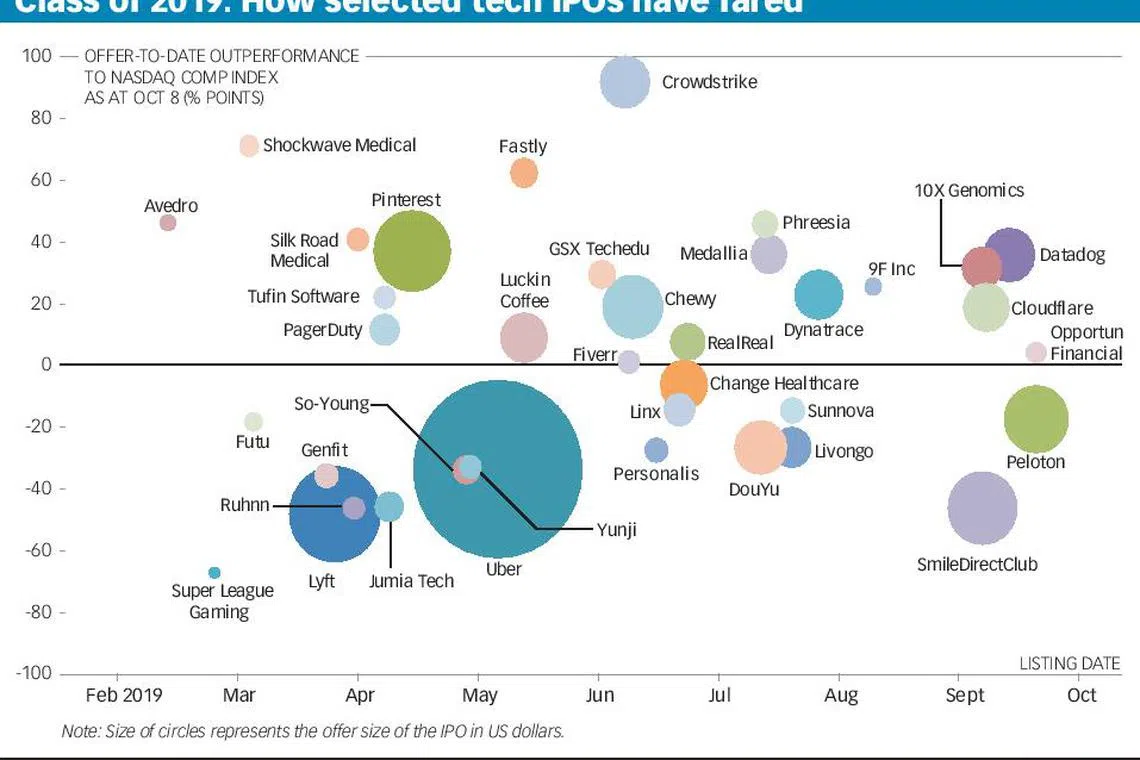
In the US, large venture-backed IPOs appear to be struggling. Out of six IPOs that raised over US$1 billion, four are trading below their offer price and have also underperformed the benchmark index as of Oct 8 (see chart). They are Uber, Lyft, teledentistry firm SmileDirectClub and fitness service Peloton.
There have been some outsized winners, like Beyond Meat, which has more than quadrupled from its offer price. But volatility abounds. For instance, CrowdStrike's share price was nearly triple its offer price in August, but has since more than halved.
Overall, there have been at least 44 listings of venture-backed tech companies in the US this year. Thirty of these are US firms, while the remainder are mainly Chinese players, such as gaming platform DouYu. A handful are from other regions, such as Linx from Brazil and Israel's Tufin Software.
Over three-quarters of these 44 firms ended their first trading day above the offer price. But as of Oct 8, the proportion of companies trading above the offer price dipped to 61 per cent.
WeWork's high-profile pullout was another major dampener. Said Mr Robson: "The market sentiment doesn't necessarily equate with the private valuations of these companies... And whilst there is a big gap, you're going to have IPOs that are going to be put off."
The poor showing post-listing reflects investors' fears about the fundamentals, said Chua Joo Hock, managing partner at local venture firm Vertex Ventures.
And South-east Asia's startups are taking heed, he added.
"All the startups (here) that are at least of unicorn status are concerned about... the debacle of the recent IPOs in the US - that you cannot continue to widen your losses and you need to show, really, a path to profitability," he said.
Such scepticism is not lost on startups here, said associate professor Mak Yuen Teen from the National University of Singapore (NUS) Business School. Beyond financials, poor corporate governance could also dampen IPO valuations.
"Maybe we will see investors demanding that just because you're a tech company, doesn't mean you're that special; your governance has to be up to scratch... There's also the classic issue of whether the entrepreneur will be a lousy CEO - this is another issue that people will start asking about," he said.
In the longer term, things could still pick up. While South-east Asia may be some years away from seeing a sizeable batch of startups heading for IPOs, "hopefully, we can see some significant IPOs coming out from South-east Asia within the next three or five years," Mr Chua of Vertex said.
This could be driven by a slowdown in private capital inflows amid softening macroeconomic conditions. Startups also have an incentive to simplify their shareholding structure via an IPO sooner than later, said Mr Robson of Morrison and Foerster.
"If they carry on doing these fundraising rounds, raising half a billion or a billion dollars at a time, each time with a new series of shares and rights attached to those shares which trump the previous rounds, it gets incredibly difficult to manage," he said.
For startups, a public listing is not the only option.
Faced with persistent cautious sentiment, South-east Asia's unicorns could also opt for partial trade sales or spin-off listings of just one business arm in the near term, Mr Robson said.
Lawrence Loh, associate professor at NUS Business School, added: "I think the South-east Asia market is more conservative, and startups here may adopt more of a watch-and-see policy before heading for listings."
"Here, the big investors are far and few between... I think startups will approach IPOs with extreme care; it's a moment of truth where it's one strike and you're out."
Over time, caution in the public markets could also flow back upstream to the venture investors, said Alan Hellawell, partner at venture firm Alpha JWC. "Investors' due diligence will be cast forth more thoughtfully, or they may have to intensify their study of business models, to develop a higher confidence in the path to profitability."
Vertex's Mr Chua puts it more candidly: "We've always said that the music will stop, and the sucker is the one who is left holding (shares obtained at) the highest valuation. Of course, everyone tries not to be the sucker."
Learn more about venture investing in South-east Asia at the Private Equity Tech Conference (PETC), on Oct 30 and 31 at The Westin Singapore. The conference will bring over 250 funds and investors to explore the venture capital and private equity scene through two simultaneous panel tracks. The Business Times' startups vertical Garage is the exclusive media partner for PETC.
TRENDING NOW

ComfortDelGro appoints two new independent directors

Once staunchly pro-China, Malaysian Chinese businesses are now distancing themselves from Beijing

NoonTalk needs continued financial support from CEO Dasmond Koh, auditors warn

DP Architects sets the benchmark for sustainability disclosure and design

