Thai tycoon's Lightnet sued in Singapore over crypto tokens allegedly owed to ex-staff
Lightnet is co-founded by Chatchaval Jiaravanon, whose family controls the Charoen Pokphand Group


FORMER employees of fintech startup Lightnet have dragged the company to court after Lightnet allegedly failed to issue cryptocurrency tokens promised to them in their employment contracts and consultancy agreements.
The two former executives, Ilya Zusman and Crystal Ma, are claiming an aggregate amount of US$1.37 million and a declaration that the company will release the remaining tranches of tokens still owed to them.
Lightnet is among a growing number of companies globally, including Binance, that have incorporated cryptocurrencies into staff compensation and benefit packages. The shift comes amid a proliferation of blockchain tech startups.
Zusman was director of digital finance and strategy at Lightnet. Court documents did not state Ma's role in Lightnet, but her LinkedIn profile lists her as a business director of the group.
Lightnet was founded by Tridbodi Arunanondchai, an ex-banker and entrepreneur, and Chatchaval Jiaravanon, whose family controls Charoen Pokphand (CP) Group - one of the largest conglomerates in the world. Its goal is to build an international cross-border money transfer network, according to past press statements.
Lightnet Pte Ltd, which Zusman and Ma have brought a lawsuit against, is part of the Lightnet network of companies in the remittance business, according to past legal filings. It was incorporated in Singapore to raise financing from investors.
The group's core operations and headquarters are in Thailand, BT understands from sources.
Lightnet raised US$31.2 million in a Series A round in January 2020, from backers that included UOB Venture Management and Hanwha Investment and Securities.
Financial losses
Zusman and Ma had entered into employment contracts and consultancy agreements with Lightnet between end-May to end-July 2020, according to court documents obtained by The Business Times in December.
Under a token incentive plan outlined in the contracts, Zusman and Ma were entitled to receive VELO tokens in four equal tranches once their probation ended. VELO is a utility token ostensibly used in a digital ecosystem of money transfers.
Zusman was to receive an equivalent of US$200,000 in tokens, while Ma was to receive an equivalent of US$30,000. The base price of VELO tokens used in the calculation was US$0.05.
After Lightnet delayed awarding the first tranche of 1 million tokens to Zusman, he allegedly suffered a loss of US$696,450 as a result of the difference in the token's market price, according to the legal statement.
The first tranche was due on March 17, 2021. The average listed price of VELO token then was US$1.18, as indicated on price-tracking website CoinMarketCap.
Zusman only received the tokens on August 17, 2021 after making various demands, by which then the average listed price of VELO had sunk to US$0.48355.
He suffered a further loss of US$432,350 due to Lightnet's failure, refusal or neglect in issuing the second tranche of 1 million tokens due on Sep 17, legal documents stated.
In its defence filed in January, Lightnet said its management deferred and delayed the release of VELO tokens to employees because there was a lack of liquidity for the tokens in February and March 2021.
It said Zusman was compensated with US$7,567 on April 29 for the delay of his first tranche, and had waived strict compliance in relation to the release date of the tokens.
Lightnet also disagreed that Zusman had suffered the monetary losses he alleged. If the company had needed to release the first tranche of tokens to Zusman on March 17, it would likewise have released tokens to all eligible employees on the same date, Lightnet claimed.
"It would in any event not be possible (for Zusman) to have sold 1 million VELO tokens on 17 March 2021 at a price of US$1.18, given the liquidity, volume of transactions and market demand for VELO tokens."
As for subsequent tranches of tokens, they were forfeited after Zusman's employment was terminated on Sep 17, 2021, Lightnet said.
The company said its token incentive plan states that employees terminated within the lock-up period of up to two years are not entitled to VELO tokens or subsequent allocations.
Falling value
VELO was listed on cryptocurrency exchange KuCoin on Sep 17, 2020, according to an online post by a company called Velo Labs, on publishing platform Medium.
The token was launched by Velo Labs Technology, an entity incorporated in the British Virgin Islands. Lightnet co-founders Jiaravanon and Arunanondchai are listed as chairman and vice-chairman on Velo Labs' website.
The company aims to build a decentralised settlement network with an initial focus on partners in South-east Asia's remittance market, according to a whitepaper. The VELO token "represents a value link between fiat deposits and digital credits" used in money transfers.
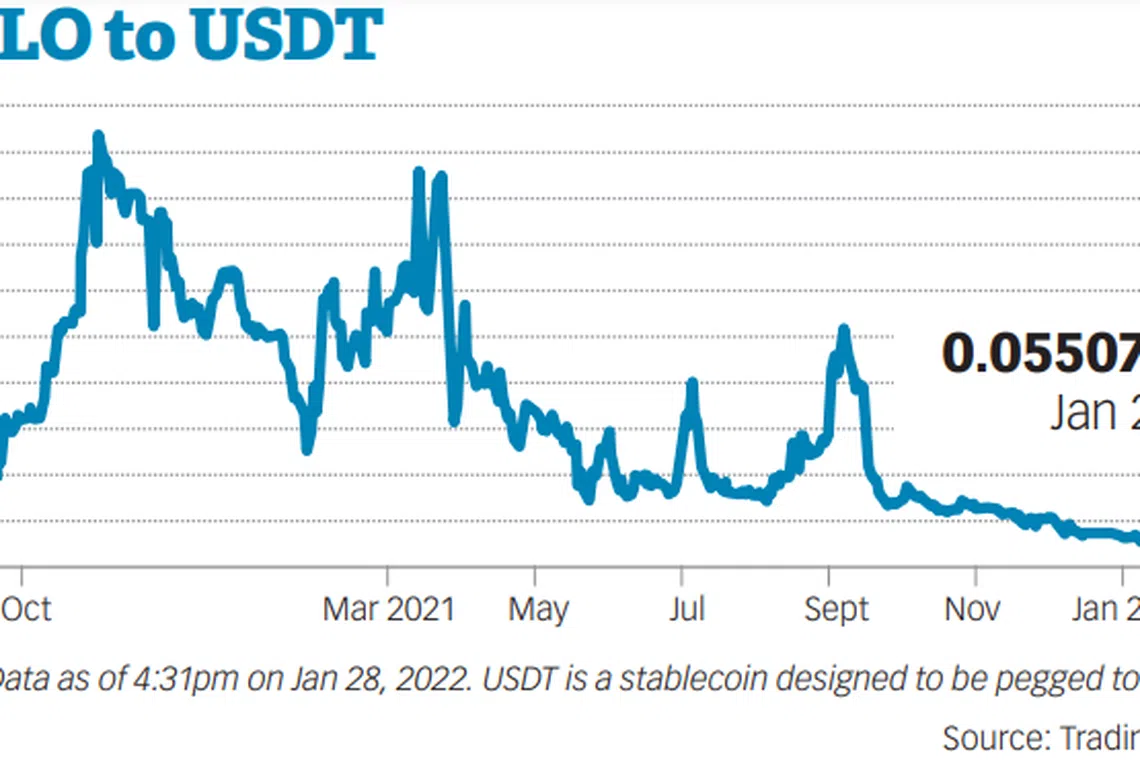
But the utility token's value has been declining since it hit a high of US$2.07 on Mar 8, 2021, according to data from CoinMarketCap.
The token's price recently sank to an all-time low of US$0.039 on Jan 22, 2022 - down 28.2 per cent from US$0.05 at its launch - and was trading at US$0.05548 as of 5pm on Friday (Jan 28).
Similarly to Zusman, Ma alleged that she had suffered a loss of US$241,852.50 after Lightnet failed, refused or neglected to issue the first and second tranches of 150,000 tokens each after her probation ended on Oct 30, 2020.
The amount was based on the US$1.18 average listed price of VELO on March 17, 2021 and the US$0.43235 average listed price on Sep 17, 2021.
Lightnet however said Ma had not completed her probation as claimed.
Before her probation period ended, Ma entered into an employment agreement with Lightnet's related company Asset Net Co around Oct 10, 2020. The probation period was then revised to run from Oct 9, 2020 to Feb 4, 2021.
Ma later resigned from Thailand-incorporated Asset Net in January 2021 and is therefore not entitled to any tokens, Lightnet said.
Oon & Bazul partner Suresh Divyanathan, who is representing Zusman and Ma, on Friday (Jan 28) said his clients deny the assertions in Lightnet's defence and will be pursuing their claims vigorously.
"In particular, we are instructed that the alleged Velo Token Incentive Plan (VTIP) is an afterthought; a hastily made up excuse to try to deny our clients' claims. Our clients would never have agreed to work for Lightnet if their award of Velo tokens could be so easily taken away by an alleged VTIP," Divyanathan said in a statement to BT.
This is not the first time Lightnet has had a tussle in Singapore courts. In November 2020, Lightnet Pte Ltd and Thailand-incorporated Lightnet (Thailand) Company Ltd were sued by Singapore-based recruitment firm Space Executive for unpaid invoices totalling over S$300,000.
Lightnet denied the allegations and countersued for misrepresentation, which arose from alleged resume fraud involving one of the candidates handled by Space Executive.
The matter was eventually settled out of court, BT understands.