

Turning talent into impact
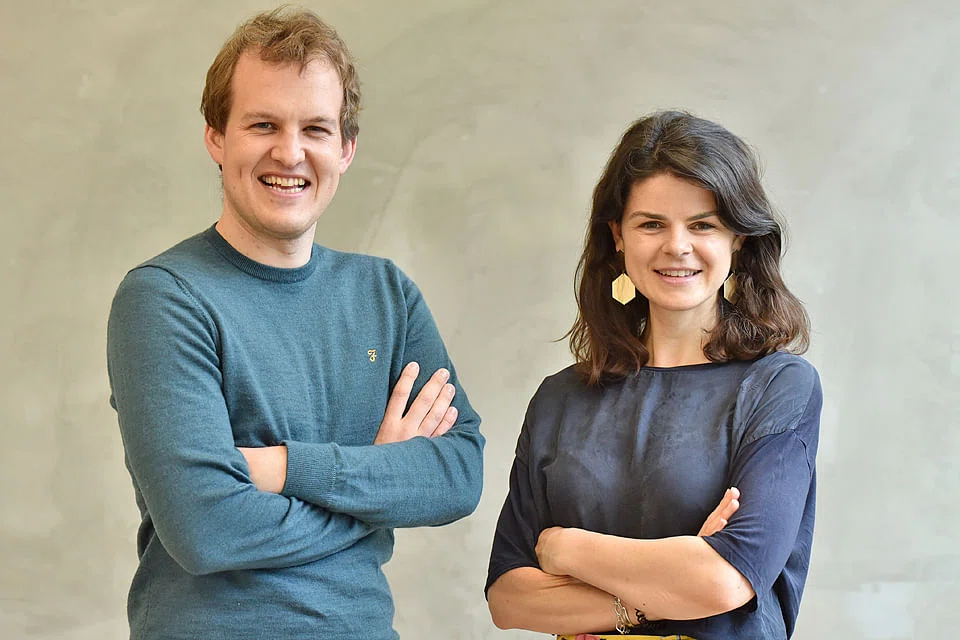
Entrepreneur First co-founders Matthew Clifford and Alice Bentinck set out to build the world's leading talent hub - home to the most ambitious people - and have so far helped more than 1,200 individuals create over 200 companies worth some US$1.5 billion.


THE business of investing in startups is complex. Sure, venture capitalists would tell you to bet on disruptive companies with high growth potential and outstanding founders.
But how does one prepare to part with his money, keeping in mind that these infant businesses are typically unprofitable and have unproven business models? How to confidently seek out a winner amid all the noise? When it comes down to it, there really isn't a Golden Rulebook to consult.
That said, there are some things that, a few years ago, most in the industry would probably have agreed on: Don't fund individuals before they have a company, for one. It's also best to stay away from teams that have only known each other for a few weeks. And don't fund people before you know what exactly they are going to work on.
So it was probably for the best that Alice Bentinck and Matthew Clifford - two people with rising importance in the venture capital scene - had zero experience in the field when they set out eight years ago to build the world's first talent incubator. Instead of waiting and hoping for the next Facebook or Alibaba to come along, London-headquartered Entrepreneur First (EF) catalyses the creation of promising startups by giving potential entrepreneurs a nudge in the right direction.
"The truth is, we were totally unqualified to start this business - totally unqualified! Whatever you're imagining? Less qualified," Mr Clifford tells The Business Times during an interview in EF's Singapore office, one of the company's six locations worldwide.
He grins as he says this, and he has reason to. Since its inception, EF has helped more than 1,200 individuals build over 200 companies, worth a total valuation of almost US$1.5 billion. Not too shabby for an organisation started by a pair of sorely unqualified 20-something year-olds.
"You know, we've never worked in tech, we've never worked in startups and never worked in investment. And in most ways, that was a huge weakness," says Mr Clifford, now 33. "But actually, one of the things that was a strength was that we didn't come into this thinking about how we can create a new kind of venture capital. We came into it because the question we were trying to answer was, 'What do the world's most ambitious people do with their lives?' What that meant was that we were willing to break every rule of venture capital, because we didn't know the rules."
To be sure, EF doesn't invest in individuals from the get-go, at least in the sense that it does not take equity. But participants of EF's full-time programme do get a reasonable monthly stipend - S$5,000 for the Singapore cohort - and access to a range of resources to develop a business idea.
EF runs cohorts of 50 to 100 people every six months in Europe and Asia. Each programme is competitive - roughly 1 in 10 applicants are offered a place. When filtering applications, EF looks for risk-takers who have treaded on alternative paths throughout their lives. Besides super-smart and skilled individuals, it keeps its eye out for contrarian thinkers who define themselves by their work and are motivated to build a company.
The first 14 weeks of the programme focus on matching co-founders and supporting the teams in developing and refining an idea. At the end, co-founders pitch to receive funding; for Singapore founders, this amounts to S$75,000 from EF for each selected team.
Then comes the critical phase: over the next six months, co-founders take part in structured training and work with advisers to accelerate their growth. This culminates in an Investor Day where teams present their companies to venture capitalists hungry for good deals. Over 300 of the world's top investors attended Investor Day in Singapore in January, EF says.
EF also commits to further backing every team that pitches at Investor Day by contributing 15 per cent of the team's seed round. To date, the organisation has invested US$65 million, with about US$100 million in the pipeline.
Latent demand
In many ways, Mr Clifford and Ms Bentinck's journey mirrors that of the entrepreneurs they help to grow. Back in 2011, Ms Bentinck was about to leave management consulting firm McKinsey - which Mr Clifford had just joined - for a job at Google. Her friends and family, and even venture capitalists, were stunned when they learnt of her plans to ditch Google to forge her own path in the startup world.
But this is nothing new for EF participants, who similarly left behind promising career prospects to seek a more fulfilling purpose. Some have ventured far from family and home to join EF's programme in a foreign land.
"They come to us because they feel constrained by the career path they're in; they don't feel their potential's being met. And they know that they can have an enormous impact on the world," says Ms Bentinck, 32.
"We had a Syrian woman join us who'd been a professor in deep learning. She had a thousand citations of her papers. And the reason she came to EF was because she was one of the most successful people in her field, but she didn't feel that had impact. She wanted to have practical, real world impact. So she came to EF and built a company that is now applying that research to drug discovery."
One reason why EF has had such a successful run is because there was so much latent demand for what it offers. The first engagement its founders did was at Cambridge's engineering department. About 70 students turned up to hear the pair talk about entrepreneurship, and by the time applications closed for the first cohort, there were some 500 people to choose from.
EF also had the financial backing of McKinsey and corporate sponsorships from firms such as Microsoft and KPMG. Mentors like Kevin Sneader, now the global managing partner of McKinsey, helped steer the direction of EF's programme.
Now that the company has seen how successfully talent and ambition can be turned into impact, it is determined to replicate its model to the rest of the world.
"You know, the reason there hasn't been a Google of Europe - and now I suspect the same may apply here - is that there's almost a social norm against being too ambitious in public," says Mr Clifford.
"Weirdly, ecosystems constrain ambition rather than raise ambition, outside of Silicon Valley," says Ms Bentinck. "And we've seen that. We're in six different countries now, across Europe and Asia. And it's amazing how consistent that is - whether it's Paris, or whether it's Hong Kong, the type of ambition you're allowed is determined by your location."
Both founders went through the same struggle when leaving McKinsey. "It almost felt in some ways that we were letting people down by taking a step off that path. And that was how it was perceived - by becoming entrepreneurs, we were stepping off this path of expected ambition," says Ms Bentinck.
The pair isn't fully convinced that their own parents really understand what they are doing. Mr Clifford muses: "They're proud of it. I think they (now) see it as something that has clearly worked."
"We were given an award by the Queen, which helped, right?" Ms Bentinck cuts in with a laugh.
The right people, the right match
So how does one find the ideal person to back? And even if you've found that person, how does one match them to someone they've just met?
There are some patterns in looking for individuals who are outliers with a personal competitive edge, and EF does have an in-house tech team analysing data collected over the last eight years. Some commonalities among participants include being technically skilled, contrarian and very smart.
But when it comes down to it, one of the most interesting things is that one can never be too dependent on the patterns. One key way EF finds people who do not fit a certain path is through referrals. Over 20 per cent of EF founders joined the programme through that route, says Mr Clifford.
"What's great about that is that very often they can identify something (special) about someone they know, because they know them. It would have been very hard to pick that up from a LinkedIn profile or a Google search."
To help participants find their co-founders, EF uses matching techniques ranging from presentations, speed-introductions, casual socialising as well as training, feedback and check-ins from the EF team. But the most powerful technique was uncovered when Ms Bentinck and Mr Clifford were hit with their biggest setback in all their years of running EF.
"There was a moment in our second cohort where we had a bit of an existential crisis," reveals Ms Bentinck. As with the first cohort, teams were built from scratch. But one day, they all broke up, "just like that", she says with a sharp snap of her fingers.
With their dreams for the programme beginning to crumble, both founders took a slow walk around the local park - but their minds were racing. "We were sort of having that conversation of, you know, has this been a big mistake? Should we go back to our jobs?"
Then, the most unexpected thing happened. People began regrouping. They found new co-founders and made teams that were even better than the previous teams they had been in.
"And that was really the beginning of us saying, okay, maybe it's not about helping people get into teams and kind of forcing them to stay together for as long as possible. It's about getting people into and out of teams in a very seamless fashion," says Ms Bentinck.
In fact, EF now encourages co-founders to break up and move on quickly if the pair is not productive. It even publishes team rankings that inform teams how likely they are to get investment committee funding. This tends to make the participants re-evaluate their teams, and leave them time to find a new co-founder before the Week 8 deadline.
The third cohort - post-crisis - turned out to be one of the most successful to come out of the programme. One of the companies, visual processing startup Magic Pony Technology, was sold to Twitter for a reported US$150 million just 18 months after its founding.
Scaling venture capital
Having been through a year of rapid growth, with launches in Hong Kong and Bangalore, Mr Clifford and Ms Bentinck's current focus for EF is to deepen the talent investor's presence in the six cities it is in. The company isn't looking to expand further until 2020.
EF's growth reflects how its founders have ignored yet another bit of conventional wisdom - that venture capital doesn't scale. But EF has scaled so well that in January, it announced the US$115 million first close of its inaugural global deep tech fund. The total fundraising target has not been disclosed.
Mr Clifford is convinced that EF has been able to grow so well because of the community that it has built. "It has never been about me and Alice," he says. "We needed to find smart ways to scale that would allow every individual to have the very best possible experience without being able to clone ourselves."
Out of the EF community have emerged stories of alumni advising founders, becoming customers of each other, and sometimes even becoming investors in other EF startups.
"One of the reasons that we've actually gotten better as we've expanded, not worse, is that the community becomes more and more helpful. Its density, its ability to provide answers to difficult questions, and to provide connectivity become stronger and stronger," says Mr Clifford.
Singapore was picked as EF's first location to expand to outside London. It was almost exactly four years ago that Ms Bentinck and Mr Clifford sat at the city's Marina Bay area and thought, "Should we just do it?" Before they knew it, they had fired off an e-mail to the team.
The pair felt confident enough to do that because they had visited some universities here that day and were blown away by the talent. They were also amazed that none of the people they spoke to thought of entrepreneurship as "the obvious thing".
"The mismatch between the quality of the talent, and the opportunities opened up by helping them to think about entrepreneurship, is just so large," says Mr Clifford.
"In such a short period of time, Singapore has gone from being an experiment to becoming our biggest office. The cohort that we just ran in Singapore is the biggest cohort we've ever run anywhere - bigger than London. And it's because we just really believe that Singapore is one of the world's greatest talent magnets - people from all over the world, and all over the region, come to Singapore. They come for the universities, the industry, the financial centre, and they come for the stability."
With an ever-growing community, a unique DNA and plenty of financial backing, EF is on a mission to cement its place in the world. How it wants to be remembered is not by the size of the organisation, but by the impact of its alumni. Decades down the road, when people are talking about the century's most impactful individuals, EF wants them to know that those individuals came out of its programme, says Mr Clifford.
"The goal is to be the world's most important talent organisation, the natural home of the world's most ambitious people."
ALICE BENTINCK
Co-founder, chief product officer Entrepreneur First
1986: Born in New Forest, England
EDUCATION
2005-2008: BA in Management Studies, University of Nottingham
CAREER
2009-2011: Consultant, McKinsey & Co, London
Since 2011: Co-founder, Entrepreneur First, London
Since 2012: Co-founder, Code First: Girls, London
MATTHEW CLIFFORD
Co-founder, CEO Entrepreneur First
1985: Born in Bradford, England
EDUCATION
2004-2008: BA in Management, History, University of Cambridge
2008-2009: MSc in Political Science, Massachusetts Institute of Technology (Kennedy Scholar)
CAREER
2011-2012: Associate, McKinsey & Co, London
Since 2011: Co-founder, Entrepreneur First, London
Since 2012: Co-founder and Non-executive Director, Code First: Girls, London
TRENDING NOW

Once staunchly pro-China, Malaysian Chinese businesses are now distancing themselves from Beijing

Looking beyond looming CEO succession, should UOB potentially pursue a transformative merger?

Could stablecoins be the future of money?

Grab CEO’s wife Chloe Tong on life with Anthony Tan and finding her purpose

