What's turbocharging Carro and Carsome's funding fever?

Singapore
SOUTH-EAST Asia's Carro and Carsome have been on a tear, drawing in hundreds of millions in venture money as they eye the public market.
On Jan 10, Carsome announced that it has raised US$290 million in Series E funding, giving it a valuation of US$1.7 billion. This was jointly led by the Qatar Investment Authority and Temasek-backed investors 65 Equity Partners and Seatown Private Capital Master Fund.
Likewise, Carro late last year raised US$100 million from investors including Temasek's Anderson Investments, and then another US$15.6 million from more backers. Its last valuation stands at US$1.2 billion, as per data platform VentureCap Insights (VCI).
While there is an influx of funding into this business model, some are also wary of the capital-intensive nature of operations and the impact on the bottom line.
"It would be challenging for both platforms to achieve profitability due to inventory risk and the capital intensiveness of their procurement models. There are also significant costs associated with an expansion of physical footprints," said Kristine Lau, an analyst at research firm Third Bridge.
The Business Times looks further at the bull and bear sentiment surrounding these platforms.
South-east Asia's Carvana?
Online used car transactions are not new, with classifieds marketplaces having facilitated purchases and sales for decades.
However, in recent years, a different "inventory model" has emerged: no longer serving as just an asset-light marketplace, but behaving more like a digital dealership.
A prominent name in this regard is Arizona-based Carvana, known for its multi-storey "car vending machine" gimmick. It takes a leaf from the playbooks of Amazon and online shoe retailer Zappos - offering a seamless user experience, transparent pricing and money-back guarantees, eliminating the fear of being cheated by a slick used car salesman.
While stock market reception was initially tepid when Carvana listed in 2017, the pandemic proved to be an inflection point. As car showrooms closed, buyers shifted online. Meanwhile, the global chip shortage led to delays on new car supply, boosting the used car market.
This more than doubled Carvana's net used vehicle sales to US$7 billion for the first 9 months of 2021, with a narrower net loss of US$46 million, compared with US$108 million the year before.
And yet Carvana isn't a clear-cut pandemic success story. Its share price soared from under US$90 in early-January 2020 to over US$360 in August 2021. But this has since corrected to US$141.35 on Feb 11, on concerns over the company's growth prospects in the current macro environment.
Sentiment is split. Out of 26 analysts, 15 have buy calls on Carvana, while 10 have hold calls and 1 has a sell recommendation, Bloomberg data shows.
Some see South-east Asia's used car platforms emulating Carvana's model. Aaron Tan, chief executive of Carro, noted strong similarities.
"We like to think of ourselves as an Amazon.com for cars and I think no other car dealership embodies this spirit better than Carvana," he told BT. (Carsome was not available to comment for this story.)
That said, Carvana's model certainly can't be exactly copied in South-east Asia's complex landscape.
Cracking the puzzle
If Carvana has had to endure years of cash burn to dominate the US market, any South-east Asian player could arguably have an even more challenging path ahead.
But the market potential is vast, especially in Indonesia. The lack of regulations around limiting a car's age is one factor, noted Anugrah Pratama, Indonesia consumer products and retail sector leader at Ernst & Young Indonesia.
"Hence, a car can enter the used car market and be traded multiple times. There is also a tendency for used cars to be relocated and redeployed from first-tier, megapolitan cities like Jakarta to second or third tier cities," he said.
While the greater Jakarta area is planning to impose a limit to car age, this is still in discussions and he does not see other areas in Indonesia adopting such a policy.
The country's post-pandemic recovery is further expected to raise demand. "The used car market will be a more economical option for many of these first-time car buyers," said Pratama.
He added: "With these developments, the used car market has huge potential and ample room for new and existing players... With such growth potential, it is understandable that this sector is attractive for venture capital players."
As BT previously reported, there is also optimism that used car platforms can earn juicy margins from ancillary financial services. In line with this, Carro last month disclosed a minority investment in Indonesian digibank Allo Bank.
Asked about the rationale, Tan said that it will help Carro "digitise the entire customer purchase journey more seamlessly".
Capital intensive
While the addressable market is huge, it is also fragmented. In the Indonesian market, investing heavily in a physical presence is key to being able to capture market share.
Carro itself is committed to spending and investing over US$100 million in Indonesia this year, said Tan.
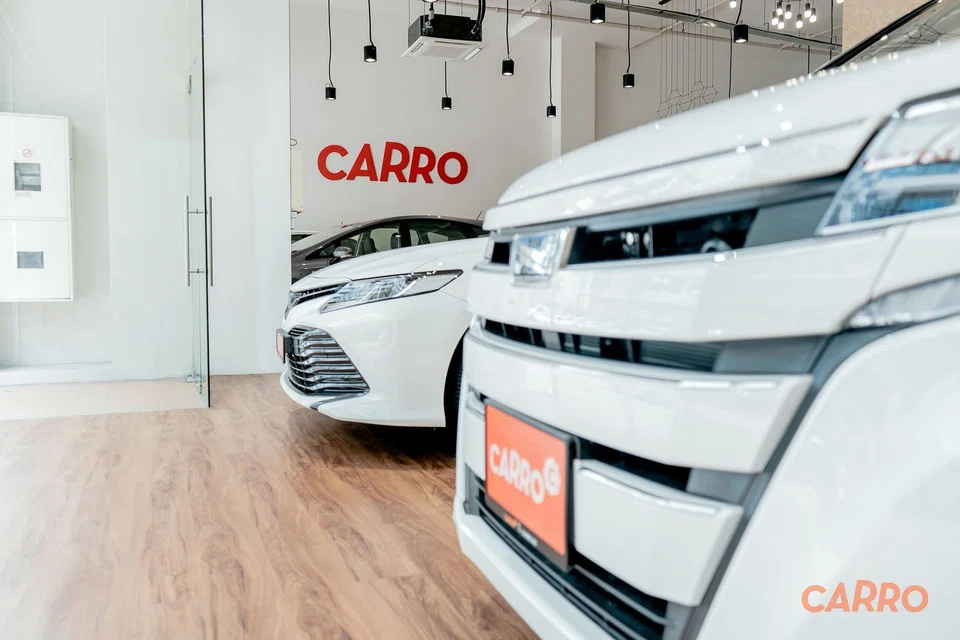
The 7-year-old startup already has a sizable physical presence in Indonesia. It opened Carro Square, its headquarters in Jakarta last year, and also has stores called Carro Automalls in Bekasi, South Tangerang, Tangerang and Semarang, alongside stock yards and inspection centres.
"Ultimately, we are trying to bring car buying online and do not want to rely too much on physical presence, though it is still necessary in order to build up trust," said Tan.
Adding to the challenge, competition is stiff. Carro and Carsome are competing with offline dealers, given that they have adopted an inventory model, said Lau of Third Bridge.
New competitors with different models are also attracting capital. Last month, Moladin, which has a network of over 15,000 agents and dealers, raised US$42 million led by Sequoia Capital India and Northstar Group.
Acknowledging the competitive landscape, Tan believes that there is room for multiple players and that Carro can hold its own, with a focus on user experience.
What he certainly does not see is Carro being "just another car dealer with a glorified website".