



Delta-related drags in 2021 for Asia Pacific but stronger 2022 in view: Oxford Economics
 Add BT as a preferred source
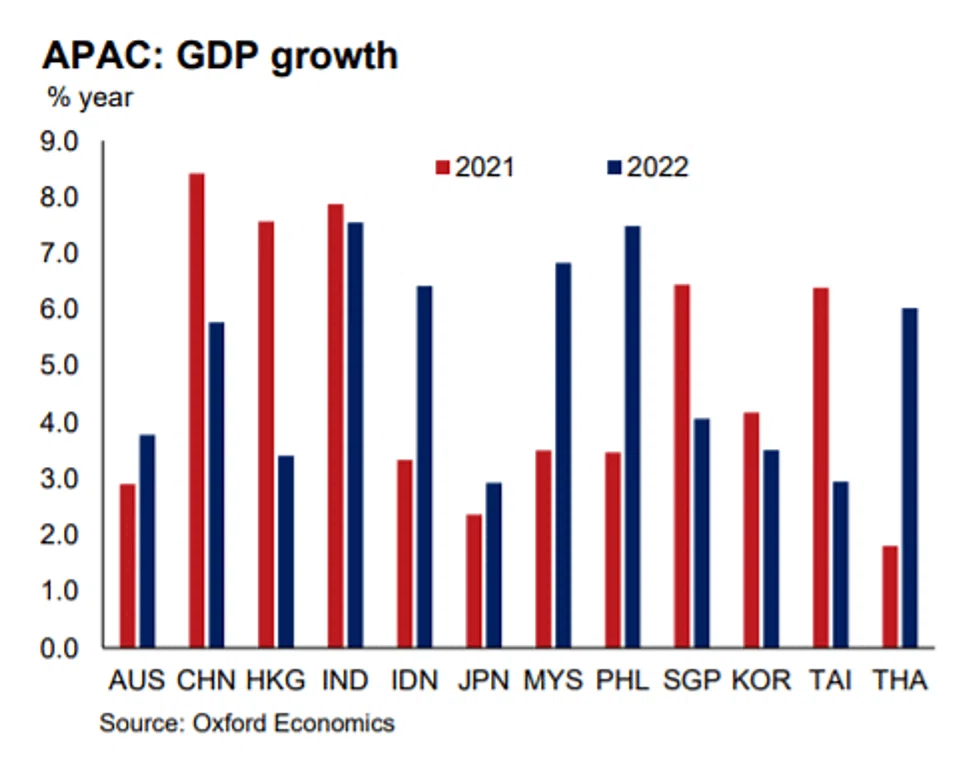
ASIA's economic performance over the next six to nine months will be "hugely influenced" by developments in the pandemic, more so than the US, Europe or Latin America, reflecting the 'zero tolerance' approach to the virus adopted by some countries in the region, in addition to continued limited progress on rolling-out vaccines.
On average, gross domestic product (GDP) growth forecasts for 2021 have slipped over the past six months although this masks a divide between developed economies and emerging markets (EM) economies, noted Oxford Economics lead economist Simon Knapp.
In the former, Taiwan and Hong Kong have seen significant upgrades over this period while in the latter group, all six economies have seen their growth prospects downgraded, with the largest setback occurring in the Philippines (forecast dropped from 8 per cent in March to 3.5 per cent in Sept).
"To a great extent, this disappointing performance in the region's EM economies reflects developments in the pandemic," said Mr Knapp.
In India, the surge of the virus in April/May severely disrupted, albeit temporarily, India's recovery in Q2 while in EM Asean, stubborn outbreaks and the emergence of the Delta variant have generally kept mobility levels far below normal, he noted.
China's vigorous response to cases has also led to periodic bouts of disruption and a sluggish pickup in several areas of domestic demand.
Navigate Asia in
a new global order
Get the insights delivered to your inbox.
"In Q2, six of the region's main economies showed quarterly declines in real GDP, with developments in the pandemic the key factor in four of these - most notably, a 6 per cent-plus contraction of India's economy.
"With regard to Q3, further pandemic-related deterioration in Malaysia will likely result in a second consecutive quarterly GDP decline, while efforts to contain severe outbreaks of the virus during the quarter are likely to lead to GDP contractions in Indonesia, Australia, Thailand, New Zealand, and Vietnam," he said.
Meanwhile, extensive supply-side disruptions point to a pause in trade recovery. These include signficant disruptions to supply chains, shortages (particularly of semiconductors), and congestion in many of the world's key ports, resulting in long delays.
"We expect these problems will start to ease over the next few quarters as more economies move toward normal activity levels," said Mr Knapp, adding that global trade will likely regain momentum during the first half of next year.
Oxford Economic's baseline forecast is that demand for Asia's manufactured goods will grow between 5 per cent and 7 per cent in 2022, reflecting solid Chinese, US, European, and regional demand.
Total export volume growth in 2022 will range between 2.7 per cent (Indonesia - after a very large gain in 2021) and 13.9 per cent (Thailand - buoyed by recovering tourism), compared to a range of -2 per cent (Australia) and 20.9 per cent (India) this year.
He added that the Asia Pacific region will "resume its normal position as clearly the world's fastest-growing region" in 2022 and beyond, noting that by the middle of next year, China, India, Indonesia, the Philippines and Vietnam should all have returned to the strong growth trends seen before the crisis.
Decoding Asia newsletter: your guide to navigating Asia in a new global order. Sign up here to get Decoding Asia newsletter. Delivered to your inbox. Free.
Copyright SPH Media. All rights reserved.
TRENDING NOW

The retirement advice that worries me the most

Haidilao co-founder’s family buys second bungalow in Cluny Hill for S$85 million

From hawker stall to Enterprise Award winner: How Han Keen Juan scaled the Old Chang Kee empire

Yeo’s, Tiger Beer and now Gardenia – flight of food manufacturing from Singapore might be just as planned

