

A manufacturing renaissance can lift Singapore
Consultants agree that Singapore is well-positioned to grow sector, especially in higher value-added processes

Mindy Tan
Singapore
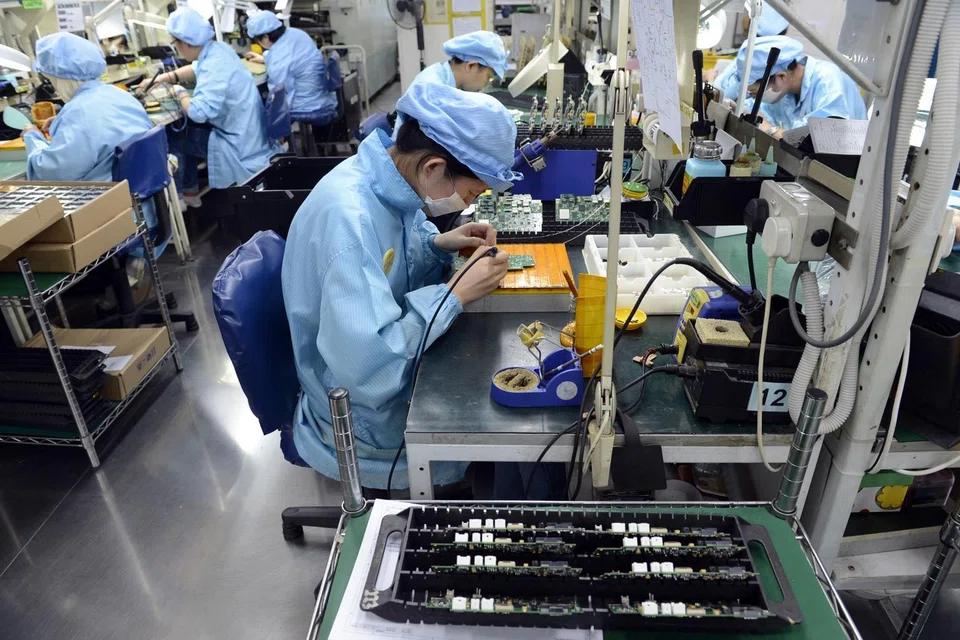
COSTS while important, will become secondary, as governments and companies focus on strategic and critical manufacturing in the coming years, putting Singapore in a position to further strengthen its manufacturing sector.
Sudhan Sundaram, managing director, supply chain and operations lead (consulting), Singapore at Accenture, said that the firm has already started working with some of its clients in critical sectors in rethinking their approach to manufacturing and supply chain.
"They have come to realise this may entail more costs, such as increasing inventory levels or duplicating manufacturing capabilities in order to build the required resilience," explained Mr Sundaram.
Indeed, he expects that there will be support from the government to build the required resilience and self-sustainability of these critical manufacturing activities.
"This includes maintaining low level production capability of critical medical equipment locally when global demands drop post-pandemic," he added.
Mr Sundaram noted that the industry has overcome a dip in manufacturing activity even prior to the outbreak. FDI in manufacturing has doubled from 2008 to 2018, while the industry has been a key pillar in Singapore's economy at over 20 per cent of GDP for the past eight years, he said.
The manufacturing industry has grown steadily over the years, adding thousands of employees each year in the workforce (employing 400,000 employees or 14 per cent of the workforce).
In the first quarter this year, the manufacturing sector was the largest contributor in investment commitments garnered by the Economic Development Board. In terms of Fixed Asset Investments (FAI), the sector attracted S$10.6 billion worth of commitments, out of a total of S$12.4 billion.
But former MP for the People's Action Party, Inderjit Singh, who has been in the manufacturing and consumer appliance for over three decades, thinks that manufacturing should form a bigger component of Singapore's future economy.
"Manufacturing share of Singapore's economy is about 21 per cent in 2019... Singapore manufacturing peaked around the early 2000s at around 28 per cent before declining again over the years. I suggest we bring manufacturing up to 25 per cent to 30 per cent of our economic contribution in the years ahead," he said.
"Realistically, we can never compete with China or India or Vietnam based on cost and labour availability, so we have to be selective on what areas of manufacturing we can compete in," added Mr Singh.
In the near term, strategic local manufacturing such as the production of masks, medical supplies and essential food items, will likely take precedence but in the medium term, the fundamentals of good business will not change and that must mean driving efficiencies and innovation while striving for customer intimacy, according to Graham Conlon, head of digital supply chains at SAP Asia Pacific Japan.
Singapore has been ramping up its domestic production of surgical masks since mid-February; the decision to quickly establish local production capabilities for masks came about shortly after Covid-19 broke out in China. The first made-in-Singapore surgical masks rolled off a production line by ST Engineering in mid-February.
Indeed, Accenture's Mr Sundaram said his team has noticed that more manufacturers are shifting their focus to address opportunities for hyper-growth, mainly in the space of food, respirators, and personal protective equipment.
But Mr Singh counters that Singapore doesn't have to jump into doing this just because a health emergency pushed the city-state into a corner.
"Many others around the world are also getting into this area so long-term sustainability may make it not so viable," he said.
"We were very strong in semiconductors before and we lost that edge the last 10 years. We were very strong on contract manufacturing, disk drives and a few other areas before but we also lost the edge because of cost and lack of government support... Other areas we can focus on which will be critical and where I believe we have the technologies and capabilities to do are food production, biomedical, and precision engineering."
Local manufacturer Theo10, for instance, specialises in skin products for people with sensitive skin. They had planned to start producing hand sanitisers this year but fast-tracked the launch of this line in mid-January. Even as they still enjoy brisk sales, the company is actively looking for ways to diversify its range.
"In the months to come we are launching a first in the world - patented technology to inhibit the spread of hand, foot and mouth disease," said founder Theodore Khng.
Even as Mr Khng credits the company's small size for its nimbleness and ability to pivot and make quick decisions, Peter Slagt, a partner in the Singapore office of Bain & Company, noted that companies in general are moving away from traditional strategy cycles of three to five years and trying to focus on building agility and responsiveness. "The crisis unlocks many decisions that many companies should have taken years ago, but are now actioned and accelerated in a couple of weeks," Mr Slagt said.
Ultimately, consultants agree that Singapore is well-positioned to grow the sector, especially in the higher value-added processes.
"Singapore already has the advantage of a strong base in advanced manufacturing in industries like biomedical sciences, electronics, chemicals and we can expect manufacturing to continue to be strong with rapid digitalisation and Industry 4.0 transition to high-value manufacturing," said SAP's Mr Conlon.
According to Mr Singh, Singapore has a "huge opportunity" to develop regional supply chains managed from here.
"First, we can recreate many more jobs to employ the displaced workforce. Job creation is one of the most important things for building an economy and for governments. Second, we can control supply chains better if we keep manufacturing and technology expertise in Singapore. We don't be too dependent on foreign enterprises. When we control supply chains, all other service sectors can be better retained in Singapore too compared to when big MNCs (multinational corporations) move out of Singapore which may result in loss of service sector jobs. The key is to be in control of some major parts of the supply chains, like manufacturing, like Taiwan has done," said Mr Singh.
"We have to act fast before Singapore becomes irrelevant."
READ MORE: Pandemic prompts manufacturers to rejig supply chains, operations
TRENDING NOW

Grab CEO’s wife Chloe Tong on life with Anthony Tan and finding her purpose
Stocks to watch: DBS, DFI Retail, Frasers Property, Clint, ESR-Reit, Centurion, Coliwoo
DFI Retail to bag US$340 million, Starbucks business in Asia in deal with Maxim’s Caterers
Green fuels, autonomous ships: How Singapore is future-proofing its shipping industry

