

'Even with money, you can't source for anything': Surbana Jurong CEO
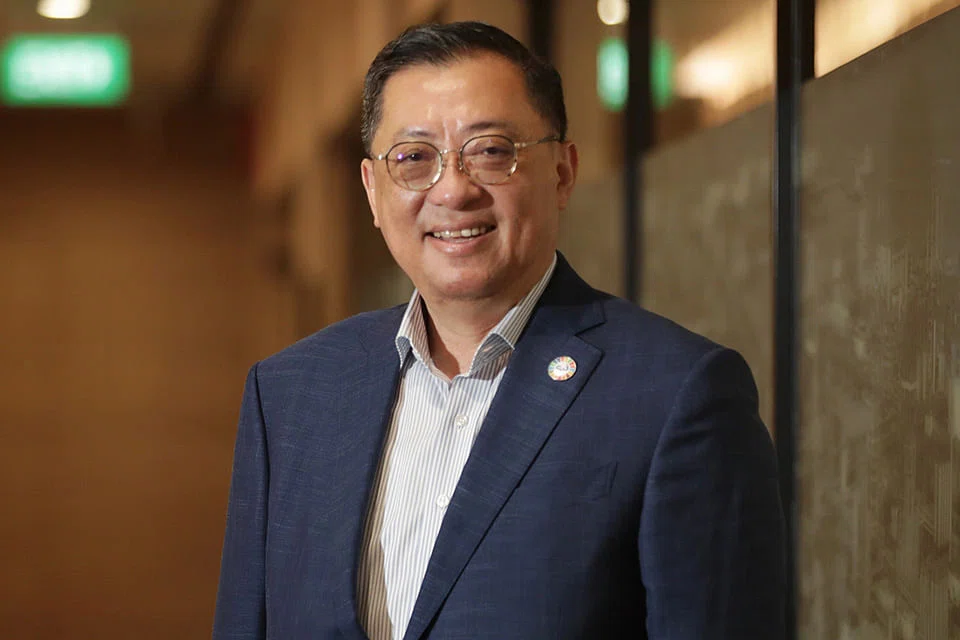
Surbana Jurong CEO Wong Heang Fine recalls immense challenge in transforming Expo halls into healthcare facilities

Singapore
IT WAS a problem that having money alone could not solve.
Rather, time was of the essence for Surbana Jurong (SJ), the consultancy firm given the mammoth task of converting the cavernous event halls at the Singapore Expo into healthcare facilities at the height of the coronavirus pandemic towards the end of March 2020.
This was when the number of Covid-19 cases in Singapore was rapidly on the rise and many countries were fast shutting their borders, triggering much uncertainty and instability in global supply chains.
Wong Heang Fine, Surbana Jurong's group chief executive officer, recalls being activated by parent company Temasek Holdings on March 29 last year, and it was just five days later on April 3 that they presented a plan and estimated budget.
For SJ, the plan was to repurpose the 10 event halls at the Singapore Expo to accommodate patients with milder cases of the virus to relieve the crunch at the hospitals.
"To design a new hospital is technically quite challenging, but to repurpose (the halls) is doubly more difficult because we are working within the constraints of the facility," said Mr Wong in an exclusive interview with The Business Times. He explained that the halls were not designed for residential purposes, which meant they needed to install toilets and bathrooms while ensuring everything followed fire safety rules.
On the SJ team were about 50 employees who volunteered for the project, with expertise in areas such as architecture, civil structures, mechanical and electrical engineering, facility management and security.
One thing that they didn't have in their favour was time. On that very day, April 3, Prime Minister Lee Hsien Loong went on national TV to announce that Singapore would enter a "circuit breaker" four days later on April 7.
The partial lockdown, which eventually lasted nearly two months, saw all non-essential businesses close their doors.
"We had literally Saturday, Sunday and Monday to get everything before the whole nation shut down," Mr Wong recalled.
And the pressure kept on mounting. Covid-19 was starting to spread rapidly in the foreign worker dormitories, which meant SJ had difficulty finding enough workers to work on the project to transform the Expo halls into a community care facility (CCF).
Meanwhile, from 480 beds per hall in its initial design, SJ was asked to double the capacity to 960 beds. The biggest problem facing SJ then was how to obtain enough beds, cabinets, curtains, partitions and other essential items when almost all factories were shuttered.
"At that time, even with money, you can't source for anything - nobody can sell you anything because there is nothing," said Mr Wong, adding that there was a need to exercise "quite a lot of ingenuity" in sourcing for the items.
For example, buying beds from Malaysia was no longer an option due to the lockdown there as well as the fact that the Causeway was already closed, Mr Wong said.
The SJ team eventually managed to contact a former Indonesian diplomat in Singapore to reach out to factories in Indonesia that could make beds.
"But that's the first part of the story. Part two is, how to ship (the beds) across (to Singapore)? Ships and ports were not working," said Mr Wong.
SJ had to work with Singapore port operator PSA to deliver the beds to the port they are managing in Tanjung Priok in Jakarta, before shipping them over to Singapore.
Having enough secure cabinets to store personal belongings was also important, since the workers would be staying for at least two weeks, but these too were in short supply at that time.
This led the SJ team to improvise by using big plastic containers.
"We rang up NTUC FairPrice CEO Seah Kian Peng and said, you will need to open up (your) warehouse for us and give us all these containers," said Mr Wong. The team then drilled holes into the containers and attached individual locks to each of them.
Another shortage they encountered was a lack of bedsheets and curtains, while blankets were scarce too.
"We had to ring up SIA (Singapore Airlines) and said: 'Since you are not flying, can you pass us some blankets'," Mr Wong recalled.
"So this is where, really, you can feel all of Singapore came together... It doesn't matter which company you are, everybody was answering our call."
After settling the furnishing, the SJ team then worked on fitting in mechanical ventilation to ensure that the halls had negative pressure, an isolation technique that helps prevent the spread of airborne diseases.
Although the deadline given to SJ to complete the CCF was noon on April 10, they took an additional six hours to complete the project due to the lack of manpower, Mr Wong said.
Just two hours later, at 8pm, the CCF's first patient checked in.
"We felt an achievement because we had to do it within a short time and to meet all those requirements. It wasn't easy. We were under tremendous pressure. Every day we had a meeting, and the first question posed to me was: 'When can you finish?'" he recalled.
Mr Wong credits SJ's experience in a wide range of projects and its extensive network as the "secret ingredient" that brought the CCF to fruition.
"If you don't have that spread of contacts and the networking in the industry, it is very difficult to try and pool all this together because we would have nowhere to go," he added.
SJ's network was also instrumental in helping to keep costs low, he said, noting that they were able to compare costs across different sources.
But during crunch time, having a keen business acumen is critical when it comes to making decisions.
"We always take the cheapest and the most reliable (route) - because some can quote you the cheapest rate but they cannot deliver - so we had to do a sensing when we talk to (people in) our network," Mr Wong said.
Looking back at the episode a year later, Mr Wong believes that having close cooperation and friends within the industry was the key in getting things done.
But the frantic search for suitable venues to repurpose - the team visited many exhibition halls, shopping centres, carparks, hostels, disused schools and factories across the island during their recce - also brought another insight to Mr Wong, one that could influence the way future buildings are designed.
Public facilities should be designed for multiple purposes to prepare for future pandemics or emergencies, he pointed out.
He cited the example of earthquake-prone Japan, where substations can be converted into medical facilities, while there are many concealed storage areas that can be turned into medical facilities.
Singapore, being relatively sheltered from natural disasters, has not yet given much thought to this, he said, noting that repurposing these facilities later on could be more challenging and expensive.
"It's a good learning point, and that's why we felt that being involved in this (project) really gave us some insight into how we should be thinking about future facilities that we design and engineer," he added.
READ MORE:
TRENDING NOW

Inside Singapore’s government team that kills its own products

Once staunchly pro-China, Malaysian Chinese businesses are now distancing themselves from Beijing
Cliff Tan has 7 million followers and a 4-month waitlist. Why won’t he expand his business?

Grab CEO’s wife Chloe Tong on life with Anthony Tan and finding her purpose

