

Access to Sinovac shot welcomed by frequent travellers to China
Singapore's Health Ministry says it will not subsidise vaccines administered under the Special Access Route


Singapore
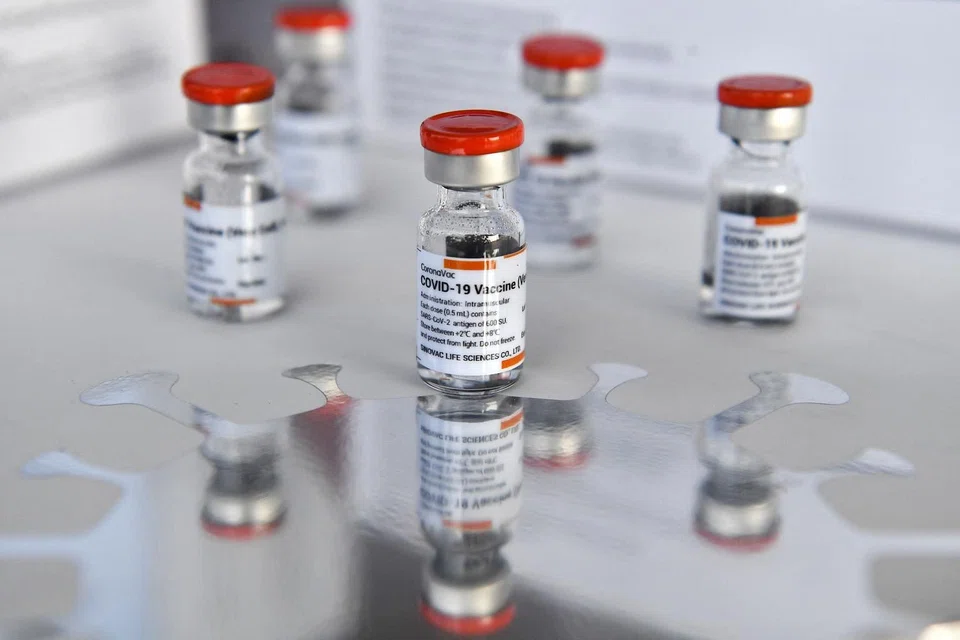
SOME frequent business travellers to China have been waiting for months for the Sinovac Covid-19 vaccine to be approved for use here, as taking it would make it easier for them to enter China again in future.
With the Singapore government's recent announcement that it is opening up access to certain alternative vaccines via private healthcare providers, these travellers may now get a shot.
China Enterprises Association (Singapore) secretary-general Fu Xiaohui told The Business Times that since the Sinovac vaccine stocks arrived in Singapore in February, China firms here have been waiting for it to be approved by the authorities, and some have even appealed to the Chinese Embassy to expedite the process.
The association's members range from Chinese state-owned enterprises to small firms.
Mr Fu noted that businessmen and residents from China in neighbouring countries have already taken the Sinovac vaccine, "which does make it more convenient when returning to China".
In March, China said it is easing border restrictions for travellers who have taken any of the four China-produced vaccines. Indonesia and Thailand are among the countries in the region that are using Sinovac in their respective vaccination programmes.
On Monday, Singapore's Health Ministry (MOH) said that apart from the Pfizer-BioNTech and Moderna mRNA vaccines used in the national vaccination programme, access will be granted to some alternative vaccines. This is "to meet medical needs of individuals in unique and special circumstances", an MOH spokesman told BT on Wednesday.
Under the existing Special Access Route (SAR), meant for the import and supply of unregistered medicines, private healthcare firms will be able to bring in Covid-19 vaccines that are on the World Health Organization's (WHO) emergency-use listing.
These include China's Sinopharm. On Tuesday, Sinovac was officially added to the WHO's list, meaning that it will also be available via the SAR, said the MOH spokesman.
But the government will not subsidise vaccines administered under the SAR, nor will those who are vaccinated under the SAR be eligible for the Vaccine Injury Financial Assistance Programme for Covid-19 Vaccination.
MOH said it will give more details soon on how private healthcare institutions here can apply to be licensed providers for Sinovac under the SAR.
"We are also studying the possibility for the private healthcare institutions to access our current stock of 200,000 doses, and work out details on pricing, informed consent process and safety of the patients who prefer to be administered with Sinovac-CoronaVac under the SAR," said the ministry spokesman.
Lim Yong Yee, director of Advanced Sealing Devices, is among the many business executives who used to fly regularly to China before the pandemic hit last year, but has not travelled there since.
He added that he is considering taking the Sinovac vaccine to make it easier for him to go to China in future, but he is holding out for now until it is approved by Singapore's Health Sciences Authority.
For Jonathan Cai, the head of partnerships at Atome, the possibility of access to Sinovac via the SAR came a little too late. The Singaporean flew to Hong Kong on Wednesday - he is a resident there - and has plans to take the Sinovac vaccine in that city, although he told BT that he would have taken the jab in Singapore if he was not going to Hong Kong.
"I'm also doing my executive MBA at Tsinghua University, so this makes travel easier to China," said Mr Cai.
He added that he has faith in the China-made vaccine since "it doesn't seem to have caused as much problem as I think a lot of people were envisioning it to", given the large number of doses administered so far. "But principally, I'm just keen to get it done and move on with life," he said.
A Chinese national working in Singapore's finance sector, who declined to be named, chose to take the Sinovac vaccine in March, in China.
Besides concerns about the maturity of mRNA technology and side effects of the mRNA vaccines, one consideration was the relative ease of entering China. "I don't foresee international travel to resume in any short period of time, but I want to at least offer myself the possibility of going back home with fewer quarantine days, or no quarantine at all, with the Sinovac vaccine," she said.
TRENDING NOW

Once staunchly pro-China, Malaysian Chinese businesses are now distancing themselves from Beijing

Cliff Tan has 7 million followers and a 4-month waitlist. Why won’t he expand his business?

Could stablecoins be the future of money?

Grab CEO’s wife Chloe Tong on life with Anthony Tan and finding her purpose

