

American democratic experiment still works despite Trumpian assault
MORE than two months since the controversial US presidential election, Joe Biden will be inaugurated as the 46th President of the United States on Wednesday as he tries to rekindle the "shining city on the hill" of American democracy after the most restive transition since the Civil War.
More often than not in the last four years, Donald Trump's presidency felt like one of those train-wreck reality TV shows that could never be cancelled because its tawdriness gripped so many viewers.
But the Trump show has been cancelled - both at the ballot box in November; and, after his incitement of a violent mob in Washington on Jan 6 to overturn that result, cancelled on Twitter.
After Mr Biden's inauguration, the Senate may convene a court to cancel Mr Trump from any future office.
With his speech on Wednesday at around noon (Thursday 1am, Singapore time), Mr Biden will attempt to change the channel to drier public-service programming.
"One thing I have taken some comfort in in the past few months of uncertainty is that, no matter what Trump does, at 12.01pm on Jan 20 he ceases to be president," said Parker Hevron, an associate professor of political science at Texas Woman's University.
For students of American history, the context of Mr Biden's inauguration is surreal.
Four years ago, Mr Trump spoke to an audience that dwarfed any security presence.
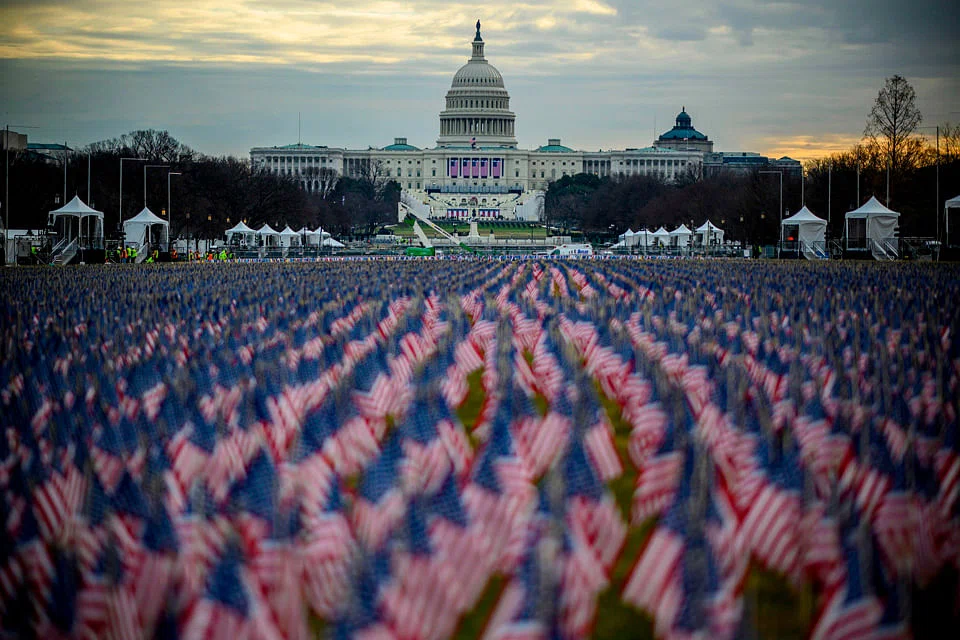
This time, Mr Biden will speak before a security presence that is far greater than the crowd, as some 25,000 National Guard troops fortify Capitol Hill against a recurrence of the deadly storming of the Capitol.
The very idea of a vacant national mall on the most significant of all American events would have been unthinkable before the Covid-19 pandemic.
The fact that the sacred ground between the Lincoln Memorial and the Capitol would be surrounded by two-metre high fences would have been unthinkable just a fortnight ago.
Mr Biden effectively opened the proceedings on Tuesday evening with a memorial for those who have died due to the virus.
He stepped up to the "consoler-in-chief" role that all of the post-World War II presidents, up until Mr Trump, had taken on in times of catastrophe.
"It's crazy that we have now lived through 11 months of the pandemic, and no public official has really apologised to people about their family members who died," said Mr Hevron.
Mr Biden's entrance to the greatest stage will likely echo that of Franklin D Roosevelt, the last president to enter the White House with the nation at such a low ebb.
Mr Roosevelt carefully cultivated a fatherly persona with his fireside chats and railing against "fear itself".
The emotive and older Mr Biden, however, is arguably a more authentic father figure than the aristocratic Mr Roosevelt.
The 78-year-old Mr Biden has prepared for this moment throughout a political career that has drawn on his blue-collar background, endurance of personal tragedy and his deeply held sense of empathy.
But the message of unity and healing is a tall order in a nation so divided that Democrats and Republicans cannot even agree on what unity means, according to Mr Hevron.
Republicans have used the same call to oppose the second impeachment of Mr Trump.
Still, Mr Biden's programme could be closer to Mr Roosevelt's transformative initiatives than the incrementalist approach of his old boss, president Barack Obama, whom he served as vice-president for eight years.
Pandemic relief is top of the agenda as Mr Biden addresses what his chief of staff Ron Klain has called "four overlapping crises" - Covid-19, an economic slowdown, climate change and the outcry over racial injustice sparked by the killing of George Floyd last year.
Mr Biden will reiterate his promise to get vaccines to 100 million Americans in his first 100 days in office, addressing the gaps in federal vaccine guidelines that have led to frustration and confusion.
Elderly people have lined up overnight in Florida and other states only to leave vaccination sites empty handed.
Stories abound of the wealthy and well-connected skipping the priority line, leaving the most vulnerable to wait for their dose.
Mr Biden will talk about wealth inequities as he previews his US$1.9 trillion economic aid plan, the latest fiscal stimulus response to the effects of Covid lockdowns on US businesses and consumers.
He will tease out the overlap between economic recovery and climate-change planning, outlining his version of the sustainable-energy infrastructure plan known as the "Green New Deal."
Perhaps nobody is better qualified than Mr Biden's vice-president, Kamala Harris, the former attorney general of California, to push for the criminal-justice reforms so ardently sought by the Black community.
The contempt that Mr Trump and his supporters hold for the long-established rituals of American democracy will be reflected in the departing president's snub of his departing inauguration.
Mr Biden, who, as Mr Trump derisively noted during one of their debates, has spent four decades as a Washington insider, will make clear his own reverence for the ceremony itself, even in its somewhat diminished, pandemic-era form.
Mr Biden can point to himself and to Ms Harris as proof that - even after the Trumpian assault - the American meritocratic and democratic experiment still works.
READ MORE: The Biden bulldozer is ready to roll on
TRENDING NOW

Singapore identifies 7 firms responsible for haze fires, notices issued urging action: Grace Fu

Philippine power giant First Gen rebuffs foreign offers, plans up to US$2.6 billion in expansion

DBS remains analysts’ pick ahead of Q3 earnings after Singapore banks’ share slump
Indonesia imposes US$116 million in fines over manipulation of Sinar Mas, Prajogo-linked stocks

