

As Biden weighs China tariff options, any move unlikely to ease inflation in a big way

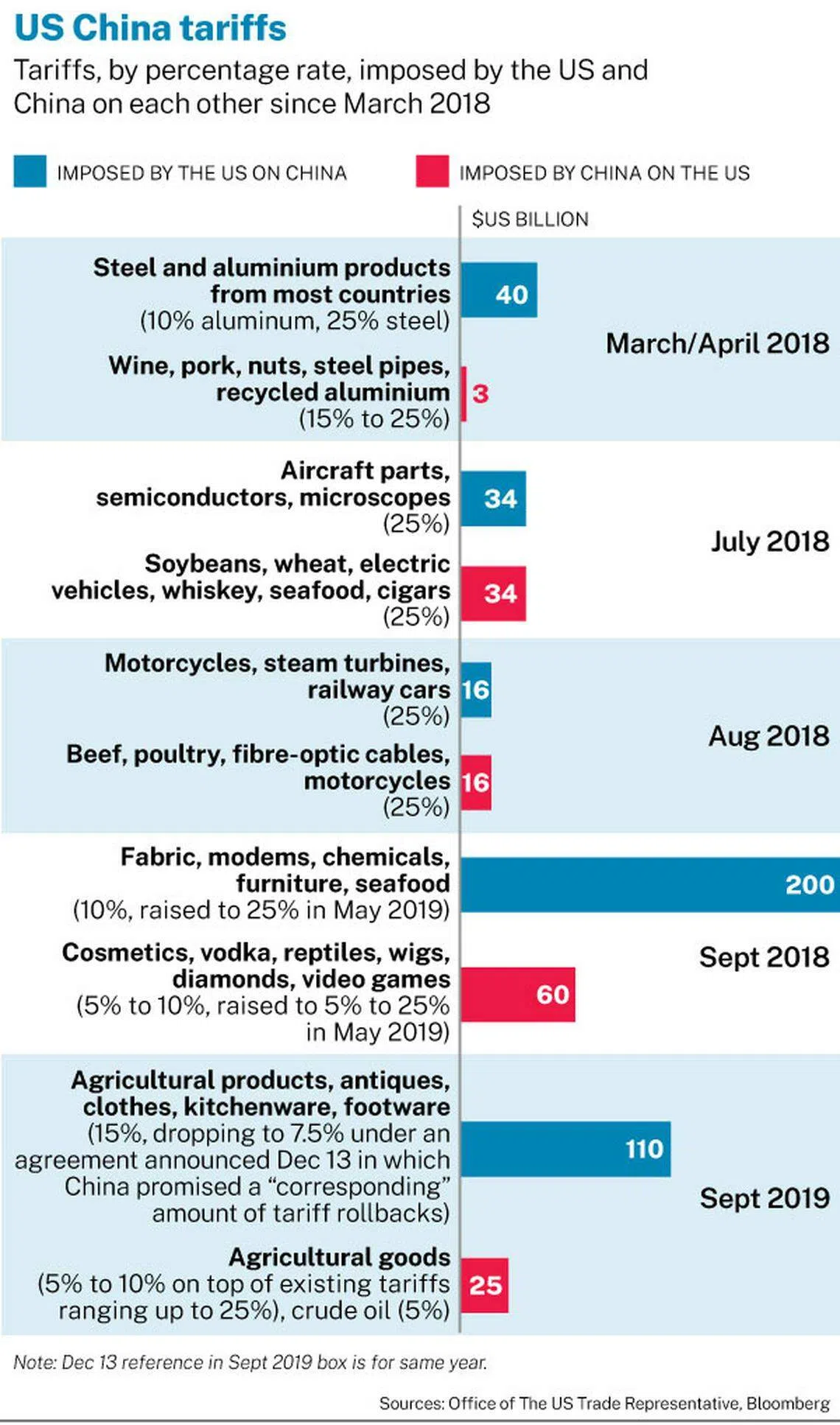
THE Biden administration’s planned rollback of tariffs on Chinese goods initially spurred excitement in the stock market, but there are signs that it is more of a tactical shift by the US rather than a move towards a ceasefire in the ongoing trade war between the world’s two largest economies.
During a virtual tete-a-tete on Tuesday (Jul 5), US Treasury Secretary Janet Yellen and China’s top trade negotiator, Vice Premier Liu He, discussed the tariff issue again. A subsequent statement by the Treasury, however, did not mention the specific types of duties and instead focused on the broader economic challenges and Russian sanctions.
“We see this as a one-off event with bilateral relations continuing to be very challenging,” said strategists at brokerage Bank of America Global Research, in a note to clients. “With the midterm elections approaching in the US, anti-China rhetoric could escalate along with non-tariff trade actions.”
US President Joe Biden’s aim is not to smooth over the troubled relationship with China. To a large extent, his tariff plans are motivated by domestic rather than foreign-policy goals. He is trying to lower prices on household staples like schoolbooks, button-down shirts, stuffed toys and sofas. All this, in a desperate bid to wound the dragon that’s torching his poll numbers - inflation.
The Bank of America strategists say the measure is unlikely to shave more than one-tenth of one percentage point off consumer prices. Considering that the consumer price index in the US rose 1 per cent overall in June, that’s not going to provide much relief to cash-strapped Americans.
“In this environment, even a smidgen of rollback in inflation would be helpful,” said Quincy Krosby, the chief equity strategist at brokerage LPL Financial.
It’s not immediately clear if Biden will end up taking any action at all to cut tariffs on Chinese imports, with industry requests flowing in to maintain the status quo for the duties. Late on Tuesday night, the US Trade Representative’s office received more than 400 requests to keep the tariffs in place on Chinese goods.
Krosby noted that Biden faces a thorny political dilemma, given that this may be his best chance to do something tangible on inflation, and neutralise Republican attacks on the so-called “Bidinflation.”
At the same time, Biden risks opening himself up to further criticism from the Republicans about him being too “soft” when it comes to dealing with China. “If his tariff plan fails, and inflation continues to rise, the gambit may drop the Democrats even further in the polls,” said Krosby.
Nicholas Creel, an assistant professor of business law at Georgia College & State University, said that tariff reductions may not bring the inflationary relief that Biden is hoping it will, given that companies have already increased prices to accommodate them.
“Companies affected by these tariffs could just keep prices as they are and pocket the increased revenue as profit,” he told The Business Times.
Most geopolitical theorists see the 21st-century struggle for global dominance to involve China and the US, with Russia as a marginal player. For this contest, the critical economic and trade issue is technology, analysts say.
In this sphere, the Biden administration seems intent on keeping former US president Donald Trump’s tariffs on semiconductors, integrated circuits and other computer hardware in place, said Louis Lau, the director of investments at Brandes Investment Partners.
The US and China are involved in an arms race over computer chips and weaponry around the world. The US has sought to “diversify the manufacturing base away from China”, strengthening ties to Taiwanese and South Korean chipmakers, and responding to recent supply-chain logjams by building a TSMC plant in Arizona and a Samsung plant in Texas, said Lau.
“I don’t think they are counting on China too much for semiconductors,” said Lau. “China is mostly manufacturing at the lagging edge, not at the leading edge. The US very much wants to impede China from moving up the value chain in terms of semiconductors.”
Even if Biden balances the lifting of tariffs with more punitive measures on technology, China could well say that the US blinked first in the 4-year trade war. Going into the twice-a-decade jamboree of the National Congress of the Chinese Communist Party later this year, observers say that Chinese President Xi Jinping could do with some propaganda ammunition.
“President Xi is under pressure because the economy has weakened markedly, primarily due to the country’s zero-Covid lockdown measures,” said Krosby.
The US will likely follow through on the plan to raise tariffs on consumer goods, and that both Biden and Xi will claim the development as a significant win. But it’s unlikely to budge inflation in a big way, or tilt the balance of power between the US and China.
TRENDING NOW

Once staunchly pro-China, Malaysian Chinese businesses are now distancing themselves from Beijing

Stocks to watch: HPL, Aims Apac Reit, Zico, Advanced Systems Automation, ComfortDelGro
‘How many will survive?’: Bubble fears arise as China’s humanoid robotics face reality check
Smaller board lots can’t fix a market run by three banks

