

Asean, Australia to make it easier for businesses to conduct cross-border digital trade
The countries will work together on a new Digital Standards Cooperation Initiative which will facilitate trade, cut costs
Sydney
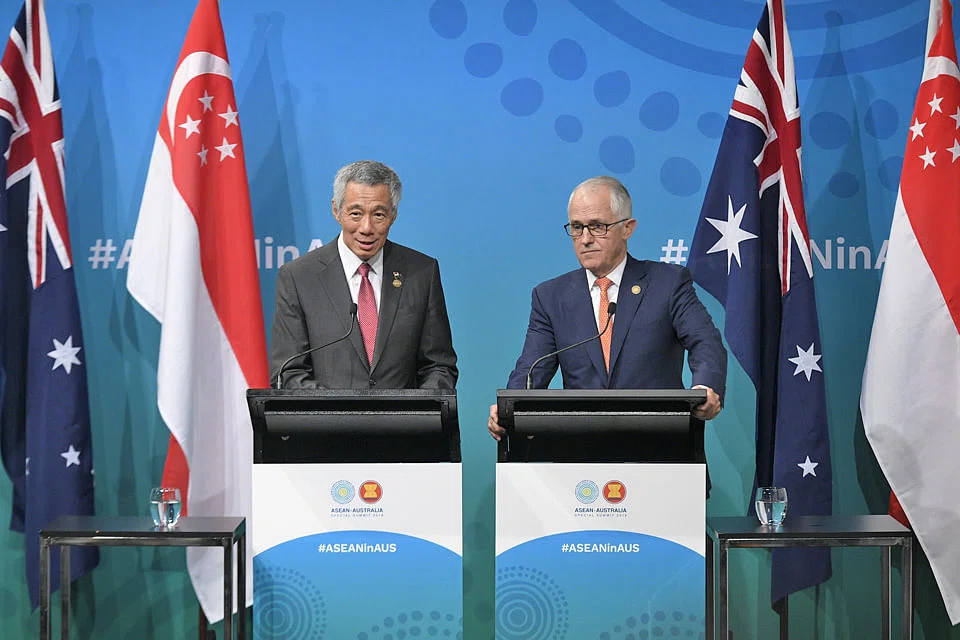
PROTECTIONISM is a "dead end", Australian Prime Minister Malcolm Turnbull said on Friday, as he and Singapore Prime Minister Lee Hsien Loong made a strong push for countries to continue working together on free trade.
Speaking at an Asean-Australia business summit, Mr Turnbull said Australia will continue to work with its closest neighbours in the region on trade liberalisation.
"You dont grow stronger by closing the door to other markets. Protectionism is a dead end. It is not a ladder to get you out of the low-growth trap. It's a shovel to dig it much deeper," he said.
"We must face the world, not turn from it. Embrace free trade, not retreat from it, and do so on the basis of strong and transparent rules, fair and open competition and non-discriminatory legislation."
Mr Turnbull's remarks echoed those made by Mr Lee on Thursday in an interview with Australian media, in which he said that recent moves by the US to protect its domestic industries have raised the spectre of tit-for-tat trade wars.
He warned that steps taken by US President Donald Trump, such as imposing tariffs on steel and aluminium imports, set a precedent and countries were now "under pressure to retaliate".
On Friday, a spokesperson from Singapore's Ministry of Trade and Industry said the country is concerned by the US's decision to impose tariffs on steel and aluminium "and its potential impact on companies in Singapore".
"We are closely monitoring developments on this issue and will continue to engage the US and our companies on the next steps," the spokesman said.
Steel and aluminium accounted for S$11.8 million or 0.07 per cent of Singapore's domestic exports to the US in 2017.
Speaking at the summit, Mr Lee noted that Asean continues to work towards strengthening regional economic integration.
"The global mood may be moving in the opposite direction, but within Asean, within South-east Asia, we are trying our best to strive forward to deepen integration, to deepen interdependence, to work together to trade and open up markets, to co-prosper together," he said.
In one such move, Asean and Australia will work together on a new Digital Standards Cooperation Initiative, said Mr Turnbull. These will be a set of standards to make it easier for businesses to conduct cross-border digital trade.
"The digital trade standards will underpin the benefits of new technologies, everything from big data to artificial intelligence, and harness the opportunities they bring to our region," said the Australian leader.
The standards will ensure that the region can tap the potential of digital trade to gain greater access to markets and secure a more certain online environment in which to do business, he added.
"It will show the world yet again what can be achieved when nations work together," said Mr Turnbull.
Mr Lee welcomed the initiative, saying it is a good first step in developing inter-operable digital standards, which will facilitate trade and reduce costs for businesses, particularly small and medium enterprises.
During Singapore's Asean chairmanship this year, Asean is pursuing an agreement on e-commerce to streamline the varying regulatory systems across member states and make electronic transactions safer and more convenient, he added.
Mr Lee noted that Asean's growing digital economy is a compelling area of opportunity for Australian businesses.
"Though still in its infancy, it is fast becoming more vibrant. In 2017, Southeast-Asian startups attracted a record US$8 billion from investors. These startups include Grab, Go-Jek and South-east Asia, which have quickly become household names," he said, adding that Asean is a compelling market for Australian businesses for other reasons.
Asean's economic fundamentals are sound and the prospects for growth are strong and its combined population is expected to become the fourth-largest in the world by 2030, said Mr Lee.
Incomes are also growing, with Asean's annual consumer spending forecast to reach US$2.3 trillion by 2020, he said.
More than 60 per cent of its population is under 35 years old, which means a steady workforce and a growing consumer market in coming years.
TRENDING NOW

He built the Vingroup empire. Now South-east Asia’s richest man is handing some key roles to his sons
‘Our bread and butter’: Family-run Loo’s Hainanese Curry Rice hands reins to third generation

Grab CEO’s wife Chloe Tong on life with Anthony Tan and finding her purpose

US says China to buy 10 million tonnes of coal in 2027 and 2028

