Asean increasingly important to US firms: AmCham survey

Janice Heng
Singapore
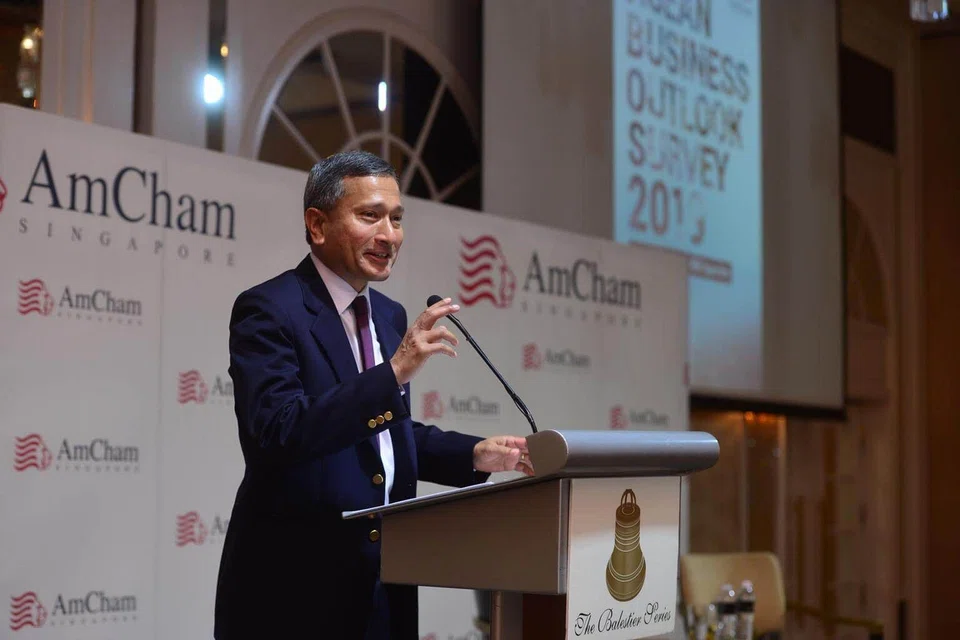
NOW, more than ever before, economic ties with the United States rely not just on what its government does, but on "the US private sector as an indispensable partner", Minister for Foreign Affairs Vivian Balakrishnan said on Wednesday, at an event held by the American Chamber of Commerce in Singapore (AmCham).
He cheered the US' continued commitment to South-east Asia and Singapore, noted moves such as the recent US-Asean Smart Cities Partnership, and highlighted Asean's potential as a youthful region whose "demographic dividend has not yet been harvested". The stock of US foreign direct investment in Singapore alone is about US$242 billion, he noted.
US companies' enduring and growing interest in Asean was evident in AmCham's 17th annual Asean Business Outlook Survey of US companies operating in the region. The report for this was launched by Dr Balakrishnan at the event.
Out of 210 respondents, 61 per cent expect the Asean markets to become more important to them in terms of worldwide revenue over the next two years; another 32 per cent expect their importance to remain the same, comparable to the finding in the past two years of the survey.
The proportions were similar for the 117 respondents operating in Singapore. However, the reasons for Asean's growing importance differed. Overall, raw material availability was the top reason, cited by three-quarters of all respondents. But in Singapore, regional integration came out on top, cited by 76 per cent of firms here, compared to 59 per cent globally.
Expectations for trade and investment in Asean are stabilising, with 77 per cent of respondents expecting them to rise in the next five years - down from 80 per cent and 87 per cent in the previous two surveys respectively. The dip came from more respondents expecting trade and investment levels to remain the same in coming years: 21 per cent in the latest survey, compared to 17 per cent and 11 per cent previously.
Firms in Singapore are optimistic, with 76 per cent expecting profits to rise in 2018 and 2019, comparable to the previous survey and above the Asean average of 71 per cent.
In Singapore, the sectors that respondents identified as most promising for US businesses were banking and finance (named by 33 per cent), software, IT and telecommunications (32 per cent), and consulting and e-commerce (27 per cent each).
But even as he highlighted both countries' strong economic ties, Dr Balakrishnan added that Singapore is "watching with great interest, in fact with great concern", the ongoing US-China trade talks. "For us as an open economy, as a city-state in which our trade volumes are three times our GDP, we obviously have a lot riding on these negotiations, in which we have no say," he said.
With the survey having been conducted from April to June 2018 amid trade tensions, 46 per cent of respondents in Singapore expected US trade actions against China to have a negative impact on operations. Most of the rest expected no effect; 3 per cent anticipated a positive effect.
Vietnam remained the top destination for US companies in Asean, with over four in 10 firms intending to expand there. Thailand came second (37 per cent), while Indonesia was third (35 per cent). For firms in Singapore, the top picks for expansion were Vietnam (50 per cent), Malaysia and Thailand (47 per cent each).
Within their respective locations, 60 per cent of respondents overall and 58 per cent of those in Singapore intend to expand. Five per cent expect to contract, and the rest expect no change.