

Asia phoenix will rise from decoupling of US
A less integrated world dominated by regional trading blocs does not mean slower growth

Singapore
FALLING growth in global trade and the decoupling of the US economy from China's is forcing investors to take stock of their bets as the world plunges into an abyss of political and economic divergence.
But the twilight of globalisation isn't all bad news, pundits reckon.
In fact, it might mark a healthy end of the era of chasing large-cap tech stocks and shift investor focus back to genuine domestic stories, said Sat Duhra, co-portfolio manager of Janus Henderson's Asian dividend income strategy.
He told The Business Times: "This (de-globalisation) is not necessarily a bad outcome. The real opportunities in Asia lie outside of the well-established mega caps. Domestic-led consumption names in China like sports brands and beverage makers are currently performing very well, defying the global doom and gloom."
Mr Duhra said he seeks out companies with unique business models set to benefit from long-term shifts in consumer trends.
The importance of regionalisation should not be underestimated either, said Silvia Dall'Angelo, senior economist at Hermes Investment Management.
"A less integrated world dominated by regional trading blocs would not necessarily imply slower growth and fewer investment opportunities," she said. "New technologies have enabled this trend, even before the rise of protectionism. Indeed, artificial intelligence and robotisation have been allowing for a shortening of value chains and re-location of production."
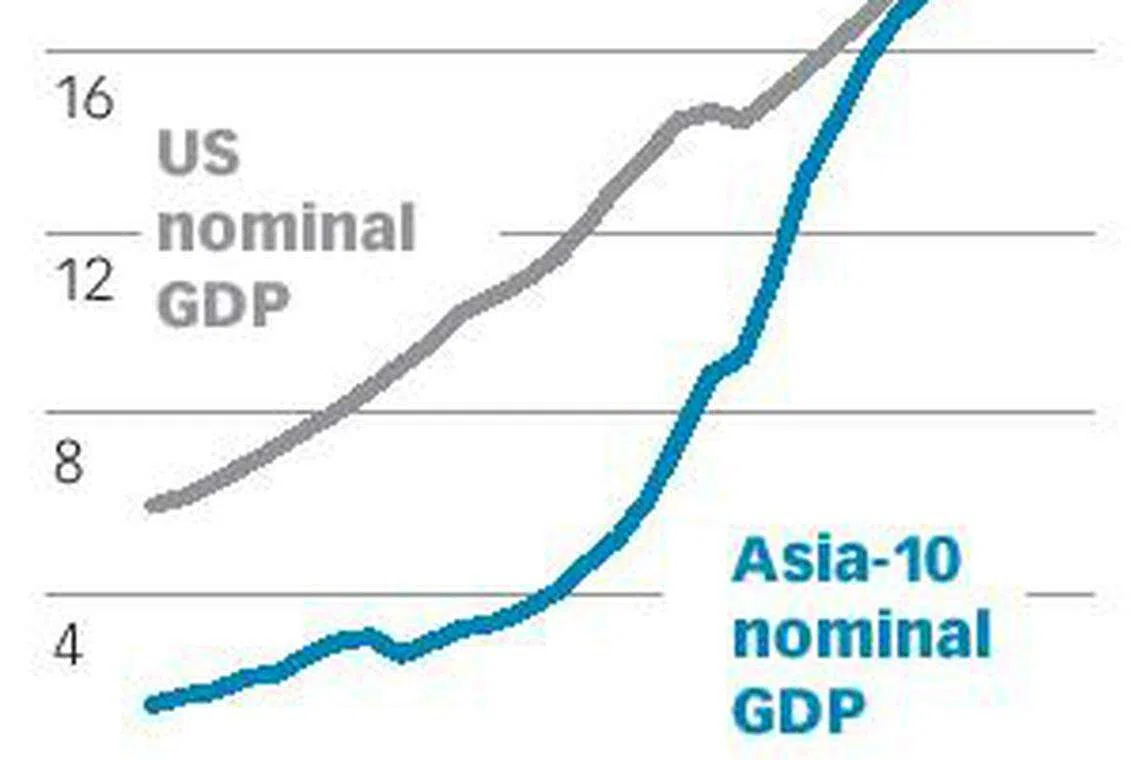
Regionalisation is the right idea and the Asian growth story remains very much alive, said DBS senior economist Irvin Seah: "Who is driving global growth? If you sum up the nominal GDP of the Asia-10 economies, they are already as big as the US economy. Asia is no longer that small."
In terms of GDP growth rates, for every one dollar the US puts on the table, Asia puts in two, he added: "And for every one dollar of global trade, 30 cents will have to pass through Asia."
Really, it's the US that loses out in the long term if it reduces its linkages with the rest of the world, Mr Seah said: "Even though people talk about decoupling, it doesn't mean that the whole world is split into half.
"I see it more of a case of the US gradually reducing its linkages with the rest of the world. We have to be clear that decoupling is very much driven by the US... Whereas China has taken a totally opposite approach. It continues to embrace free trade and strengthen linkages with the rest of the world."
In other words, by the hand of the US itself, the world could finally have reached peak America.
Between 2008 and 2018, the US stock market tripled in value while the rest of world struggled. Now that the US trade is well understood, it's time to pivot, author Ruchir Sharma suggested at the end of 2018: "Peak America is a theme that could play out in the next decade and many countries in Asia could shine in that shadow."
Looking further out, some have warned that US-China tensions could result in a bifurcation of supply chains, technology and of markets, creating a decades-long period of uncertainty more serious than a financial crisis. To be sure, a bifurcated world is not anyone's base case scenario. Most investors rest assured that US multinationals will defenestrate President Donald Trump before a full bifurcation happens.
Mr Seah said: "This scenario will only happen if the US is totally, entirely self-subsistent. It challenges the basis of comparative advantage, will create a lot of inefficiency, a lot of negative externalities and deadweight."
Janus Henderson's Mr Duhra noted that recent events have changed US-China relations forever, with the Chinese now even more determined to become self-reliant in key sectors: "But both countries have already been following their own systems whether that be political or technological. The fact that Google, Facebook etc don't function there but China is still leading the path in some areas of technology adoption is some evidence that various eco-systems can co-exist."
A bifurcated world does not necessarily mean that the total addressable market for every company shrinks.
But when companies, like those in the tech sector, are forced to focus on two or more international standards, there is likely to be a higher cost of doing business, Mr Duhra said.
Make no mistake, multinationals don't need to wait for the world economy to fully bifurcate before they feel the squeeze. The process of adjusting to a new norm of uncertainties in global trade flows and investment flows will be painful enough, said DBS's Mr Seah.
Andy Wong, senior investment manager at Pictet Asset Management, said: "Since the option of a tech war or a capital market war have been triggered (for example, threats of sanctions on Chinese banks), the value of a trade deal has decreased. Even if there is a trade deal, supply chains can still be disrupted."
So corporate managements need to plan ahead, and one of Pictet's secular growth ideas is picking national or regional champions that are embarking on capex and productivity improvements.
Mr Wong said: "In order to make up for scale or labour requirement constraints, automation, robotics, software investments, and other productivity improvement tools are needed."
The flipside of this is that companies that may be reporting robust operations now but delaying their investment decisions due to the present uncertainty may be compromising on future growth.
Indeed, the bigger problem is still this, said Mr Wong: "In an older, more indebted, and more unequal world, things like growth rates, interest rates, and inflation will stay lower."
The challenge will be to find secular growth ideas, he said: "Gold and convertible bonds are also good portfolio hedges as well as select government bonds with good real yields."
Ms Dall'Angelo said: "It is early days to say whether the global economy will fully bifurcate and what the picture will look like eventually, but ... irrespective of the shift to a more bipolar world order, some themes will likely continue to dominate, i.e. technological advance, and the need for a transition to a low carbon economy. Hence, there should be investment opportunities."
TRENDING NOW

One-third of Singapore-listed firms at risk in severe AI downturn: MAS

‘Not done’: Keppel CEO Loh Chin Hua transformed the group, but says there’s ‘still a lot to do’

He built the Vingroup empire. Now South-east Asia’s richest man is handing some key roles to his sons
‘We don’t want to stay as we are’: CEO Patrick Ng builds a more resilient Huationg

