

Brace for greater headwinds: Chan Chun Sing

Singapore
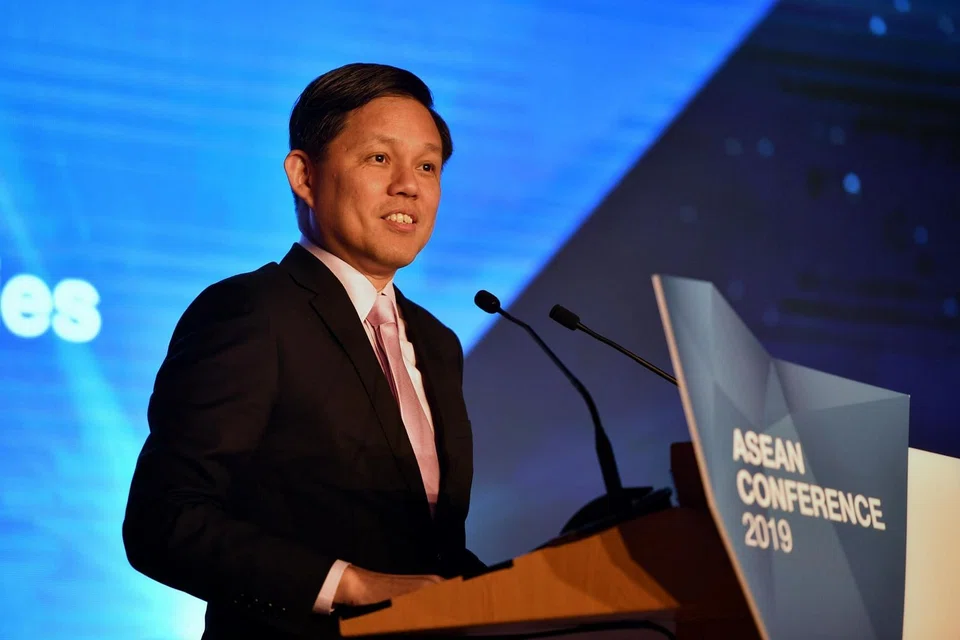
SINGAPORE must "brace for greater economic headwinds in the year ahead", though the country's strong fundamentals and strategies will help it tackle these challenges, Minister for Trade and Industry Chan Chun Sing said on Wednesday.
Speaking at the National Center for Asia-Pacific Economic Cooperation Executive Forum, he also called upon business leaders to help governments understand the digital economy's opportunities and challenges.
In his speech, Mr Chan noted that global growth is expected to slow, with uncertainties and risks also remaining in the form of trade tensions, slowing growth in China, Brexit-related uncertainties, and pressures on the World Trade Organization (WTO).
Weaker global demand is expected to weigh on Singapore's growth this year, with recent data suggesting that outward-oriented sectors will remain weak. Amid continued uncertainty, Singaporeans "should stay alert but not afraid", he said, laying out reasons for confidence.
First, Singapore has strong fundamentals. It remains "a safe harbour for companies looking to invest in the region", with a principled stance amid increased polarisation, as well as a belief in free trade.
Second, Singapore is working to uphold the rules-based international trading system: playing a role in WTO reform discussions; leading efforts to create new rules on e-commerce, alongside Australia and Japan; and deepening ties through trade pacts and collaborations.
Having recently returned from Regional Comprehensive Economic Partnership (RCEP) talks in Thailand, Mr Chan said it is "very clear to all the Asean member countries that there is great need, a great urgency for us to conclude the RCEP this year". The proposed free trade agreement involves the ten Asean members as well as Australia, China, India, Japan, South Korea and New Zealand.
Third, Singapore is investing heavily in educating and training a skilled workforce that can take advantage of new opportunities created.
Addressing public and private sector representatives from the Asia-Pacific region, Mr Chan highlighted the role that businesses themselves must play. Firms must invest in their own training structures and processes, and explore new markets, he said.
"Finally, business leaders also have an important role to help shape their respective governments' stance towards greater digital integration and the upholding of a rules-based global economy," he added.
Not all governments have the same understanding of the digital economy, and some may "wrongly" apply "artificial geographical boundaries" to the concept of data, treating it like a physical commodity.
But sharing data does not deprive others of access to it. Rather, the more that data is allowed to flow freely - taking into account privacy and security issues - the greater the opportunities, he said.
In the ensuing fireside chat, Mr Chan noted that apart from preparing workers for the digital age, firms can provide thought leadership on the importance of digital integration instead of fragmentation.
Big firms should work with authorities to formulate pro-business, progressive rules, he added. Rules need not be defensive, and can instead enable "good things to happen".
Data fragmentation is part of a larger danger of "regressing to a fragmented system", he warned. A hundred years ago, the world faced a choice between open economies and protectionism - and made "the wrong choice", leading to the Great Depression and arguably World War II. Today, facing a similar choice, the world must decide correctly, he said.






