

Building, marine, process sectors still struggling to get entry for workers
Some bosses speak of uphill battle to get approvals, especially for workers from India and Bangladesh; result has impacted projects and planning
Singapore
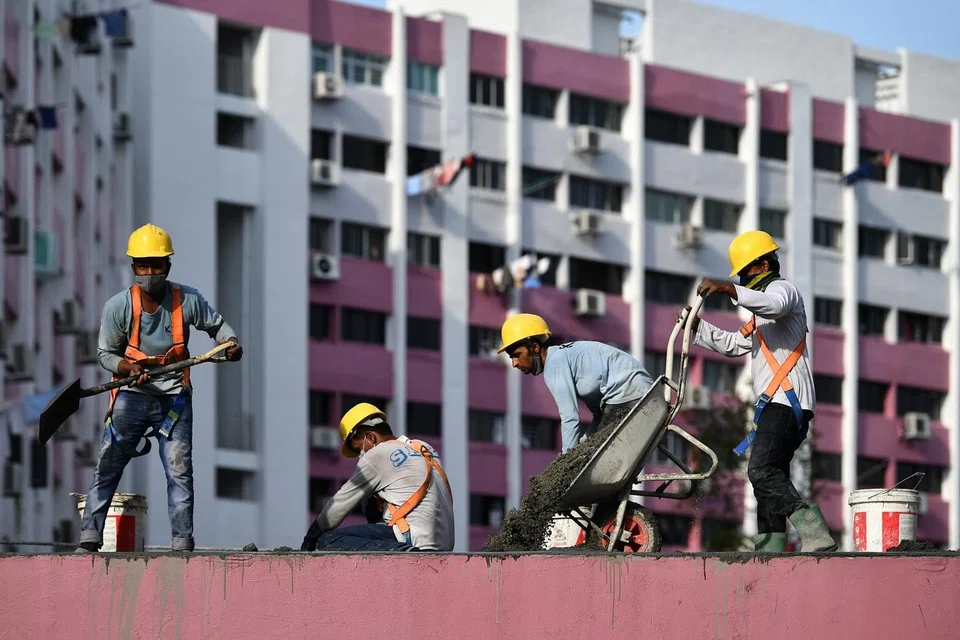
EMPLOYERS in the construction, marine and process (CMP) sectors continue to face difficulties getting entry approvals for their work permit holders - particularly those from India and Bangladesh - with some having submitted their applications repeatedly for months, only to face rejections multiple times.
Most are understanding of the current circumstances, and recognise that the government is in a catch-22 situation: bring in too many foreign workers at a go, and the country risks seeing an increase in imported Covid-19 cases.
But the lack of certainty on when workers can come in makes it difficult for employers to plan ahead. Many are still struggling to meet their contract deadlines, and have a tough time planning for their manpower or taking on new projects.
"I think there's a lot of rumour or speculation about how the (entries) are approved, but the exact requirement or criteria, I think nobody knows, except the authorities," said Thomas Oh, director of Beng Khim Engineering and Construction. "We just have to continue trying and hope that it will be approved."
Checks with eight other employers in the CMP sectors found similar circumstances. Many have submitted applications multiple times, only to be rejected. Some eventually saw success.
Some sources speculated that foreign workers from countries with a lower rate of infection, such as China, tend to get a higher rate of approval compared with countries such as India and Bangladesh, that are still hard-hit by the pandemic.
In response to queries from The Business Times, a spokesperson from the Ministry of Manpower (MOM) said the ministry "adjusts entry approvals dynamically, depending on the global Covid-19 situation and risk levels of countries and regions our work pass holders come from".
But the bulk of foreign workers in the CMP sectors now come from India and Bangladesh, said those in the industry. As such, the manpower crunch remains rife.
"The Chinese themselves are no longer as keen to work in Singapore because of the closing gaps in wages between China and Singapore," said David Leong, PeopleWorldwide Consulting's managing director.
Heatec Jietong, which provides piping and heat exchanger services for the marine, petrochemical, oil, and gas industries, is one employer facing difficulties getting the necessary approvals for its foreign employees.
Since last December, group general manager Jenson Soon said he has been applying for entry approvals for six of his workers from India and Bangladesh - who were previously working in Singapore and had returned to their home countries prior to the onset of the pandemic - but to no avail. The rejections from MOM read: "The entry of pass holders needs to be staggered. This is to reduce the risk of importing Covid-19 and safeguard public health."
The e-mails provided alternative arrival dates that could be used for "a higher chance of an approval", but subsequent applications continued to be rejected.
"The main issue is (that) there is no concrete date when these workers can come in, so that we can at least plan for it," said Mr Soon, adding that there is also no certainty on whether the workers "will still be interested to come work with us in Singapore even when the entries are approved, which seems to take forever. (They) have been waiting since December and also need to find other work for money".
MOM told BT that in light of the entry restrictions arising from the pandemic, it has automatically extended the validity of In-Principle Approvals (IPAs) for work permit holders from the CMP sectors who are still outside of Singapore, till end-June this year. No further action is required from these employers and MOM will review whether there is a need to extend the IPAs beyond June 2021. Prior to this, IPAs - one of the requirements for getting foreign workers into Singapore - were only allowed to be extended once, and for up to one month.
Lim Ah Cheng, chief executive of Dyna-Mac Holdings, an engineering, procurement and construction firm for the offshore and renewable sectors, said his company has close to 300 foreign workers with IPAs. Of these, about 10 per cent have been granted entry approvals to date.
He said the situation has seen marked improvements, particularly after actively engaging with the government agencies. Mr Lim said his company currently has some projects that are facing delays, and is operating at 70-80 per cent of its original capacity. To overcome this, the company is outsourcing some of its fabrication work to local and overseas partners and multi-skilling its workers, among other measures.
James Yuen, director for Singapore operations at Gammon Construction said some of his projects have been delayed by three to six months. Heatec's Mr Soon said he faces delays of about three to four months.
Kenneth Loo, executive director and chief operating officer of Straits Construction, said that with no resource clarity, companies have to plan for existing and future projects according to "what we have now".
"I believe (the authorities) are trying to find a solution... (and) are doing their best, but of course some clarity, (such as) how many workers we are able to bring in every month, information like that is useful," said Gammon's Mr Yuen.
A marine industry expert, who declined to be named, said that while revealing such numbers might not necessarily help companies to better plan for their manpower as they are not company-specific, it at least provides employers with some peace of mind. "I think having that transparency facilitates the industry feeling that they are being given (the manpower)... that my sector is not being overlooked," he said. The authorities could also look into "ringfencing" the quotas according to sectors, rather than having the different industries compete for a pool of entry approvals, he suggested.
Meanwhile, PeopleWorldwide's Dr Leong said that given the current circumstances, it's "hard to provide any fair transparency on this, and it's best left to MOM to regulate the flow based on national priorities and criticality of the roles involved".
MOM said it will continue to monitor the situation "closely", and will "adjust our measures to better support employers and workers".
READ MORE:
TRENDING NOW

Far East Organization’s The Serra Residences sells less than a quarter of units released at average S$3,460 psf

MAS, SGX must address our IPO problem

A bumpy road ahead for some of Singapore’s fresh graduates in their job search

Once staunchly pro-China, Malaysian Chinese businesses are now distancing themselves from Beijing

