

Casinos can't survive on local 'revenge gamblers' alone
But reopening of gaming operations a big help, as they make up bulk of revenue at both resorts

Singapore
SINGAPORE'S tourism attractions were given the go-ahead to reopen their doors this month - but the litmus test for the integrated resorts (IRs) will be whether their core casino operations can be sustained by domestic punters.
It will be tough for Genting Singapore and Las Vegas Sands Corp, which operate the two IRs, to survive on domestic business alone. That's according to gaming industry analysts who spoke with The Business Times.
And blood is already in the water: Resorts World Sentosa (RWS) resorted to job cuts in a retrenchment exercise on Wednesday, amid what it called the pandemic's "devastating impact".
Investors keen to hold a slice of the gaming industry in their portfolios may be better-off looking outside the region. Singapore's players are hampered by a reliance on an international market, the analysts noted.
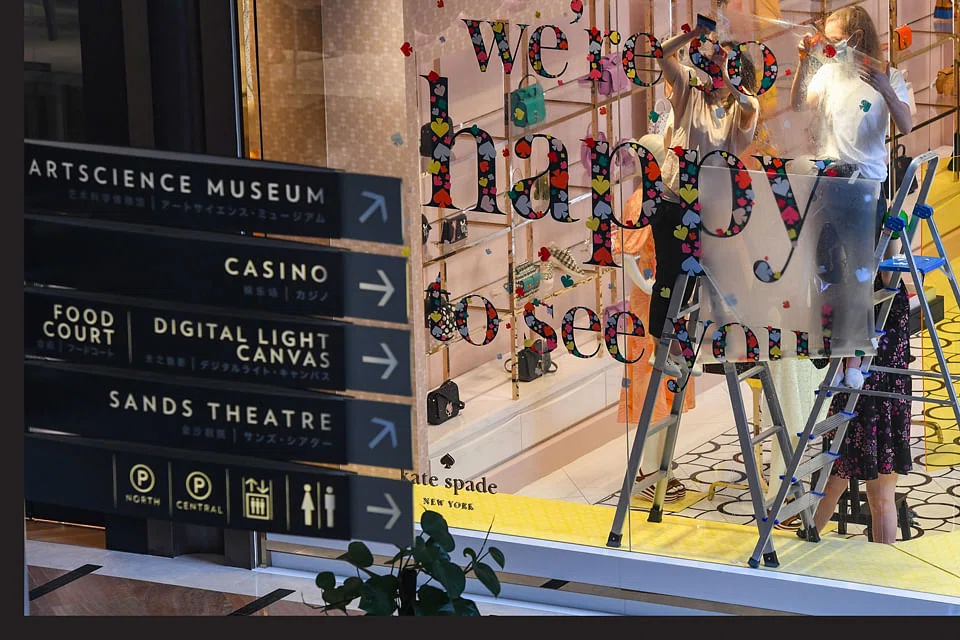
After a painful "circuit breaker" that shuttered non-essential businesses in April and May, the Singapore Tourism Board (STB) let just over a dozen attractions reopen from July 1 onwards. These include venues at Marina Bay Sands (MBS) and RWS.
MBS, which initially restricted non-gaming venues to loyalty club members when it reopened retail operations on June 19, has reopened them to the general public since July 6.
A spokesperson said that MBS has seen "a steady momentum in terms of visitorship", including full covers at three restaurants over the first weekend.
Meanwhile, RWS has reopened the Universal Studios Singapore theme park and S.E.A. Aquarium on certain days of each week. A spokesperson added: "During the first weekend of our reopening, footfall in our attractions was brisk and enthusiastic."
Yet the reopenings are not without caveats. Under STB regulations, the operating capacity of most attractions has been capped at 25 per cent. Casino access at both IRs is for members and annual levy holders only.
Chua Hak Bin, a senior economist at Maybank Kim Eng, said that the reopening of the IRs is not expected to materially affect the outlook for Singapore's economic growth, which is tipped to fall into recession this year.
"The IRs and recreation sector will only recover meaningfully - hopefully in 2021 - when a vaccine becomes widely available," he added.
Still, equity analysts showed moderate optimism over the move.
"We are positive that facilities are open for both players as it will stem both operators' monthly cash burn," said CGS-CIMB analyst Cezzane See, who covers Genting Singapore.
Stock watcher Jason Sum of DBS agreed that the gradual reopening will "bring much-needed respite".
The resumption of gaming operations is particularly important, given that this segment has made up the bulk of revenue at both resorts.
Casino operations accounted for 69.9 per cent of MBS's US$3.1 billion haul in the year to Dec 31, 2019, with rooms a distant second at 13 per cent. Similarly, gaming made up 65.4 per cent of RWS's S$2.48 billion in Singapore IR revenue for that period.
Using the mass gaming segment as a proxy for local visitors, Mr Sum believes that MBS has "moderately higher exposure to the domestic market".
Yet market watchers estimated that locals contribute no more than two-fifths of overall industry revenue - so the reopening benefit to the two IR operators may still be muted.
"Besides, the economic conditions for quite a few business owners are worse off," KGI Securities senior research analyst Chen Guangzhi told BT. "Hence, I doubt the local VIPs are willing to wager big bucks now."
DS Kim, head of Asia-Pacific gaming and leisure research at JPMorgan, was more upbeat. He estimated that demand from local betters "could quickly come in to 70 per cent to 80 per cent" of the pre-pandemic era.
But Mr Kim warned that, after a tough first half - including what Ms See called an "especially weak" second quarter - the industry may only just begin to break even in October.
KGI's Mr Chen thinks the two operators could see full-year Singapore turnover halved year on year, saying: "Conservatively speaking, the two local operators could only be back to normal in the second half of 2021."
In contrast, Malaysia has a larger domestic market, while Macau can tap the spending power of mainland Chinese. Some of the names in the region are Genting Malaysia, Australia's Crown Resorts, as well as the Hong Kong-listed casino operators Wynn Macau, Sands China, SJM Holdings, and Galaxy Entertainment Group.
At the same time, KGI's Mr Chen pointed out that "the Covid-19 crisis will not last permanently, so tourism will recover eventually" in Singapore.
DBS' Mr Sum also noted that "Covid-19 has not affected the significance of Singapore properties to the operators", as it is usually "a very lucrative market" for both the Genting Group and Las Vegas Sands Corp.
TRENDING NOW

Looking beyond looming CEO succession, should UOB potentially pursue a transformative merger?

Once staunchly pro-China, Malaysian Chinese businesses are now distancing themselves from Beijing

Family offices ‘kept captive’ by relationship managers turn to independent advisers, direct deals
MAS holds monetary policy settings, pausing after two straight tightenings

