

China November output slows as skies clear
Singapore
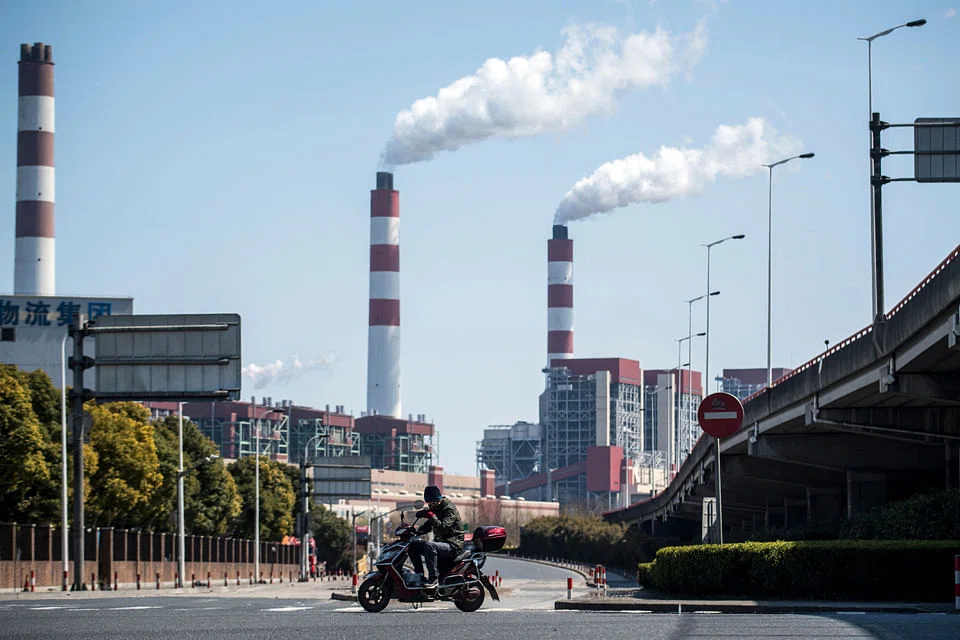
CHINA'S industrial output slowed last month as the government continued its war on polluting factories and closed coal-burning furnaces.
Growth of output in China's millions of factories slowed to 6.1 per cent, its second lowest reading since December 2016, the National Bureau of Statistics said on Thursday.
Much of China's factories in the north have had to halt all or part of their production until March while local governments have cut back on coal to heat households leaving thousands without heating as infrastructure to supply gas is lacking.
Aluminium output fell for a fifth consecutive month in November to its lowest since February 2015.
The measures to clean the skies seem to be working after Greenpeace reported that last November was the cleanest ever on record for Beijing.
"Industrial output growth has continued to soften, most likely as a result of disruptions from the pollution crackdown in the north-east of the country," said Julian Evans-Pritchard, senior China economist at Capital Economics.
Meanwhile, fixed-asset investment grew at its slowest annual pace in 20 years, rising 7.2 per cent in the 11 months to November. This is the fifth consecutive month that investment growth fell as the government scaled back on infrastructure projects.
During a major political meeting held last month in Beijing, President Xi Jinping laid out China's goals for the next decades, insisting that times of rapid short-term gains were over and that shifting China to a sustainable growth model was key to positioning the country as a global power.
While this is not the first time the Chinese leadership has said it needs to chart a new road for growth, it is the first time local governments have been pressured to sacrificing growth to implement environmental norms.
China has also actively been cracking down on lending to local governments and holding back on investing in unprofitable projects. Separately on Thursday, the People's Bank of China raised interest rates on two monetary policy instruments after the Fed's recent interest rate increase.
And the government is also tackling a structurally over-heated real estate sector which is driving the middle-class out of city centres. Property investment slowed to 7.5 per cent on-year in the 11 months to November, from a 7.8 per cent gain in the first 10 months.
However, analysts say any major slowdown of the economy is unlikely. Other economic indicators performed well last month. Retails sales grew 10.2 per cent against 10 per cent in October, while new construction starts measured by floor area accelerated 6.9 per cent from January to November
The two sets of manufacturing data, PMIs, published earlier this month both came in well above the 50 point mark.
"Overall, economic growth held up well in November, benefiting from stronger exports and resilient real estate activity," wrote Louis Kuijis, head of Asia economics at Oxford Economics in Hong Kong.
"Recent statements by policymakers confirmed a gradual shift in the macro policy stance towards somewhat less emphasis on growth and more on reducing financial risk."
However, after posting strong GDP growth in the beginning of the year, recent signs are showing that growth has peaked and will slow in the following quarters. Third-quarter growth while remaining robust fell slightly to 6.8 per cent from 6.9 per cent the previous two quarters.
Next week policy makers are to meet in Beijing to set growth targets for 2018. While a GDP target is to be maintained analysts expect the target to be dropped to between 6-6.5 per cent.
"Slowing output and investment growth adds to our conviction that real GDP growth peaked in the first half of 2017 and may continue to slow in the quarters ahead. We maintain our forecast for real GDP growth of 6.6 per cent in the fourth quarter of 2017, before falling to 6.4 per cent in 2018," said Yang Zhao, economist with Nomura.
READ MORE: China raises market rates to fend off financial risks; growth moderates
TRENDING NOW

Singapore’s central gas buyer affirms Indonesia’s role as ‘important partner’ amid export review warning

Why the biggest business decision about AI isn’t which model to choose

Is Manila Asia’s new dining hot spot?

KKR founders among investors buying 42% of Peter Lim’s Valencia; club valued at US$1.4 billion

