

China unleashes US$483b margin trader to stem stock rout
Beijing
CHINA has created what amounts to a state-run margin trader with US$483 billion of firepower, its latest effort to end a stockmarket rout that threatens to drag down economic growth and erode confidence in President Xi Jinping's government.
China Securities Finance Corp (CSF) can access as much as three trillion yuan (S$660 billion) of borrowed funds from sources including the central bank and commercial lenders, according to people familiar with the matter.
The money may be used to buy shares and provide liquidity to brokerages, the people said, asking not to be named because the information wasn't public.
While it's unclear how much CSF will ultimately deploy into China's US$6.6 trillion equity market, the financing is up to 25 times bigger than the market support fund started by Chinese brokerages earlier this month. That's probably enough to restore confidence among China's 90 million individual investors, says Bocom International Holdings Co.
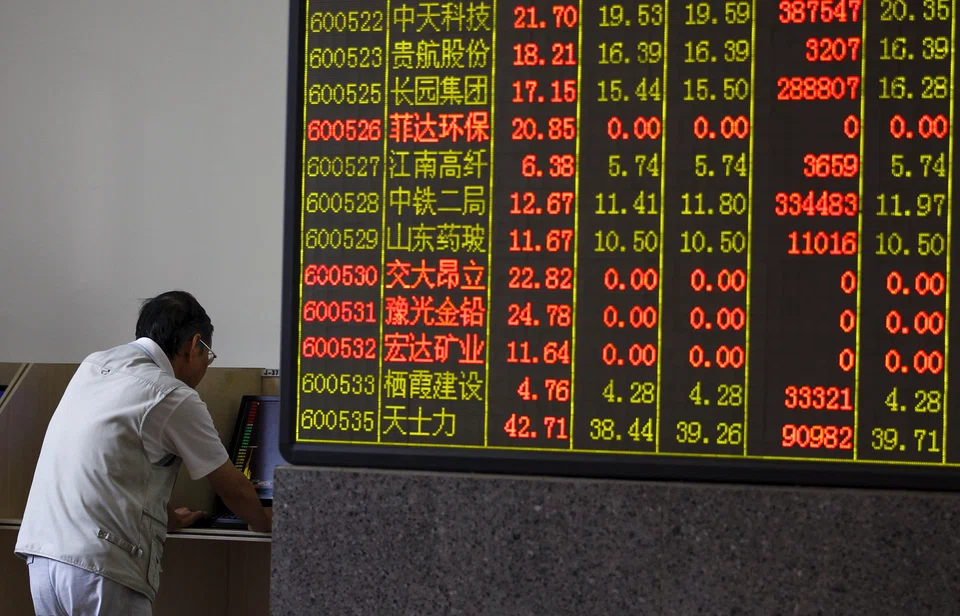
The Shanghai Composite Index jumped 3.5 per cent on Friday, capping a two-week rally that's turned it into one of the world's best-performing equity gauges. "It doesn't have to use up all the money, as long as it can make the rest of the market believe that it has enough ammunition," pointed out Hao Hong, a China strategist at Bocom International in Hong Kong. "It is a game of chicken. For now, it seems to be working."
CSF, founded in 2011 to provide funding to the margin-trading businesses of Chinese brokerages, has transformed into one of the key vehicles for the nation's stockmarket rescue package. At three trillion yuan, its funding would be about five times bigger than the new proposed bailout for Greece and exceed China's 2.3 trillion yuan of regulated margin finance during the height of the stockmarket boom in June.
"What the authorities are demonstrating to the market is that if panic does take hold, they have the resources at their disposal to deal with that," said James Laurenceson, the deputy director of the Australia-China Relations Institute at the University of Technology in Sydney. "Monetary authorities around the word regularly send the same signal in credit and foreign exchange markets."
CSF had 2.5 trillion yuan to three trillion yuan of funding available as of this week, with the exact amount constantly changing, the people familiar with the matter said.
Chinese policymakers have gone to unprecedented lengths to put a floor under the market as they seek to bolster consumer confidence and prevent soured loans backed by equities from infecting the financial system. Over the past few weeks, they've banned large shareholders from selling stakes, ordered state-run institutions to buy shares and let more than half of the companies on mainland exchanges halt trading.
China isn't the only market with a history of intervention. Hong Kong authorities bought US$15 billion of shares to prop up prices during the Asian financial crisis in 1998, while the Securities and Exchange Commission temporarily banned short selling of some stocks during the global financial crisis seven years ago.
America's Congress authorised US$700 billion for the so-called TARP programme in 2008 to help re-capitalise the nation's banking system.
It also granted the government power to take over mortgage-finance companies Fannie Mae and Freddie Mac.
While the measures in China have helped support stock prices, critics say intervention undermines the country's pledge to increase the role of markets in the world's second-largest economy. Money managers have warned that government meddling threatens to further delay the entry of mainland stocks into MSCI Inc's global benchmark indexes.
"The downside of the government's recent aggressive moves is that it's moving backward in terms of market liberalisation," said Chen Xingyu, a Shanghai-based analyst at Phillip Securities Research. "It's creating moral hazard in the market as investors are reassured that the government will step in."
One of the biggest hurdles to sustaining gains in Chinese shares may be that they're simply too expensive given the nation's slowing economic growth. The median trailing price-to-earnings ratio on mainland bourses is 66, higher than in any of the world's 10 largest markets. Concern that valuations are still too rich helped fuel a record stretch of foreign outflows via the Shanghai-Hong Kong exchange link over the nine days ended Thursday.
George Magnus, a senior independent economic adviser to UBS Group, said on Thursday that the Shanghai Composite may drop as much as 35 per cent because its rally was never justified by the growth outlook. While the stockmarket boom helped China's economy expand a faster-than-estimated 7 per cent in the second quarter, annual growth of that magnitude would be the slowest since 1990.
For Chen Gang, the chief investment officer at Shanghai Heqi Tongyi Asset Management Co, the CSF funding buys time for policymakers to put the market on a more solid footing by reducing the use of unregulated margin finance. Eventually, it will convince mainland investors to put cash back into stocks, he pointed out.
"Once the confidence is back, money that's staying on the sidelines will start to trickle in," Mr Chen added. "I would say there's no battle that the Chinese government can't win." WP
READ MORE: Beijing determined not to let sell-off hurt growth
TRENDING NOW

Motoring tycoon Peter Kwee is back in court: Here are his previous legal battles

Peter Kwee’s Ridley Park bungalow on the market with S$100 million asking price

Demand, tech capabilities position Apac and AI as Skyscanner’s next growth frontiers: CEO Bryan Batista

South-east Asia has lost Nvidia’s best salesman

