

China's economy is 'resilient, has huge potential'
President Xi also explains to US business leaders and former officials reasons behind economic slowdown
Beijing
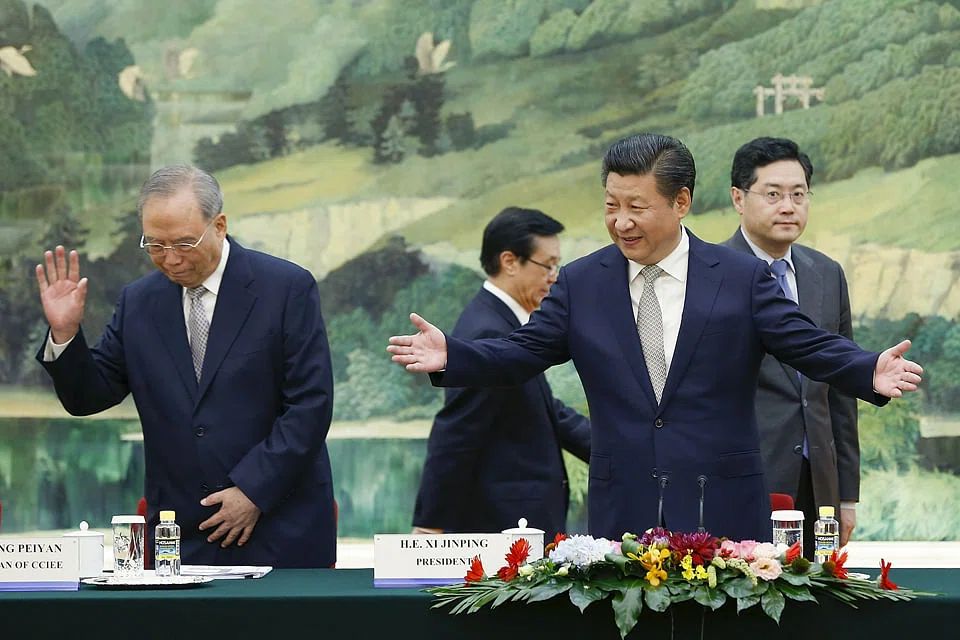
CHINA's economy is resilient and has the capacity to maintain a long-term medium-to-high growth rate, state media reported President Xi Jinping telling US business leaders and former officials.
Mr Xi said slowing growth was the result of the country shifting to a different mode of development, adjusting its economic structure and digesting earlier stimulus moves, according to the Xinhua news agency and state broadcasters.
Speaking to the business leaders in advance of his trip to the United States next week, Mr Xi acknowledged that the economic slowdown has raised international concern.
The economy has huge potential and room for manoeuvre, Mr Xi was reported to have said.
China's economy is on track to post its slowest growth in 25 years and a big crash in the stock market has added to uncertainty.
Mr Xi will meet President Barack Obama next week during his first state visit to the US, with lack of business access adding to tensions that include cybersecurity, the valuation of the yuan and territorial disputes in the South China Sea and East China Sea.
"This is about the worst time I've seen for multinationals in China," said James McGregor, Shanghai-based author of the 2012 book No Ancient Wisdom, No Followers: The Challenges of Chinese Authoritarian Capitalism, who has worked in China since 1990. "You now have a very powerful Chinese economy and a powerful Chinese government that seems to be making less room for foreigners and reserving a bit more for Chinese companies."
At stake for China is its ability to transition to a new growth model reliant more on services and consumption than investment and exports. Foreign investment played a pivotal role driving China's rise as a manufacturing juggernaut since it opened to the world in the late 1970s.
That was enhanced by its accession to the World Trade Organization in 2001, which opened its domestic market to greater competition and helped power a decade of double-digit growth. Service industries were either excluded from the WTO agreement or opened only fractionally.
"China used the WTO and foreign investment to turn itself into a manufacturing powerhouse," said David Loevinger, a former China specialist at the US Treasury. "It can do the same with services."
Concluding a bilateral investment treaty that's under negotiation between China and the US would be a step in the right direction, said Mr Loevinger, now an analyst at fund manager TCW Group Inc in Los Angeles. "While both sides are still far from an end game, Xi's upcoming meeting with Obama is an important opportunity to gain some serious yardage and move the ball down the field," he said.
Hopes triggered almost two years ago by the leadership's vow to give markets a "decisive" role have given way to subdued optimism in an emerging environment of "reform and closing up", the European Union Chamber of Commerce in China said in a report this month.
More than 30 per cent of members of the American Chamber of Commerce (AmCham) in China have no investment expansion planned this year, the highest rate since 2009, and more companies than ever have moved or plan to move capacity outside of China, an AmCham report said in April. REUTERS, BLOOMBERG
READ MORE: Market overreacting to changes in China, says DBS chief
TRENDING NOW

Nvidia reinstates Jensen Huang as CEO; Trump says move poses no national security risk

Beyond the greenback, Vietnam’s big borrowers turn to Asian-currency bonds

Indonesia’s coal tycoon Low Tuck Kwong replaced as Bayan Resources president-director

Six workers file employment claims against Crystal Jade Food Manufacturing

