Covid-19 prompts spurt in new, small businesses like no other crisis
Boom in cellphone use, digital platforms seen as cost-efficient way to reach consumers; exit of some players has prompted others to enter market

Singapore
THE Covid-19 crisis has thrown Singapore into its worst recession since independence. But it has also ignited the biggest spark of small business formation in crisis times.
The Business Times found that the Republic has seen a mushrooming number of businesses formed over the past five months - since emerging from the partial lockdown in June - and across the year.
Critically, this upward trend is unlike past crises, such as the Global Financial Crisis in 2008/09 and the Asian Financial Crisis a decade before that. In both times, the pace of business formations weakened.
There was a gradual increase in new businesses formed in the wake of the Sars outbreak in 2002/03, but the uptick is steeper this year.
Coming out of the two-month "circuit breaker" in June, the number of new business entities per month formed went up by 17.8 per cent, from 3,804 in May to 5,563 in June.
All in, 30,304 new businesses were registered from June to October, compared with 22,138 in the first five months of the year, figures from the Accounting and Corporate Regulatory Authority (Acra) showed.
The bulk of the new entities formed are small companies and startups. Figures from data analytics firm Handshakes show that between 87 per cent and 92 per cent of the new monthly incorporations from January to October are of companies with less than S$100,000 in issued capital. These numbers exclude sole proprietorships and partnerships.
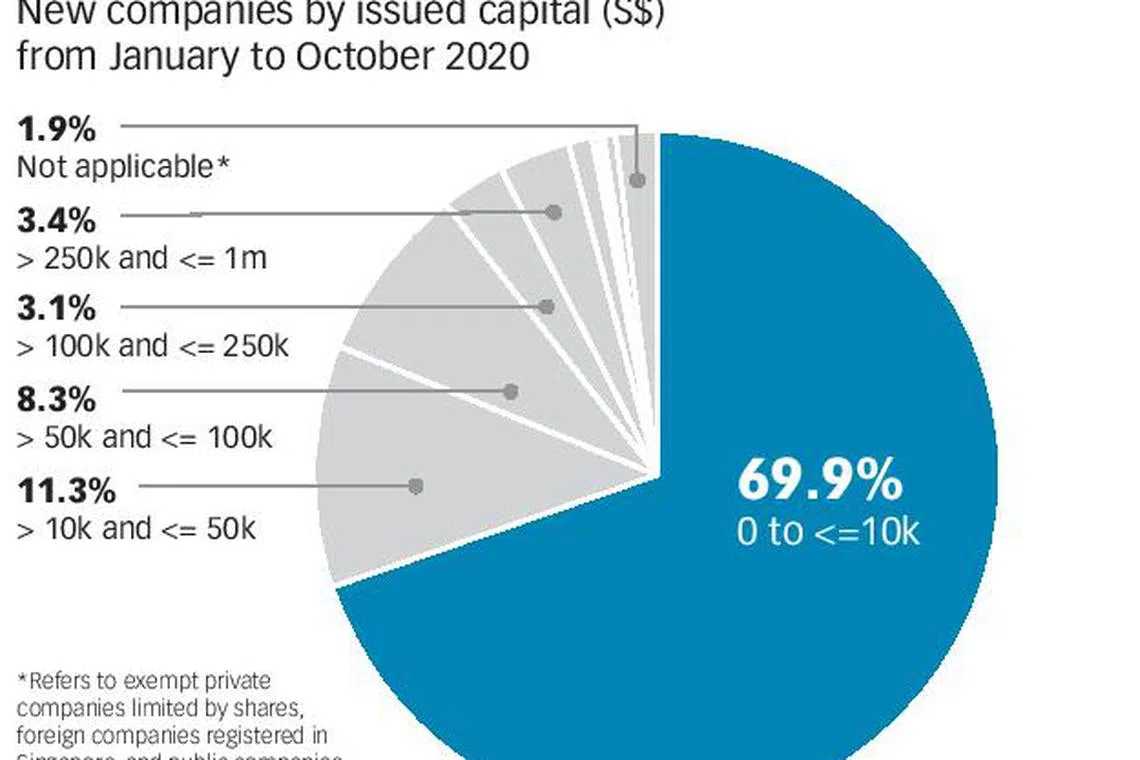
About seven in 10 of new companies formed over the same period have started out with less than S$10,000 in issued capital.
Several factors are at play. New business owners are hopeful that digital platforms will be a cost-efficient way to reach consumers who are tethered even more to their smartphones and devices in the post-Covid era. The digital boom was not fully present in the other crises.
Some budding entrepreneurs have found technology a critical enabler. Adeline Chen, who started Allegro Fine Wines with her husband in May, attributes growing sales to the e-commerce boom amid the pandemic.
Their business, which sells Italian wines entirely online, was kickstarted with the help of the Economic Development Board's productivity solutions grant. The grant helps companies adopt new technologies to enhance business processes. It took three to four weeks for the productivity solutions grant to be approved.
"We have been deliberating about bringing in these wines from Italy for over a year, but the pandemic was what spurred us into action. It's a 'now or never' mindset," said Ms Chen.
Food and beverage (F&B) services as well as retail trade are among the business sectors that have seen the steepest increase in new entities formed this year. There was an 89 per cent increase in new F&B businesses formed from June to October (1,682 entities), versus January to May this year (889 entities). Retail trade saw an 86 per cent jump in new businesses formed, from 2,566 entities in January to May, to 4,769 from June to October.
Both the F&B and retail sectors are particularly tough trades, and have been clobbered by lockdown measures. Even before the pandemic, the traditional retail sector had been battling the inevitable take-off in e-commerce, observers have said.
NUS business professor Wong Poh Kam said the new burst of small-business activity in the retail and F&B sectors is most likely pushed by an uptick in e-commerce and online-delivery services. There has been a reported surge in interest in online retail amid the pandemic, whereas other retail sub-sectors have seen little change to their active entity numbers over the past two years.
Handshakes's analysis also shows that almost half (49.3 per cent) of new retail entities formed over the last 10 months retail via the Internet, with the bulk of their income coming from online sales.
Some may also eye opportunities where others have left, said Singapore Retailers Association executive director Rose Tong. "Former suppliers to Robinsons may now be opening up their own companies and running stores themselves as opposed to being a distributor," she suggested, referring to the high-profile closure of the department store stalwart.
Existing businesses may be diversifying into new businesses as part of their ringfencing or restructuring strategy. "Disruptions due to Covid-19 may present new opportunities for some businesses and entrepreneurs. We have observed that businesses in strong financial positions may expand and diversify into other areas of growth to mitigate risks," Singapore Business Federation chairman Ho Meng Kit told BT.
Andrew Tan, who co-founded Japanese lifestyle store atomi with his wife, is one such entrepreneur. He plans to incorporate a new company to focus on business consulting.
"It makes sense for existing companies to set up companies for new services and product lines that they want to experiment with, so as not to harm the mothership or main brand," he told BT. "Incorporation doesn't cost a lot and the process is relatively easy. And you do need to set up a company to qualify for some of these grants and deferments from the government and banks."
Professor Foo Maw Der from the Nanyang Business School noted that those who have lost their jobs or been temporarily laid off may also be starting businesses in sectors with lower barriers to entry. "Many of the new businesses are those that require less financial capital. Some sectors such as F&B and administrative support services could be run out of the home. Operating costs have also gone down with rental rates falling this year," he said. Prof Foo cited the example of Kevin Khoo Bistro, a new restaurant in the Central Business District set up by grounded crew members of Singapore Airlines in October.
He added that the number of new businesses established had been falling around the end of last year, prior to the onset of the pandemic. This, coupled with stringent movement restrictions in the middle of this year, may mean that some who had put off their business plans earlier are now making up for lost time, he said.
Business cessation numbers have not shown significant trends over the past 10 months - except for a dip from July to August, and then a spike after that. But Acra had explained that this was likely due to administrative delays as a result of the circuit breaker. Still, observers expect cessations to go up in the coming months, especially as relief schemes are set to expire at the end of this year.
Prof Foo said: "Another reason is that during the earlier parts of this year, the government's efforts were directed toward encouraging business survival and preserving jobs. But now, there is an acknowledgment that some businesses that cannot survive the new normal will have to either pivot or go out of business."
Prof Wong of NUS also noted the lag between business failures and actual winding up. "Debt repayment negotiations and lawsuit settlements can take months, if not years. Firms can stay dormant for years without being struck out."
READ MORE: Singapore banks boost support for micro businesses