

Deep understanding of Asean is key to seizing opportunities: panellists
Minister for Trade and Industry Chan Chun Sing says it is crucial to maintain S'pore's role as a gateway to Asean
Singapore
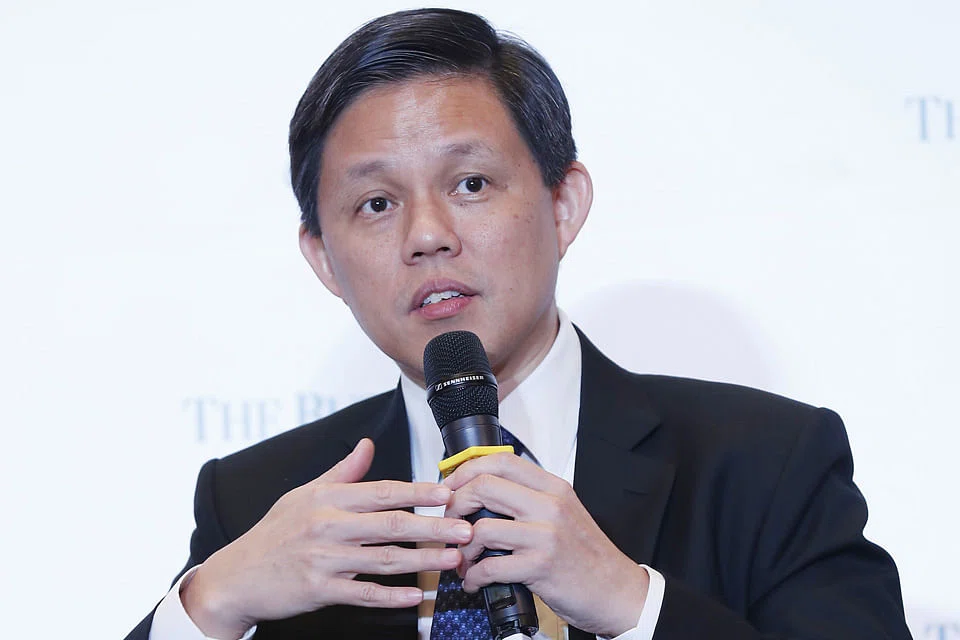
CONTRARY to popular belief, China's Belt and Road Initiative (BRI) consists of more than just large-scale, infrastructure projects, and Singapore can be an effective partner for China to enter the region if it plays its cards right, said Minister for Trade and Industry Chan Chun Sing on Monday.
"The Chinese are looking to invest in Asean and many other parts of the world in non-infrastructure projects - we should not miss that opportunity," he added.
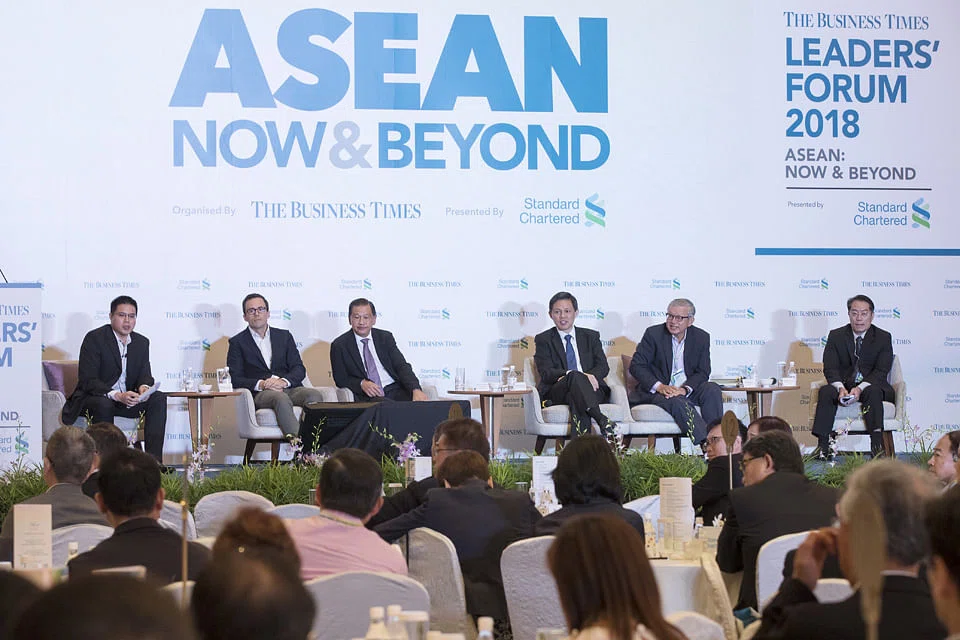
He was speaking as a panellist during a discussion at The Business Times Leaders' Forum, attended by almost 300 business leaders in Shangri-La Hotel.
For 11/2 hours, Mr Chan and fellow panellists Liew Mun Leong, chairman of Changi Airport Group and Surbana Jurong Private Limited; Alexis Lanternier, CEO of Lazada Singapore; Ho Meng Kit, CEO of Singapore Business Federation (SBF); and Tan Soon Kim, assistant CEO of Enterprise Singapore, spoke on the challenges and opportunities in Asean. This was moderated by BT's deputy news editor Lee U-Wen.
Mr Chan highlighted that one third of all Chinese outward investments go through Singapore, due to the attractiveness of the city-state's system of rules, laws, arbitration, syndication of loans, and syndication for projects.
"We can do many of these things in partnership with China, not just for the Chinese or the Singapore market, but for third party markets," he said.
He cited the example of Chinese e-commerce companies collaborating with local players to enter the Asean market, instead of doing it alone.
One reason is because Asean is still quite fragmented in several ways, said Mr Chan.
"Many people will say that it is difficult to penetrate the Asean market because the Asean countries are in different levels of development. But therein lies the opportunities for Asean companies - if we understand our markets well or better than other people, then there is a reason people outside want to work with us," he added.
This was the sentiment shared by Lazada's Mr Lanternier.
Chinese giant Alibaba has a controlling stake of above 83 per cent in Singapore-based e-commerce company Lazada. Mr Lanternier said that such investments present an "amazing opportunity" for small and medium-sized enterprises (SMEs) in the region.
"They want to invest in local SMEs like Lazada instead of doing everything themselves... The fact is that a lot of money is coming into the region, and you need to focus on the core value that you bring and go very fast."
But for Singapore to effectively capture opportunities in Asean and beyond, securing talent is key, said panellists.
Mr Lanternier said that one reason that businesses consider themselves an Asean company instead of belonging to just one country is because of the need for talent, especially in the field of technology, he explained.
Such tech talent is hard to find in the region, he added.
SBF's Mr Ho urged the audience - mostly business leaders - to signal to their workers the importance of going out into Asean for career progression.
"After all, if Asean is a central part of your growth strategy, you should be putting your best person in the region for business development," he said.
To maintain Singapore's role as a gateway to Asean, Mr Chan said that it is crucial for Singapore to deeply understand the regional markets to add value.
"It's not a choice. It's almost existential for us to understand the regional markets better than others," he said.
To do so, Singaporeans need to be prepared to live and work in Asean countries, as well as to go beyond the usual capital cities to get a deep understanding of the region, he said.
Closer to home, one top question posed by the audience is Singapore's economic relations with Malaysia, following the change in government after the latest elections.
As the two economies are closely intertwined, with many areas of mutual interest, Singapore will work with the Malaysian government of the day, both on the bilateral and multilateral fronts, he said.
On the Kuala Lumpur-Singapore high-speed rail, Mr Chan said that it is premature to say if Malaysia will review this.
"On our part, we will be fully committed to what we have undertaken under the bilateral agreement and we look forward to work with the Malaysians on this," he added.
Enterprise Singapore's Mr Tan said that Malaysia's "economic fundamentals remain strong", especially its consumer and infrastructure sectors.
"If we look at Malaysia in totality, the opportunities are still there," he said.
Panellist Mr Liew also gave his take on the issue: "In the case of business, we always say there are no long-term friends or long-term enemies. If you adopt the philosophy, then you will cater for different contingencies."
He shared his advice for doing business in the region.
"One, we only stick to clean business. Two, be politically neutral and never take sides. Be friendly with politicians, but never sleep with them," he advised.
This is the third edition of the BT Leaders Forum. Standard Chartered Bank returned as the presenting sponsor.
READ MORE:
TRENDING NOW

Grab CEO’s wife Chloe Tong on life with Anthony Tan and finding her purpose

Singapore-based Ryde accused of pump-and-dump fraud in class action lawsuit

Malaysia’s F1 return: A low-cost second chance, possible Singapore boost

Canada is upping oil flows to Asia, but South-east Asia’s refineries aren’t ready to handle them yet

