

Economists retain Singapore's full-year GDP forecast for now despite tighter Covid-19 rules

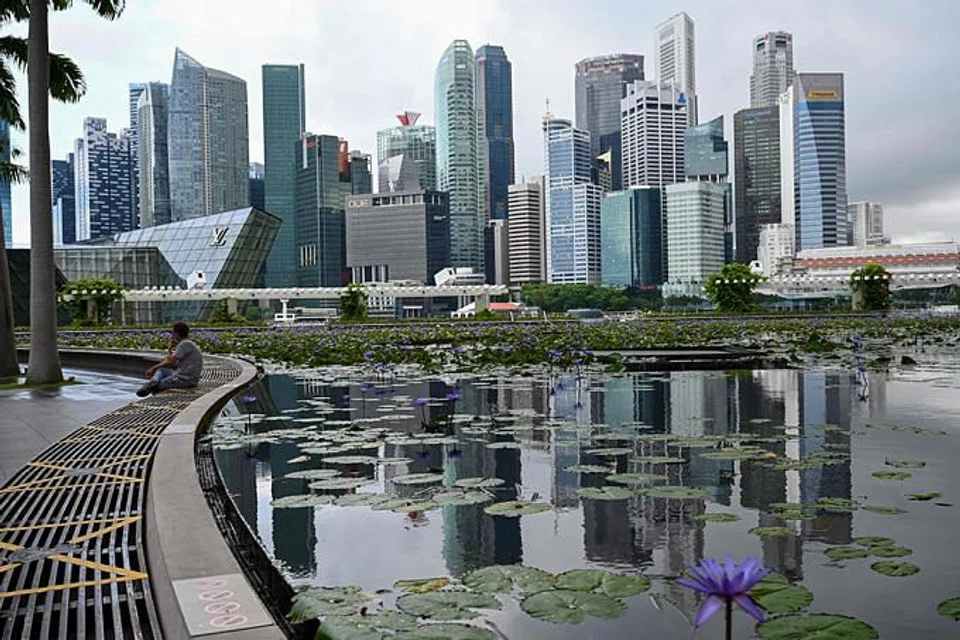
THE Straits Times Index shaved nearly 3 per cent on Friday following news of tighter Covid-19 restrictions set to last about a month from Sunday, but economists say they are not expecting the changes to throw Singapore's economic recovery off course for now, even if the services sector will take a longer time to make a comeback.
On Friday, Singapore's Covid-19 taskforce announced a ban on dining-in and a further reduction in the size of social gatherings from five to two, following the discovery of a new cluster at Changi Airport that taskforce co-chair Lawrence Wong described as "very worrying".
Workplaces will revert to working from home as the default, reversing earlier measures to allow up to 50 per cent of employees at the office.
Activities that require the removal of masks - such as dining-in, strenuous indoor exercise classes or facials - will also not be allowed.
These measures, which will last until June 13, come just slightly over a week after the multi-ministry taskforce announced Singapore's return to Phase 2 amid a spike in community cases driven by the B1617 variant that originated from India.
In a Facebook post, Prime Minister Lee Hsien Loong said the authorities are testing more intensively and "doing our utmost to ring-fence the transmissions", but the stricter measures are needed to stop more cases from popping up.
Selena Ling, OCBC chief economist, said the timing of the latest announcements may be a surprise, leading to a knee-jerk reaction in financial markets while denting confidence.
But on the whole, economists appeared sanguine when asked about the measures' potential impact on Singapore's gross domestic product (GDP), especially since most companies are likely to be better prepared to make these adjustments, compared with a year ago, when the Republic entered a "circuit breaker" or partial lockdown from April 7 to June 1.
"Economic activities will be hampered with the restrictions but because we have better procedures like TraceTogether and contact tracing in place, we will cope with it far better this time around," said Song Seng Wun, CIMB Private Banking economist.
He added that many food and beverage (F&B) firms have adapted to offering food delivery and takeout options when dining-in was similarly banned during last year's circuit breaker, which means they are unlikely to be in a "blind panic" this time.
Overall, the stricter measures could go some way in moderating the possible 15 per cent year-on-year rebound in the second quarter that economists had been anticipating, given the low base from Q2 last year, but it is not likely to leave a big dent.
Irvin Seah, DBS senior economist, is expecting Q2 growth to still hit about 14 per cent, on the assumption that the stricter measures do not last beyond four weeks.
"It hits mainly the F&B sector, which hasn't been a big driver of growth to begin with. We are also mindful that sectors like manufacturing continue to power ahead very strongly," said Mr Seah said.
OCBC's Ms Ling had projected a 6 per cent full-year growth, but said the downside risks may lower Q2's performance, which would thus bring her full-year growth forecast within the bracket of 5-6 per cent.
However, other economists are holding on to their full-year GDP outlook as they continue to watch the situation. The official growth forecast is 4-6 per cent.
Chua Hak Bin, Maybank Kim Eng senior economist, said he is maintaining his prediction of 6.2 per cent for the full year, which already factors in a sluggish services recovery.
"We will adjust the GDP forecasts if the stricter measures fail to contain the spread and are extended for another month into July," said Dr Chua.
DBS' Mr Seah also said his 6.3 per cent forecast already takes into account one quarter of sequential decline.
"By and large, the impact will definitely be felt, but it is at this point in time not enough to warrant a massive downgrade. If there's any downward adjustment, it will be more of a recalibration," said Mr Seah.
UOB economist Barnabas Gan said the further tightening of social distancing measures would likely add some "downside impact" to Singapore's retail sector, which could in turn inject marginal downside risk to his full-year outlook of 5.5 per cent. But for now, he is keeping his forecast until there is further clarity on how the situation evolves.
However, he warned that a rise in Covid-19 cases could push Singapore back into a circuit breaker, which could see the Republic "revisiting the prospect of a GDP contraction" like last year.
READ MORE:
TRENDING NOW

Two Singapore-listed palm oil firms named in Greenpeace report on Indonesian plantation fires
Singapore Airlines flight returns to San Francisco after ‘unruly’ passenger incident
Singapore looking into which companies responsible for haze-causing fires: PM Wong
Deluge IPO 3.86 times subscribed ahead of SGX debut

