EU bent on knocking London off top spot as financial activity hub
Already, 7b euros in dealings in European equities have migrated from London to the continent daily this month
London
THE European Union (EU) is determined to wrest control of euro, European securities and derivatives trade from London, with the British capital already experiencing some leakages.
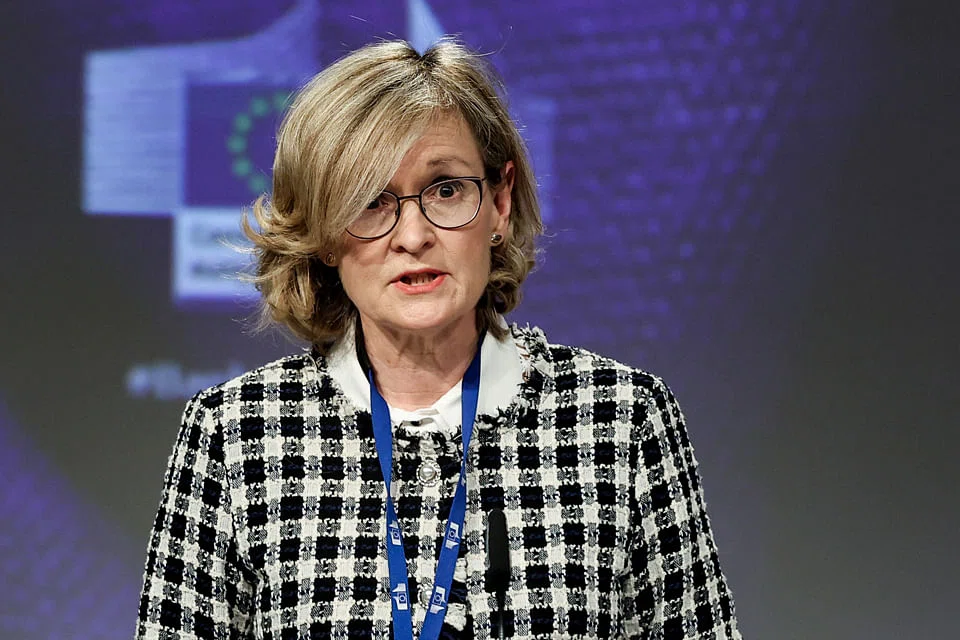
EU Financial Services commissioner Mairead McGuinness has said that Brussels will not grant Britain's financial firms access to the bloc before assessing the risks to financial stability.
Estimates are that, each day this month, some 7 billion euros (S$11.25 billion) in dealings in European equities has shifted from London to Paris, Amsterdam and Frankfurt so far in January.
To counter the shift in trade since Brexit, the City of London, the UK financial services industry, has made a deal with Switzerland to trade Swiss securities, estimated at 1.5 billion Swiss francs (S$2.23 billion) a day.
Moreover, there is also speculation that the UK and Switzerland will merge into a centre of currency, securities and derivatives trade that would have less regulation than the EU.
Bank of England governor Andrew Bailey recently told a House of Commons committee that Britain must not be a "rule-taker" from the EU in return for access to its financial market.
The Swiss deal could thus be the first step as the City moves to spur relationships and trade with New York, Toronto, Sydney, Singapore and other Asian equity and bond centres, analysts say. The hope is that this business will counter any losses of deals to EU cities.
Due to various reasons, the British government under former prime minister Theresa May and then Boris Johnson failed to strike a separate deal on services that accounts for just under 80 per cent of the UK economy.
Financial services, the driver of prosperity in London, contributed £132 billion (S$240 billion) to the UK economy and represented 6.9 per cent of total annual economic output before Covid-19 struck last year.
There is a sizeable goods trade deficit but UK financial services have generated large balance-of-payments surpluses with the EU and rest of the world.
Two key issues must be agreed in coming weeks with the aim of establishing a financial services cooperative "memorandum" by the end of March.
They are "equivalence" - UK regulations that are equivalent to EU financial rules, and "passporting", which would allow UK banks, insurance companies, asset managers and others to trade freely and sell their products in the EU.
"There is growing disquiet that the government has failed to agree (on a) a clear regulatory framework with the EU from 2021," said Paul Grainger, chief executive of compliance consulting firm Complyport and chairman of the UK compliance industry's Brexit working group.
Lloyds of London, large banks, insurance companies and asset managers have either had or recently opened subsidiaries in Brussels, Paris, Frankfurt, Amsterdam and other EU capitals, and are free to conduct business and to sell their products.
But some 3,000 to 4,000 small and medium-sized enterprises do not have the capital to establish branches there, Mr Grainger said.
When the UK was in the EU, their executives could get on a plane or Eurostar and market their products. Without a passport, they can neither promote or market financial services in the EU via advertisements, websites and social media.
Moreover, there has to be permission in individual countries, although there are groups of EU nations that have similar rules.
In contrast, the UK has allowed EU firms to have passporting rights and they can market their products, although they must register with the UK Financial Conduct Authority, the local regulator.
To prevent disruption, the EU and UK have both agreed that foreign exchange and derivatives trading should continue until the March memorandum is agreed.
According to market participants, however, the EU wants euro currency and euro derivative trade to shift towards EU centres.
Brussels has indicated that this June should be the deadline. The question is whether Frankfurt, Paris, Brussels and Amsterdam will have time to build up adequate liquidity and transparency for traders and investors.
According to the Bank for International Settlements' tri-annual foreign exchange survey in April 2019, London accounted for 43 per cent of global foreign-exchange activity, compared with Paris (2.8 per cent), Frankfurt (1.5 per cent), Amsterdam (1.3 per cent) and Brussels and Rome (both 0.3 per cent).
Despite its skills and capital, London is still likely to lose euro trade. It is huge. In October last year, the Bank of England surveyed 27 financial institutions and euro dealings against the US dollar, pound, yen and other currencies was 940 billion euros a day.
The UK has dominated European derivative trading. In 2019, about 80 per cent of the 681 trillion euro market involved a British counter-party, said the European Securities and Markets Authority. The expectation is that this lucrative market will shrink, placing more pressure on London and the overall British economy.