

EU heads meet to haggle over multi-billion-euro recovery plan
 Add BT as a preferred source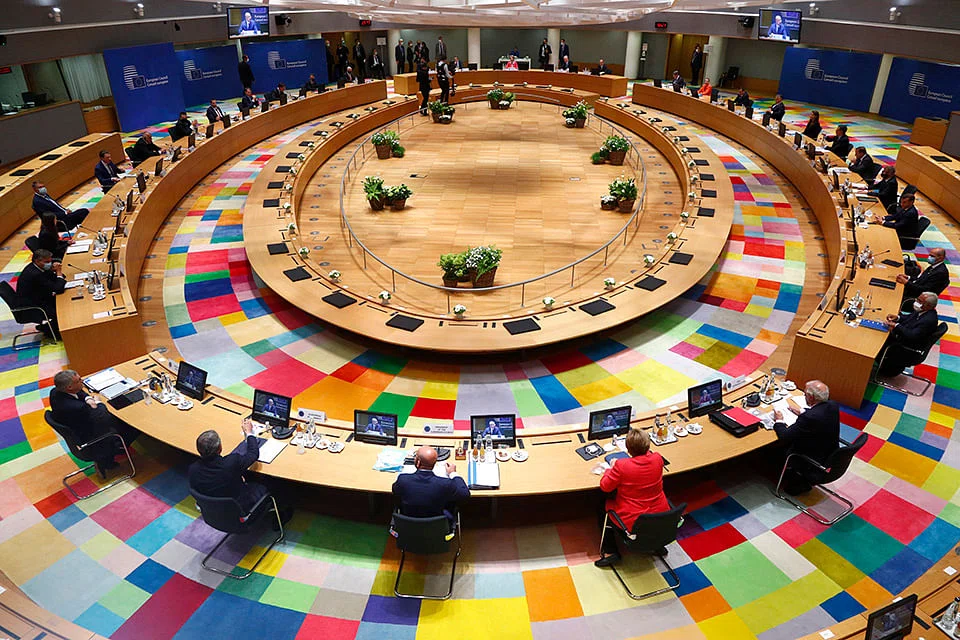
DeeperDive is a beta AI feature. Refer to full articles for the facts.
Brussels
EUROPEAN Union leaders gathered on Friday for crunch summit talks on a multi-billion-euro plan to breathe life into their economies, their first face-to-face summit since the coronavirus pandemic plunged the bloc into its latest crisis.
"It is a moment of truth and ambition for Europe," French President Emmanuel Macron said as he arrived for the meeting of 27 leaders in Brussels, after weeks of tension over the scale and scope of the rescue fund.
Dutch opposition and a threat of a Hungarian veto weigh on chances for a deal on the EU's 2021-27 budget, envisaged at slightly above one trillion euros (S$1.59 trillion), and an attached new recovery fund worth 750 billion euros meant to help rebuild the southern economies affected the most by the crisis.
The 27 EU heads met in a room equipped with hand sanitisers and disinfected headsets to provide translation, in the Brussels EU headquarters, which was unusually devoid of journalists, as a health precaution.
The summit is scheduled to run for two days, though officials said it could spill into Sunday if an agreement remains elusive.
Navigate Asia in
a new global order
Get the insights delivered to your inbox.
The stakes are high with EU economies in free fall, immediate relief measures such as short-time work schemes running out this summer and paving the way for what some fear will be an autumn of deep economic malaise and discontent.
That would risk damaging the EU, already struggling with the protracted saga of Brexit and bruised by past crises, from the financial meltdown to migration feuds. That in turn could expose it to more eurosceptic, nationalist and protectionist forces and weaken its standing against China, the United States or Russia.
"Everybody knows that autumn will be difficult," said a senior government official in one EU state. "It would be really good for Europe to send a signal to all that we are united."
After months of feuds over medicines, medical gear, border closures and money to respond to the coronavirus, the EU has already agreed to a half-a-trillion-euro scheme to cushion the first hit of the crisis, and narrowed some differences over how to finance kick-starting economic growth over the long term.
Dutch Prime Minister Mark Rutte is the main holdout among a thrifty camp of northern, wealthy EU countries demanding a smaller overall package, economic reforms as a condition for funds, an expanded vetting process for granting aid and keeping rebates for net payers to the bloc's joint coffers.
The high-debt, ailing southern countries, including Italy and Spain, want the recovery financing to come as free grants rather than repayable loans, while Hungary has threatened to veto the whole package over a proposed new mechanism to freeze payouts for countries undercutting democratic values.
Among the other sticking points are when to make the recovery money available and for how long, how to repay debt to be acquired by the bloc's executive European Commission to collect these extra funds, and how much should be channelled to green projects that help the EU to meet its emissions targets. REUTERS
Decoding Asia newsletter: your guide to navigating Asia in a new global order. Sign up here to get Decoding Asia newsletter. Delivered to your inbox. Free.
Share with us your feedback on BT's products and services
TRENDING NOW

Shelving S$5 billion office redevelopment plan proved ‘wise’ as geopolitical risks mount: OCBC chairman
OCBC is said to emerge as lead bidder for HSBC Indonesia assets
Middle East-linked energy supply shocks put Asean Power Grid back in focus

Eurokars Group introduces rental car franchises Enterprise Rent-A-Car, National Car Rental, and Alamo to Singapore

