

EU-Singapore FTA signals commitment to economic integration: Iswaran
Asean presents many opportunities for businesses from Europe with its rapid growth and rising middle class, he says at the opening session of the Ambrosetti Forum

Janice Heng
Cernobbio, Italy
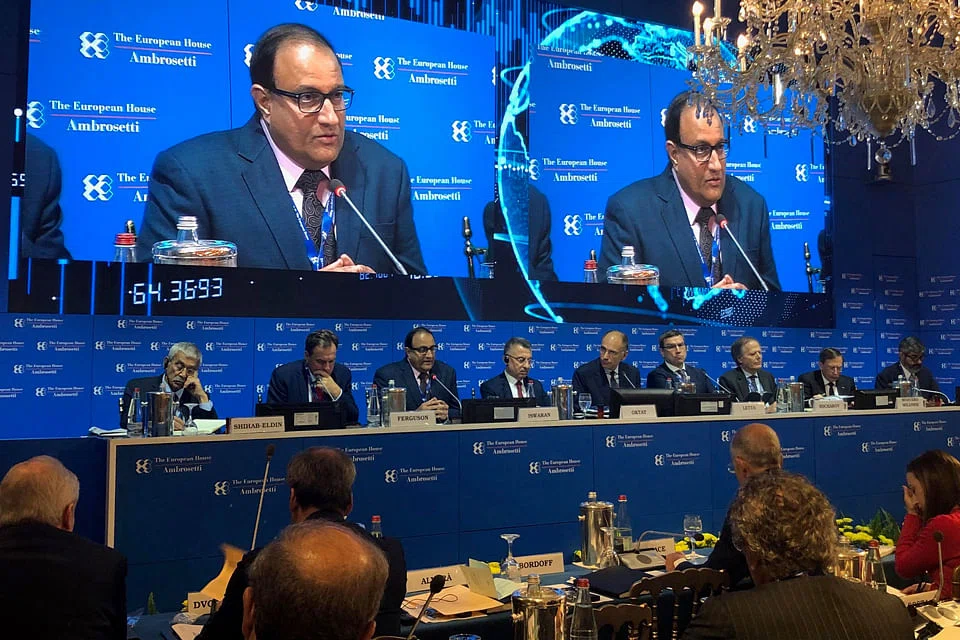
AGAINST the backdrop of threats posed to the multilateral trading system by anti-globalisation and anti-trade rhetoric, agreements such as the European Union-Singapore Free Trade Agreement (EUSFTA) are important both in symbolic and practical terms, Minister-in-charge of Trade Relations S Iswaran said while in Italy last weekend.
Mr Iswaran was in Cernobbio, Italy from Sept 6 to 7, attending the 45th Ambrosetti Forum organised by The European House-Ambrosetti. He has headed to Brussels to meet EU Trade Commissioner Cecilia Malmstrom and EU businesses, as the EUSFTA enters the final stages of ratification.
The annual Ambrosetti Forum is attended by international heads of state and government, top representatives of European institutions, ministers, Nobel Prize winners, businessmen and experts.
On Sept 6, Mr Iswaran spoke at the Forum's opening session on future global challenges and impacts on businesses. In his speech, he stressed the importance of being committed to and strengthening the rules-based multilateral trading system in the face of the aforementioned threats.
The EUSFTA "has a strong signalling effect that even as we look at the global environment and all the challenges, countries and regions are prepared to work together to continue to push the boundaries in terms of economic integration", he said.
On the practical side, Asean presents many opportunities for businesses from Europe with its rapid growth and rising middle class, with the EUSFTA as "a way to build a path towards a larger Europe-Asean FTA".
Second, Mr Iswaran highlighted the need for new economic partnership models in a digital age, citing Singapore's digital economy agreements with like-minded partners, and the World Trade Organisation joint statement initiative on e-commerce launched earlier this year.
Third, he spoke on the need to guard against cyberattacks, including via collaboration across nations and jurisdictions. And while globalisation and digitalisation bring much benefit, they also cause disruption: "If you don't do this well, then despite all the fruits of globalisation and technological advancement, if the spoils are not fairly distributed, people will feel that they do not have a fair share and we will end up with a sharp pushback." Governments must strengthen and equip businesses and individuals for this transition, he concluded.
At the Forum, Mr Iswaran also participated in a panel discussion that included Italian Minister of Foreign Affairs and International Cooperation Enzo Moavero Milanesi, Vice-President of Turkey Fuat Oktay, and Deputy Minister of Industry and Trade of the Russian Federation Oleg Bocharov.
While in Cernobbio, Mr Iswaran met former Italian prime ministers Enrico Letta and Romano Prodi. They discussed the potential for deeper collaboration between the EU and Asean, and Singapore and Italian firms, via platforms such as the EUSFTA and the Italy-Asean Association.
Italy is Singapore's sixth largest trading partner in the EU. Bilateral trade in goods between both countries has been on the rise, exceeding S$6 billion in 2018.
One company named in Mr Iswaran's Forum speech was Italian pharmaceutical firm Menarini, which has its regional headquarters in Singapore. Since 2012, Menarini Asia-Pacific has nearly tripled its revenue to almost 600 million euros (S$921 million) this year.
The firm continues to grow its business in Asean and China especially, which will strengthen its operations in Singapore as a regional hub, said Pietro Giovanni Corsa, Menarini Group corporate general manager for management, finance and ICT.
"As a European company that conducts extensive business across the region through Singapore, Menarini Asia-Pacific looks forward to reaping strong economic benefits from the elevated partnership that Singapore will have with the EU," said Dr Corsa.
EUSFTA benefits include flexible rules of origin for Singapore exports, improved market access to services and reduction of non-tariff barriers in key sectors including pharmaceuticals, he noted. "From supply chain to manufacturing and research and development, the EUSFTA will only serve to increase the efficiency and cost-effectiveness of doing business across our borders, thereby giving unfettered access to a larger range of services for our businesses."
Menarini entered the region by acquiring regional firm Invida Group in 2011. Said Dr Corsa: "There are many other promising local SMEs (small and medium enterprises) in Singapore and the region that Italian companies can consider to expand their business through Singapore as the gateway to the region."
TRENDING NOW
Singapore expects all parties to honour commitments, says PM Wong after Indonesia cuts gas exports
Gas Supply may pursue remedies if contract breached following Indonesia’s export cuts: Tan See Leng
SoftBank’s Son plans US$50 billion Malaysia tech outlay: Anwar Ibrahim

Is Manila Asia’s new dining hot spot?

